1998 KY26
|
Three views of a computer model of asteroid 1998 KY26. | |
| Discovery[1] | |
|---|---|
| Discovered by | Spacewatch, Tom Gehrels |
| Discovery site | Arizona |
| Discovery date | 28 May 1998 |
| Designations | |
Apollo 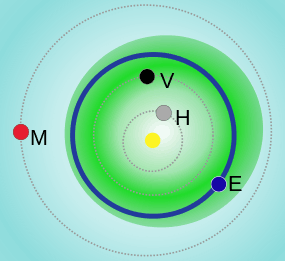 | |
| Orbital characteristics[2] | |
| Epoch 13 January 2016 (JD 2457400.5) | |
| Uncertainty parameter 2 | |
| Aphelion | 1.4816757 AU (221.65553 Gm) |
| Perihelion | 0.98408102 AU (147.216425 Gm) |
| 1.23287838 AU (184.435980 Gm) | |
| Eccentricity | 0.2018020 |
|
1.37 ± 1.003e-06 yr (499.5453 ± 0.00036636 d) | |
| 287.54278° | |
| 0° 43m 11.948s /day | |
| Inclination | 1.4810757° |
| 84.367377° | |
|
209.39245° ± 9.7658e-05° | |
| Earth MOID | 0.00278395 AU (416,473 km) |
| Jupiter MOID | 3.65902 AU (547.382 Gm) |
| Physical characteristics | |
| Dimensions | 30 metres (98 ft) |
Mean radius | 0.015 km |
| 0.1784 h (0.00743 d) | |
Sidereal rotation period | 10.704 min |
| 25.5 | |
|
| |

1998 KY26 (also written 1998 KY26) is a small near-Earth asteroid. It was discovered on June 2, 1998, by Spacewatch and observed until June 8, when it passed 800,000 kilometers (half a million miles) away from Earth (a little more than twice the Earth–Moon distance). It is roughly spherical and is only about 30 metres (98 ft) in diameter.
With a rotation period of 10.7 minutes it has one of the shortest sidereal days of any known object in the Solar System, and cannot possibly be a rubble pile. It is also one of the most easily accessible objects in the Solar System,[3] and its orbit frequently brings it on a path very similar to the optimum Earth–Mars transfer orbit.[2] This, coupled with the fact that it is water rich, makes it an attractive target for further study and a potential source of water for future missions to Mars.[4]
Physical properties
Asteroid 1998 KY26 is the smallest solar system object ever studied in detail and, with a rotational period of 10.7 minutes, was the fastest-spinning object observed at the time of its discovery: most asteroids with established rotational rates have periods measured in hours. It was the first recognized minor object that spins so fast that it must be a monolithic object rather than a rubble pile, as many asteroids are thought to be. Since 1998 KY26 was found to be a fast rotator, several other small asteroids have been found to also have short rotation periods, some even faster than 1998 KY26.
Optical and radar observations indicate that 1998 KY26 is a water-rich object.[4]
These physical properties were measured by an international team of astronomers led by Dr. Steven J. Ostro of the Jet Propulsion Laboratory. The team used a radar telescope in California and optical telescopes in the Czech Republic, Hawaii, Arizona and California.
Further reading
- Ostro, Steven J.; et al. (July 1999). "Radar and Optical Observations of Asteroid 1998 KY26". Science. 285 (5427): 557–559. Bibcode:1999Sci...285..557O. doi:10.1126/science.285.5427.557. PMID 10417379.
- Tholen, D. J. (September 2003). "Recovery of 1998 KY26: Implications for Detecting the Yarkovsky Effect (abstract only)". Bulletin of the American Astronomical Society. 35 (4). Retrieved 25 April 2009.
References
- ↑ "Spacewatch discovery of 1998 KY26". SPACEWATCH Project. Retrieved 25 April 2009.
- 1 2 "1998 KY26". JPL Small-Body Database. Jet Propulsion Laboratory. SPK-ID: 1998KY26. Retrieved 29 March 2016.
- ↑ "1998 KY26". Retrieved 25 April 2009.
- 1 2 "Astronomy Picture of the Day: Asteroid 1998 KY26". Nasa. 2002-09-19. Archived from the original on 24 April 2009. Retrieved 25 April 2009.
External links
- 1998 KY26 at the JPL Small-Body Database

- MPEC 1998-L02
- Scott Hudson's Homepage: The Earth-Crossing Asteroid 1998 KY26
- Steven Ostro's Homepage: 1998 KY26
- Lipanović, Željko. "1998 KY26 Images". Archived from the original on 2009-10-22.
- Media Relations Office. Sun never sets, for long, on fast-spinning, water-rich asteroid (press release). Pasadena, California: Jet Propulsion Laboratory. July 22, 1999.