2015 RR245
|
Orbit of 2015 RR245 | |
| Designations | |
|---|---|
| MPC designation | 2015 RR245 |
| Orbital characteristics | |
| Epoch 2016 July 31.0 TT = JDT 2457600.5 | |
| Aphelion | 128.8650253 AU (Q) |
| Perihelion | 33.7133696 AU (q) |
| 81.2891975 AU (a) | |
| Eccentricity | 0.5852663 (e) |
| 733 yr | |
| 322.50413° (M) | |
| Inclination | 7.57643° (i) |
| 211.67680° (Ω) | |
| 261.41753° (ω) | |
| Physical characteristics | |
| Dimensions | 670 km (420 mi) diameter |
| Mass | 2,374 km (1,475 mi) |
| 0.12? | |
|
| |
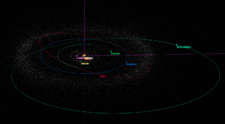
2015 RR245 is a possible dwarf planet in the Kuiper belt. 2015 RR245 is one of the few dwarf planets to survive after the formation of the solar system, along with Pluto and Eris.[1] It was discovered in February 2016[2][3] by the Outer Solar System Origins Survey (OSSOS).[2][3]
2015 RR245 was discovered by a research team while poring over images that the Canada–France–Hawaii Telescope in Hawaii took in September 2015 as part of the OSSOS (Outer Solar System Origins Survey).[2][3]
Its exact size is uncertain, but the best estimate is around 670 km (420 mi) in diameter, assuming an albedo of 12%. For comparison, Pluto, the largest object in the Kuiper belt, is about 2,374 km (1,475 mi) in diameter.[2][3]
Orbit
As of July 2016, the orbit of 2015 RR245 is approximately, but not precisely known. It has a 700-year orbit. It appears to come as close as 33.7 AU[4] to the Sun (still beyond the orbit of Neptune at 30 AU), and up to 129 AU distant.[5] It will make its closest approach to the Sun in 2096.[2]
Resonance with Neptune
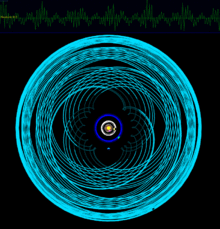
Additional precovery astrometry from the Pan-STARRS1 survey shows that 2015 RR245 is securely trapped in a 2:9 mean motion resonance with Neptune, meaning that 2015 RR245 orbits the Sun twice in the same amount of time it takes Neptune to complete 9 orbits.[6]
See also
References
- ↑ "New Distant Dwarf Planet Beyond Neptune". United Press International. 18 July 2016. Retrieved 9 October 2016 – via Gale General OneFile.
- 1 2 3 4 5 "New Dwarf Planet Discovered Far Beyond Pluto's Orbit". space.com. 11 July 2016.
- 1 2 3 4 Chang, Kenneth (13 July 2016). "Astronomers Discover New Likely Dwarf Planet, the Latest of Many". New York Times. Retrieved 14 July 2016.
- ↑ "New Dwarf Planet".
- ↑ "Kuiper Belt's Big, New, Far-Out Object - Sky & Telescope". 13 July 2016.
- ↑ Bannister, Michele T.; Alexandersen, Mike; Benecchi, Susan D.; Chen, Ying-Tung; Delsanti, Audrey; Fraser, Wesley C.; Gladman, Brett J.; Granvik, Mikael; Grundy, Will M.; Guilbert-Lepoutre, Aurelie; Gwyn, Stephen D. J.; Ip, Wing-Huen; Jakubik, Marian; Lynne Jones, R.; Kaib, Nathan; Kavelaars, J. J.; Lacerda, Pedro; Lawler, Samantha; Lehner, Matthew J.; Hsing Wen Lin; Patryk Sofia Lykawka; Marsset, Michael; Murray-Clay, Ruth; Noll, Keith S.; Parker, Alex; Petit, Jean-Marc; Pike, Rosemary E.; Rousselot, Philippe; Schwamb, Megan E.; et al. (2016). "OSSOS: IV. Discovery of a dwarf planet candidate in the 9:2 resonance". arXiv:1607.06970v1
 [astro-ph.EP].
External links
- OSSOS project
- Discovery announcement
- MPEC 2016-N67 : 2015 RR245 www.minorplanetcenter.net
- 2015 RR245 at the JPL Small-Body Database

_(cropped).jpg)