3,5-Dinitrosalicylic acid
| |||
| Names | |||
|---|---|---|---|
| IUPAC name
2-Hydroxy-3,5-dinitrobenzoic acid | |||
| Other names
3,5-Dinitrosalicylic acid | |||
| Identifiers | |||
609-99-4  | |||
| 3D model (Jmol) | Interactive image | ||
| ChEBI | CHEBI:53648  | ||
| ChemSpider | 11380 | ||
| ECHA InfoCard | 100.009.278 | ||
| KEGG | C11319 | ||
| |||
| |||
| Properties | |||
| C7H4N2O7 | |||
| Molar mass | 228.12 g·mol−1 | ||
| Appearance | Yellow needles or plates | ||
| Melting point | 182 °C (360 °F; 455 K) | ||
| Soluble | |||
| Solubility in organic solvents | Soluble in ethanol, diethyl ether, benzene | ||
| Except where otherwise noted, data are given for materials in their standard state (at 25 °C [77 °F], 100 kPa). | |||
| verify (what is ?) | |||
| Infobox references | |||

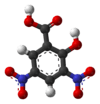
3,5-Dinitrosalicylic acid (DNS or DNSA, IUPAC name 2-hydroxy-3,5-dinitrobenzoic acid) is an aromatic compound that reacts with reducing sugars and other reducing molecules to form 3-amino-5-nitrosalicylic acid, which strongly absorbs light at 540 nm. It was first introduced as a method to detect reducing substances in urine and has since been widely used, for example, for quantifying carbohydrate levels in blood.[2] It is mainly used in assay of alpha-amylase. However, enzymatic methods are usually preferred due to DNS lack of specificity.[3]
Synthesis
3,5-Dinitrosalicylic acid can be prepared by the nitration of salicylic acid.
References
- ↑ Lide, David R. (1998). Handbook of Chemistry and Physics (87 ed.). Boca Raton, FL: CRC Press. pp. 3–318. ISBN 0-8493-0594-2.
- ↑ Description of lab use from the Department of Chemical Engineering, University of Maryland
- ↑ Miller, Gail Lorenz (1959). "Use of dinitrosalicylic acid reagent for determination of reducing sugar". Anal. Chem. 31 (3): 426–428. doi:10.1021/ac60147a030.
This article is issued from Wikipedia - version of the 12/15/2015. The text is available under the Creative Commons Attribution/Share Alike but additional terms may apply for the media files.