38 cm Siegfried K (E)
| 38 cm Siegfried K (E) | |
|---|---|
|
A Siegfried K (E) destroyed by American aircraft in the Rhône Valley, 1944 | |
| Type | Railway gun |
| Place of origin | Nazi Germany |
| Service history | |
| In service | 1941 - 1945 |
| Used by | Nazi Germany |
| Wars | World War II |
| Production history | |
| Designer | Krupp |
| Designed | 1939 - 1941 |
| Manufacturer | Krupp |
| Number built | 4 |
| Specifications | |
| Weight | 286 tonnes (281 long tons; 315 short tons) |
| Length | 31.32 metres (102 ft 9 in) |
| Barrel length | 18.405 metres (60 ft 5 in) L/48.4 |
|
| |
| Shell | separate-loading, case charge |
| Calibre | 380 millimetres (15 in) |
| Breech | horizontal sliding block |
| Recoil | hydro-pneumatic |
| Carriage | 2 x 8-axle bogies |
| Elevation | 0° to 52.3° |
| Traverse |
none (on mount) 360° (on turntable) |
| Muzzle velocity | 820–1,050 m/s (2,700–3,400 ft/s) |
| Maximum firing range | 55,700 metres (60,900 yd) |
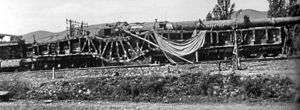
The 38 cm Siegfried K (E) (K - Kanone (cannon), E - in Eisenbahnlafette (on railroad mounting)) was a German World War II railway gun based on the 38 cm SK C/34 naval gun that served as the main armament of the Bismarck-class battleships. Only four were produced.
Design
Like the 38 cm SK C/34 naval guns deployed as coastal defense, the 38 cm Siegfried K guns were modified with a larger chamber to handle the increased amount of propellant used for the special long-range Siegfried shells.[1][2]
The gun had no ability to traverse on its mount, relying instead on moving along a curving section of track or on a Vögele turntable to aim. The turntable (Drehscheibe) consisted of a circular track with a pivot mount in the center for a platform on which the railroad gun itself was secured. A ramp was used to raise the railway gun to the level of the platform. The platform had rollers at each end which rested on the circular rail for 360° traverse. It had a capacity of 300 tonnes (300 long tons; 330 short tons), enough for most of the railroad guns in the German inventory. The gun could only be loaded at 0° elevation and so had to be re-aimed for each shot.[3]
Ammunition
It used the standard German naval system of ammunition where the base charge was held in a metallic cartridge case and supplemented by another charge in a silk bag which was rammed first. Four types of shells were used by the 38 cm Siegfried K (E), including the special long-range Siegfried shell (Siegfried—Granate) developed by the army. Almost 40 per-cent lighter, it could be fired with a reduced charge at 920 metres per second (3,000 ft/s) to 40,000 metres (44,000 yd). With a full charge it reached 1,050 metres per second (3,400 ft/s) and could travel 55,700 metres (60,900 yd)–equivalent to over 34.5 miles.[4]
| Shell name | Weight | Filling Weight | Muzzle velocity | Range |
|---|---|---|---|---|
| nose-fused HE shell with ballistic cap (Sprenggranate L/4.6 m KZ m Hb) | 800 kg (1,800 lb) | Unknown | 820 m/s (2,700 ft/s) | 42,000 m (46,000 yd) |
| base-fused HE shell with ballistic cap (Sprenggranate L/4.4 m BdZ m Hb)) | 800 kg (1,800 lb) | Unknown | 820 m/s (2,700 ft/s) | 42,000 m (46,000 yd) |
| base-fused AP shell with ballistic cap (Panzer- Sprenggranate L/4.4 m BdZ m Hb)) | 800 kg (1,800 lb) | Unknown | 820 m/s (2,700 ft/s) | 42,000 m (46,000 yd) |
| nose- and base-fused HE shell with ballistic cap (Si-Gr L/4.5 Bdz u. Kz (m.Hb)) (light load) | 495 kg (1,091 lb) | 69 kg (152 lb) TNT | 920 m/s (3,000 ft/s) | 40,000 m (44,000 yd) |
| nose- and base-fused HE shell with ballistic cap (Si-Gr L/4.5 Bdz u. Kz (m.Hb)) (full load) | 495 kg (1,091 lb) | 69 kg (152 lb) TNT | 1,050 m/s (3,400 ft/s) | 55,700 m (60,900 yd) |
Notes
References
- Campbell, John. Naval Weapons of World War Two. London: Conway Maritime Press, 2002 ISBN 0-87021-459-4
- François, Guy. Eisenbahnartillerie: Histoire de l'artillerie lourd sur voie ferrée allemande des origines à 1945. Paris: Editions Histoire et Fortifications, 2006
- Gander, Terry and Chamberlain, Peter. Weapons of the Third Reich: An Encyclopedic Survey of All Small Arms, Artillery and Special Weapons of the German Land Forces 1939-1945. New York: Doubleday, 1979 ISBN 0-385-15090-3
- Hogg, Ian V. German Artillery of World War Two. 2nd corrected edition. Mechanicsville, PA: Stackpole Books, 1997 ISBN 1-85367-480-X
- Kosar, Franz. Eisenbahngeschütz der Welt. Stuttgart: Motorbook, 1999 ISBN 3-613-01976-0
External links
 |
Wikimedia Commons has media related to 38 cm Siegfried K (E). |
German artillery of World War II | ||
|---|---|---|
| Tank guns |  | |
| Anti-tank guns | ||
| Infantry and mountain guns | ||
| Recoilless guns | ||
| Heavy mortars | ||
| Rocket artillery |
| |
| Field, medium and heavy guns | ||
| Superheavy and siege artillery | ||
| Railroad artillery |
| |
| Anti-aircraft guns | ||