88 modern constellations
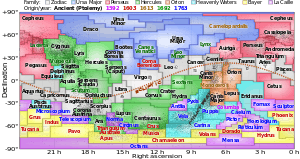

In modern astronomy, the sky (celestial sphere) is divided into 88 regions called constellations, generally based on the asterisms (which are also called "constellations") of Greek and Roman mythology. Those along the ecliptic are the constellations of the zodiac.
The ancient Sumerians, and later the Greeks (as recorded by Ptolemy), established most of the northern constellations in international use today. When explorers mapped the stars of the southern skies, European and American astronomers proposed new constellations for that region, as well as ones to fill gaps between the traditional constellations. Not all of these proposals caught on, but in 1922, the International Astronomical Union (IAU) adopted the modern list of 88 constellations.[1] After this, Eugène Joseph Delporte drew up precise boundaries for each constellation,[1] so that every point in the sky belonged to exactly one constellation.
History
Some constellations are no longer recognized by the International Astronomical Union, but may appear in older star charts and other references. Most notable is Argo Navis, which was one of Ptolemy's original 48 constellations.
Modern constellations
The 88 constellations depict 42 animals, 29 inanimate objects and 17 humans or mythological characters.
Abbreviations
Each of the IAU constellations has an official 3 letter abbreviation. They are actually abbreviations of the genitive form of the constellation names, so some letters appearing in the abbreviation may come from the genitive form without appearing in the base name (as in Sge for Sagitta/Sagittae, to avoid confusion with Sagittarius, abbreviated Sgr).
The majority of the abbreviations are just the first three letters of the constellation, with the first character capitalised: Ori for Orion, Ara for Ara/Arae, Com for Coma Berenices. In cases where this would not unambiguously identify the constellation, or where the name and its genitive differ in the first three letters, other letters beyond the initial three are used: Aps for Apus/Apodis, CrA for Corona Australis, CrB for Corona Borealis, Crv for Corvus. (Crater is abbreviated Crt to prevent confusion with CrA.)
When letters are taken from the second word of a two-word name, the first letter from the second word is capitalised: CMa for Canis Major, CMi for Canis Minor.
The abbreviations are unambiguous, with two exceptions. Leo for the constellation Leo could be mistaken for Leo Minor (abbreviated LMi), and Tri for Triangulum could be mistaken for Triangulum Australe (abbreviated TrA).[2]
List
For help with the literary English pronunciations, see the pronunciation key. There is considerable diversity in how Latinate names are pronounced in English. For traditions closer to the original, see Latin spelling and pronunciation.
The "Family" column refers to the constellation families introduced by Donald Menzel in 1975.
| Constellation | Abbreviations | Genitive | Family | Origin | Meaning | Brightest star | |
|---|---|---|---|---|---|---|---|
| IAU[1] | Other[3] | ||||||
| Andromeda /ænˈdrɒmᵻdə/[4] | And | Andr | Andromedae /ænˈdrɒmᵻdiː/ | Perseus | ancient (Ptolemy) | Andromeda (The chained lady or the Princess) | Alpheratz |
| Antlia /ˈæntliə/[4] | Ant | Antl | Antliae /ˈæntliiː/ | La Caille | 1763, Lacaille | air pump | α Antliae |
| Apus /ˈeɪpəs/[5] | Aps | Apus | Apodis /ˈæpoʊdᵻs/[5] | Bayer | 1603, Uranometria, created by Keyser and de Houtman | Bird-of-paradise/Exotic Bird/Extraordinary Bird | α Apodis |
| Aquarius /əˈkwɛəriəs/[4] | Aqr | Aqar | Aquarii /əˈkwɛəriaɪ/ | Zodiac | ancient (Ptolemy) | water-bearer | Sadalsuud |
| Aquila /ˈækwᵻlə/[4] | Aql | Aqil | Aquilae /ˈækwᵻliː/ | Hercules | ancient (Ptolemy) | eagle | Altair |
| Ara /ˈɛərə/[5] | Ara | Arae | Arae /ˈɛəriː/[5] | Hercules | ancient (Ptolemy) | altar | β Arae |
| Aries /ˈɛəriːz, ˈɛərɪiːz/[4][5] | Ari | Arie | Arietis /əˈraɪᵻtᵻs/[5] | Zodiac | ancient (Ptolemy) | ram | Hamal |
| Auriga /ɔːˈraɪɡə/[4][5] | Aur | Auri | Aurigae /ɔːˈraɪdʒiː/[5] | Perseus | ancient (Ptolemy) | charioteer | Capella |
| Boötes /boʊˈoʊtiːz/[4] | Boo | Boot | Boötis /boʊˈoʊtᵻs/ | Ursa Major | ancient (Ptolemy) | herdsman | Arcturus |
| Caelum /ˈsiːləm/[5] | Cae | Cael | Caeli /ˈsiːlaɪ/[5] | La Caille | 1763, Lacaille | chisel or graving tool | α Caeli |
| Camelopardalis /kəˌmɛloʊˈpɑːrdəlᵻs/[5] | Cam | Caml | Camelopardalis /kəˌmɛloʊˈpɑːrdəlᵻs/[5] | Ursa Major | 1613, Plancius[6] | giraffe | β Camelopardalis |
| Cancer /ˈkænsər/[4] | Cnc | Canc | Cancri /ˈkæŋkraɪ/ | Zodiac | ancient (Ptolemy) | crab | Tarf |
| Canes Venatici /ˈkeɪniːz vᵻˈnætᵻsaɪ/[5] | CVn | CVen | Canum Venaticorum /ˈkeɪnəm vᵻnætᵻˈkɒrəm/ | Ursa Major | 1690, Firmamentum Sobiescianum, Hevelius | hunting dogs | Cor Caroli |
| Canis Major /ˈkeɪnᵻs ˈmeɪdʒər/[5] | CMa | CMaj | Canis Majoris /ˈkeɪnᵻs məˈdʒɒrᵻs/ | Orion | ancient (Ptolemy) | greater dog | Sirius |
| Canis Minor /ˈkeɪnᵻs ˈmaɪnər/[5] | CMi | CMin | Canis Minoris /ˈkeɪnᵻs mᵻˈnɒrᵻs/ | Orion | ancient (Ptolemy) | lesser dog | Procyon |
| Capricornus /ˌkæprᵻˈkɔːrnəs/[5] | Cap | Capr | Capricorni /ˌkæprᵻˈkɔːrnaɪ/[5] | Zodiac | ancient (Ptolemy) | sea goat | Deneb Algiedi |
| Carina /kəˈraɪnə/[4] | Car | Cari | Carinae /kəˈraɪniː/ | Heavenly Waters | 1763, Lacaille, split from Argo Navis | keel | Canopus |
| Cassiopeia /ˌkæsioʊˈpiːə/[4][5] | Cas | Cass | Cassiopeiae /ˌkæsioʊˈpiːiː/[5] | Perseus | ancient (Ptolemy) | Cassiopeia (mythological character) | Shedir |
| Centaurus /sɛnˈtɔːrəs/[4] | Cen | Cent | Centauri /sɛnˈtɔːraɪ/ | Hercules | ancient (Ptolemy) | centaur | Alpha Centauri |
| Cepheus /ˈsiːfiəs, -fjuːs/[5] | Cep | Ceph | Cephei /ˈsiːfiaɪ/[5] | Perseus | ancient (Ptolemy) | Cepheus (mythological character) | Alderamin |
| Cetus /ˈsiːtəs/[5] | Cet | Ceti | Ceti /ˈsiːtaɪ/[5] | Perseus | ancient (Ptolemy) | sea monster (later interpreted as a whale) | Deneb Kaitos |
| Chamaeleon /kəˈmiːliən/[4] | Cha | Cham | Chamaeleontis /kəˌmiːliˈɒntᵻs/ | Bayer | 1603, Uranometria, created by Keyser and de Houtman | chameleon | α Chamaeleontis |
| Circinus /ˈsɜːrsᵻnəs/[4] | Cir | Circ | Circini /ˈsɜːrsᵻnaɪ/ | La Caille | 1763, Lacaille | compasses | α Circini |
| Columba /koʊˈlʌmbə/[4] | Col | Colm | Columbae /koʊˈlʌmbiː/ | Heavenly Waters | 1592, Plancius, split from Canis Major | dove | Phact |
| Coma Berenices /ˈkoʊmə bɛrəˈnaɪsiːz/[5] | Com | Coma | Comae Berenices /ˈkoʊmiː bɛrəˈnaɪsiːz/[5] | Ursa Major | 1603, Uranometria, split from Leo | Berenice's hair | β Comae Berenices |
| Corona Australis[7] /koʊˈroʊnə ɔːˈstrælᵻs, -ˈstreɪ-/[4][5] | CrA | CorA | Coronae Australis /koʊˈroʊniː ɔːˈstrælᵻs/ | Hercules | ancient (Ptolemy) | southern crown | Alphekka Meridiana |
| Corona Borealis /koʊˈroʊnə ˌbɔəriˈælᵻs, -ˈeɪlᵻs/[4][5] | CrB | CorB | Coronae Borealis /koʊˈroʊniː bɔəriˈælᵻs/ | Ursa Major | ancient (Ptolemy) | northern crown | Alphecca |
| Corvus /ˈkɔːrvəs/[4] | Crv | Corv | Corvi /ˈkɔːrvaɪ/ | Hercules | ancient (Ptolemy) | crow | Gienah |
| Crater /ˈkreɪtər/[4] | Crt | Crat | Crateris /krəˈtɪərᵻs/ | Hercules | ancient (Ptolemy) | cup | Labrum |
| Crux /ˈkrʌks/[4] | Cru | Cruc | Crucis /ˈkruːsᵻs/ | Hercules | 1603, Uranometria, split from Centaurus | southern cross | Acrux |
| Cygnus /ˈsɪɡnəs/[4] | Cyg | Cygn | Cygni /ˈsɪɡnaɪ/ | Hercules | ancient (Ptolemy) | swan or Northern Cross | Deneb |
| Delphinus /dɛlˈfaɪnəs/[4] | Del | Dlph | Delphini /dɛlˈfaɪnaɪ/ | Heavenly Waters | ancient (Ptolemy) | dolphin | Rotanev |
| Dorado /dəˈrɑːdoʊ/[8] | Dor | Dora | Doradus /doʊˈreɪdəs/ | Bayer | 1603, Uranometria, created by Keyser and de Houtman | goldfish | α Doradus |
| Draco /ˈdreɪkoʊ/[5] | Dra | Drac | Draconis /drəˈkoʊnᵻs/[5] | Ursa Major | ancient (Ptolemy) | dragon | Etamin |
| Equuleus /ᵻˈkwuːliəs/[5] | Equ | Equl | Equulei /ᵻˈkwuːliaɪ/[5] | Heavenly Waters | ancient (Ptolemy) | pony | Kitalpha |
| Eridanus /ᵻˈrɪdənəs/[5] | Eri | Erid | Eridani /ᵻˈrɪdənaɪ/[5] | Heavenly Waters | ancient (Ptolemy) | river Eridanus (mythology) | Achernar |
| Fornax /ˈfɔːrnæks/ | For | Forn | Fornacis /fɔːrˈneɪsᵻs/ | La Caille | 1763, Lacaille | chemical furnace | Fornacis |
| Gemini /ˈdʒɛmᵻnaɪ/[4] | Gem | Gemi | Geminorum /ˌdʒɛmᵻˈnɒrəm/ | Zodiac | ancient (Ptolemy) | twins | Pollux |
| Grus /ˈɡrʌs/[5] | Gru | Grus | Gruis /ˈɡruːᵻs/[5] | Bayer | 1603, Uranometria, created by Keyser and de Houtman | Crane | Alnair |
| Hercules /ˈhɜːrkjᵿliːz/[5] | Her | Herc | Herculis /ˈhɜːrkjᵿlᵻs/ | Hercules | ancient (Ptolemy) | Hercules (mythological character) | Kornephoros |
| Horologium /ˌhɒrəˈlɒdʒiəm, -ˈloʊ-/[4][5] | Hor | Horo | Horologii /ˌhɒrəˈloʊdʒiaɪ/ | La Caille | 1763, Lacaille | pendulum clock | α Horologii |
| Hydra /ˈhaɪdrə/[4] | Hya | Hyda | Hydrae /ˈhaɪdriː/ | Hercules | ancient (Ptolemy) | Hydra (mythological creature) | Alphard |
| Hydrus /ˈhaɪdrəs/[4] | Hyi | Hydi | Hydri /ˈhaɪdraɪ/ | Bayer | 1603, Uranometria, created by Keyser and de Houtman | lesser water snake | β Hydri |
| Indus /ˈɪndəs/[4] | Ind | Indi | Indi /ˈɪndaɪ/ | Bayer | 1603, Uranometria, created by Keyser and de Houtman | Indian (of unspecified type) | The Persian |
| Lacerta /ləˈsɜːrtə/[4] | Lac | Lacr | Lacertae /ləˈsɜːrtiː/ | Perseus | 1690, Firmamentum Sobiescianum, Hevelius | lizard | α Lacertae |
| Leo /ˈliːoʊ/[4] | Leo | Leon | Leonis /liːˈoʊnᵻs/ | Zodiac | ancient (Ptolemy) | lion | Regulus |
| Leo Minor /ˈliːoʊ ˈmaɪnər/[4] | LMi | LMin | Leonis Minoris /liːˈoʊnᵻs mᵻˈnɒrᵻs/ | Ursa Major | 1690, Firmamentum Sobiescianum, Hevelius | lesser lion | Praecipua |
| Lepus /ˈliːpəs/[5] | Lep | Leps | Leporis /ˈlɛpərᵻs/[4][5] | Orion | ancient (Ptolemy) | hare | Arneb |
| Libra /ˈlaɪbrə, ˈliː-/[4] | Lib | Libr | Librae /ˈlaɪbriː/ | Zodiac | ancient (Ptolemy) | balance | Zubeneshamali |
| Lupus /ˈljuːpəs/[4] | Lup | Lupi | Lupi /ˈljuːpaɪ/ | Hercules | ancient (Ptolemy) | wolf | Men |
| Lynx /ˈlɪŋks/[4] | Lyn | Lync | Lyncis /ˈlɪnsᵻs/ | Ursa Major | 1690, Firmamentum Sobiescianum, Hevelius | lynx | Elvashak |
| Lyra /ˈlaɪrə/[4] | Lyr | Lyra | Lyrae /ˈlaɪriː/ | Hercules | ancient (Ptolemy) | lyre / harp | Vega |
| Mensa /ˈmɛnsə/[4] | Men | Mens | Mensae /ˈmɛnsiː/ | La Caille | 1763, Lacaille | Table Mountain (South Africa) | α Mensae |
| Microscopium /ˌmaɪkroʊˈskoʊpiəm/ | Mic | Micr | Microscopii /ˌmaɪkroʊˈskoʊpiaɪ/ | La Caille | 1763, Lacaille | microscope | γ Microscopii |
| Monoceros /məˈnɒsᵻrəs/[4][5] | Mon | Mono | Monocerotis /ˌmɒnoʊsᵻˈroʊtᵻs/ | Orion | 1613, Plancius | unicorn | β Monocerotis |
| Musca /ˈmʌskə/[5] | Mus | Musc | Muscae /ˈmʌsiː/[4][5] | Bayer | 1603, Uranometria, created by Keyser and de Houtman | fly | α Muscae |
| Norma /ˈnɔːrmə/[4] | Nor | Norm | Normae /ˈnɔːrmiː/[4] | La Caille | 1763, Lacaille | carpenter's level | γ2 Normae |
| Octans /ˈɒktænz/[5] | Oct | Octn | Octantis /ɒkˈtæntᵻs/[5] | La Caille | 1763, Lacaille | octant (instrument) | ν Oct |
| Ophiuchus /ˌɒfiˈjuːkəs/[4] | Oph | Ophi | Ophiuchi /ˌɒfiˈjuːkaɪ/ | Hercules | ancient (Ptolemy) | serpent-bearer | Rasalhague |
| Orion /oʊˈraɪən/[4] | Ori | Orio | Orionis /oʊˈraɪənᵻs, ˌɒriˈoʊnᵻs/[5] | Orion | ancient (Ptolemy) | Orion (mythological character) | Rigel |
| Pavo /ˈpeɪvoʊ/[4][5] | Pav | Pavo | Pavonis /pəˈvoʊnᵻs/[5] | Bayer | 1603, Uranometria, created by Keyser and de Houtman | peacock | Peacock |
| Pegasus /ˈpɛɡəsəs/[4] | Peg | Pegs | Pegasi /ˈpɛɡəsaɪ/ | Perseus | ancient (Ptolemy) | Pegasus (mythological winged horse) | Enif |
| Perseus /ˈpɜːrsiəs, -sjuːs/[5] | Per | Pers | Persei /ˈpɜːrsiaɪ/[5] | Perseus | ancient (Ptolemy) | Perseus (mythological character) | Mirfak |
| Phoenix /ˈfiːnᵻks/[4] | Phe | Phoe | Phoenicis /fᵻˈnaɪsᵻs/ | Bayer | 1603, Uranometria, created by Keyser and de Houtman | phoenix | Ankaa |
| Pictor /ˈpɪktər/[5] | Pic | Pict | Pictoris /pɪkˈtɔərᵻs/[5] | La Caille | 1763, Lacaille | easel | α Pictoris |
| Pisces /ˈpaɪsiːz, ˈpɪ-/[4][5] | Psc | Pisc | Piscium /ˈpɪʃiəm/[5] | Zodiac | ancient (Ptolemy) | fishes | Alpherg |
| Piscis Austrinus /ˈpaɪsᵻs ɔːˈstraɪnəs/ | PsA | PscA | Piscis Austrini /ˈpaɪsᵻs ɔːˈstraɪnaɪ/ | Heavenly Waters | ancient (Ptolemy) | southern fish | Fomalhaut |
| Puppis /ˈpʌpᵻs/[5] | Pup | Pupp | Puppis /ˈpʌpᵻs/[5] | Heavenly Waters | 1763, Lacaille, split from Argo Navis | poop deck | Naos |
| Pyxis /ˈpɪksᵻs/[4] | Pyx | Pyxi | Pyxidis /ˈpɪksᵻdᵻs/ | Heavenly Waters | 1763, Lacaille | mariner's compass | α Pyxidis |
| Reticulum /rᵻˈtɪkjᵿləm/[4] | Ret | Reti | Reticuli /rᵻˈtɪkjᵿlaɪ/ | La Caille | 1763, Lacaille | eyepiece graticule | α Reticuli |
| Sagitta /səˈdʒɪtə/[4] | Sge | Sgte | Sagittae /səˈdʒɪtiː/ | Hercules | ancient (Ptolemy) | arrow | γ Sagittae |
| Sagittarius /sædʒᵻˈtɛəriəs/[4] | Sgr | Sgtr | Sagittarii /ˌsædʒəˈtɛəriaɪ/ | Zodiac | ancient (Ptolemy) | archer | Kaus Australis |
| Scorpius /ˈskɔːrpiəs/[4] | Sco | Scor | Scorpii /ˈskɔːrpiaɪ/ | Zodiac | ancient (Ptolemy) | scorpion | Antares |
| Sculptor /ˈskʌlptər/[4] | Scl | Scul | Sculptoris /skəlpˈtɒrᵻs/ | La Caille | 1763, Lacaille | sculptor | α Sculptoris |
| Scutum /ˈskjuːtəm/[4] | Sct | Scut | Scuti /ˈskjuːtaɪ/ | Hercules | 1690, Firmamentum Sobiescianum, Hevelius | shield (of Sobieski) | α Scuti |
| Serpens[9] /ˈsɜːrpɛnz/ | Ser | Serp | Serpentis /sərˈpɛntᵻs/ | Hercules | ancient (Ptolemy) | snake | Unukalhai |
| Sextans /ˈsɛkstənz/[5] | Sex | Sext | Sextantis /sɛksˈtæntᵻs/[5] | Hercules | 1690, Firmamentum Sobiescianum, Hevelius | sextant | α Sextantis |
| Taurus /ˈtɔːrəs/[4] | Tau | Taur | Tauri /ˈtɔːraɪ/ | Zodiac | ancient (Ptolemy) | bull | Aldebaran |
| Telescopium /ˌtɛlᵻˈskɒpiəm/ | Tel | Tele | Telescopii /ˌtɛlᵻˈskɒpiaɪ/ | La Caille | 1763, Lacaille | telescope | α Telescopii |
| Triangulum /traɪˈæŋɡjᵿləm/ | Tri | Tria | Trianguli /traɪˈæŋɡjᵿlaɪ/ | Perseus | ancient (Ptolemy) | triangle | β Trianguli |
| Triangulum Australe /traɪˈæŋɡjᵿləmɔːˈstræliː, -ˈstreɪ-/ | TrA | TrAu | Trianguli Australis /traɪˈæŋɡjᵿlaɪ ɔːˈstrælᵻs/ | Hercules | 1603 Uranometria, created by Keyser and de Houtman | southern triangle | Atria |
| Tucana /tjᵿˈkeɪnə/ | Tuc | Tucn | Tucanae /tjᵿˈkeɪniː/ | Bayer | 1603 Uranometria, created by Keyser and de Houtman | toucan | α Tucanae |
| Ursa Major /ˌɜːrsə ˈmeɪdʒər/[4] | UMa | UMaj | Ursae Majoris /ˌɜːrsiː məˈdʒɒrᵻs/ | Ursa Major | ancient (Ptolemy) | great bear | Alioth |
| Ursa Minor /ˌɜːrsə ˈmaɪnər/[4] | UMi | UMin | Ursae Minoris /ˌɜːrsiː mᵻˈnɒrᵻs/ | Ursa Major | ancient (Ptolemy) | lesser bear | Polaris |
| Vela /ˈviːlə/[4] | Vel | Velr | Velorum /vᵻˈlɔərəm/ | Heavenly Waters | 1763, Lacaille, split from Argo Navis | sails | Regor |
| Virgo /ˈvɜːrɡoʊ/[4] | Vir | Virg | Virginis /ˈvɜːrdʒᵻnᵻs/ | Zodiac | ancient (Ptolemy) | virgin or maiden | Spica |
| Volans /ˈvoʊlænz/[5] | Vol | Voln | Volantis /voʊˈlæntᵻs/[5] | Bayer | 1603, Uranometria, created by Keyser and de Houtman | flying fish | β Volantis |
| Vulpecula /vʌlˈpɛkjᵿlə/[4] | Vul | Vulp | Vulpeculae /vʌlˈpɛkjᵿliː/ | Hercules | 1690, Firmamentum Sobiescianum, Hevelius | fox | Anser |
Asterisms
Various other unofficial patterns have existed alongside the constellations. These are known as "asterisms." Examples include the Big Dipper/Plough and the Northern Cross. Some ancient asterisms, for example Coma Berenices, Serpens, and portions of Argo Navis, are now officially constellations.
See also
- List of constellations by area
- List of constellations in different languages
- Biblical names of stars
- Lists of stars by constellation
- Constellation family
- Galactic quadrant
- Zodiac
References
- 1 2 3 "The Constellations". International Astronomical Union. Retrieved 9 December 2015.
- ↑ Russell, Henry Norris (1922). "The New International Symbols for the Constellations". Popular Astronomy. 30: 469. Bibcode:1922PA.....30..469R.
- ↑ NASA Dictionary of terms for Aerospace Use - table V, Constellations
- 1 2 3 4 5 6 7 8 9 10 11 12 13 14 15 16 17 18 19 20 21 22 23 24 25 26 27 28 29 30 31 32 33 34 35 36 37 38 39 40 41 42 43 44 45 46 47 48 49 50 51 52 53 54 55 56 57 58 OED, 2nd edition
- 1 2 3 4 5 6 7 8 9 10 11 12 13 14 15 16 17 18 19 20 21 22 23 24 25 26 27 28 29 30 31 32 33 34 35 36 37 38 39 40 41 42 43 44 45 46 47 48 49 50 51 52 53 54 55 56 57 58 59 Random House Dictionary
- ↑ The constellations Camelopardalis, Columba, and Monoceros, formed by Petrus Plancius in 1592 and in 1613, are often erroneously attributed to Jacob Bartsch and Augustin Royer
- ↑ Corona Australis is sometimes called "Corona Austrina" /ɔːˈstriːnə/ (genitive: Coronae Austrinae)
- ↑ "Definition of dorado". Collins English Dictionary. Retrieved 28 November 2012.
- ↑ Serpens may be divided into Serpens Cauda (serpent's tail) and Serpens Caput (serpent's head)
External links
- http://www.ianridpath.com/constellations1.htm – Ian Ridpath's list of constellations.
- http://www.ianridpath.com/startales/contents.htm – Ian Ridpath's Star Tales.
- http://cdsarc.u-strasbg.fr/viz-bin/Cat?cat=VI/49 – CDS's archive of constellation boundaries. The text file constbnd.dat gives the 1875.0 coordinates of the vertices of the constellation regions, together with the constellations adjacent to each boundary segment.