A. T. Moorthy
| A. T. Moorthy | |
|---|---|
 | |
| Sri Lankan High Commissioner to the United Kingdom | |
|
In office January 1981 – May 1984 | |
| Preceded by | Noel Wimalasena |
| Succeeded by | Chandra Monerawela |
| Sri Lankan High Commissioner to Pakistan | |
|
In office 1978–1981 | |
| Personal details | |
| Born |
10 August 1928 Batticaloa District, Ceylon |
| Died |
1 April 2008 (aged 79) London, United Kingdom |
| Alma mater | University of Ceylon, Colombo |
| Profession | Diplomat |
| Ethnicity | Sri Lankan Tamil |
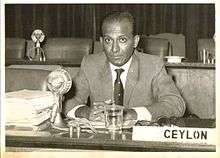
Arambamoorthy Thedchana Moorthy (10 August 1928 – 1 April 2008) was a Sri Lankan Tamil diplomat and High Commissioner to the United Kingdom.
Early life and family
Moorthy was born on 10 August 1928 in Batticaloa District in eastern Ceylon.[1] He was educated at Sivananda Vidyalayam, Batticaloa and Jaffna College.[1] After school he joined the University of Ceylon, Colombo, graduating in 1948 with a degree in economics.[1]
Moorthy married Suseela, daughter of P. Sriskandarajah, in 1959.[1] They had two daughters (Uma and Ima) and a son (Sri Ayilavan).[1]
Career
Moorthy joined the foreign service in 1953 and his first diplomatic posting was in Jakarta, Indonesia.[1] He became chargé d'affaires of the Ceylonese embassy in Beijing, China in 1957, meeting leaders such as Mao Zedong and Zhou Enlai.[1] He was first secretary at the High Commission of Ceylon, London between 1961 and 1963.[1] During this time Moorthy and Suseela studied for the bar at Gray's Inn.[1] He was called to the bar in 1965.[1]
Moorthy then served in various diplomatic positions: first secretary in West Germany (1964-66); chargé d'affaires in Thailand (1969-70); permanent representative to the United Nations Economic Commission for Asia and the Far East; and chargé d'affaires in Iraq (1970).[1] He returned to Sri Lanka in 1974 to co-ordinate the fifth Non-Aligned Summit which was to be held in Colombo in 1976.[1] He was appointed High Commissioner to Pakistan in 1978 (also accredited to Iran).[1] After the 1979 Iranian Revolution Moorthy played an important role in Sri Lankan government's attempts to free the US hostages in Iran.[1]
In 1981 Moorthy was appointed High Commissioner to the United Kingdom.[1][2][3] Back in Sri Lanka violence against the country's Tamils escalated, culminating in the Black July riots of 1983.[1] Sinhalese expatriates living in the UK started a campaign to have Moorthy replaced by a Buddhist Sinhalese.[4] He received a letter, allegedly from a member of the Sinhala Association in UK, threatening his life.[5] The Sri Lankan government ordered Moorthy to declare that his appointment was evidence that there was no serious discrimination against the Tamils.[1] Moorthy refused make such a declaration and resigned in 1984.[1]
Moorthy and his family remained in the UK.[6] He died on 1 April 2008 in London.[1]
References
- 1 2 3 4 5 6 7 8 9 10 11 12 13 14 15 16 17 18 19 Farrell, Tom (19 May 2008). "Obituary: AT Moorthy". The Guardian.
- ↑ "The History of the High Commission". High Commission of Sri Lanka, London.
- ↑ de Silva, Bandu (21 February 2007). "Reply to I. P. C. Mendis: Sri Lanka Foreign Service". The Island (Sri Lanka).
- ↑ "The London Hilton Jamboree" (PDF). Tamil Times. IV (11): 12. September 1985. ISSN 0266-4488.
- ↑ Niwunhella, Sujeeva (18 February 2001). "Britain will not name banned terrorists tomorrow". The Island (Sri Lanka).
- ↑ "The chimes of peace". The Sunday Times (Sri Lanka). 11 August 2002.
 |
Wikimedia Commons has media related to A. T. Moorthy. |