AL-LAD
 | |
| Legal status | |
|---|---|
| Legal status |
|
| Identifiers | |
| |
| CAS Number |
65527-61-9  |
| PubChem (CID) | 15227511 |
| ChemSpider |
21106248  |
| UNII |
020O2SR91L |
| ChEMBL |
CHEMBL281787 |
| Chemical and physical data | |
| Formula | C22H27N3O |
| Molar mass | 349.4713 g/mol |
| 3D model (Jmol) | Interactive image |
| |
| |
| (what is this?) (verify) | |
AL-LAD, also known as 6-allyl-6-nor-LSD, is a psychedelic drug and an analog of lysergic acid diethylamide (LSD).[1] It is described by Alexander Shulgin in the book TiHKAL (Tryptamines i Have Known And Loved). It is synthesized starting from LSD as a precursor, using allyl bromide as a reactant.
Effects in humans
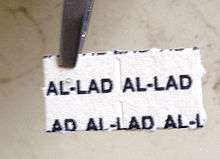
While AL-LAD has subtly different effects than LSD, and appears to be slightly shorter lasting, their potencies are similar;[2][3] an active dose of AL-LAD is reported to be between 50 and 150 micrograms.[4] AL-LAD has a known but short and highly uncommon history of recreational human use, which originated in Ireland and the UK, but spread internationally.
Chemistry
AL-LAD does not cause a color change with the Marquis, Mecke or Mandelin reagents,[5] but does cause the Ehrlich's reagent to turn purple because of the presence of the indole moiety in its structure.
Legal status
AL-LAD is not scheduled by the United Nations' Convention on Psychotropic Substances.[6]
Denmark
AL-LAD is illegal in Denmark.[7]
Latvia
AL-LAD is possibly illegal in Latvia. Although it isn't specifically scheduled, it may be controlled as an LSD structural analog due to an amendment made on June 1, 2015.[8]
Sweden
AL-LAD is illegal in Sweden.[9]
Switzerland
AL-LAD is illegal in Switzerland.[10]
United Kingdom
AL-LAD is illegal in the UK. On June 10, 2014 the UK Advisory Council on the Misuse of Drugs (ACMD) recommended that AL-LAD be specifically named in the UK Misuse of Drugs Act as a class A drug despite not identifying any harm associated with its use.[11] The UK Home office accepted this advice and announced a ban of the substance to be enacted on 6 January 2015 as part of The Misuse of Drugs Act 1971 (Amendment) (No. 2) Order 2014.
United States
AL-LAD is not scheduled as a controlled substance at the federal level in the United States,[12] but AL-LAD could legally be considered an analog of LSD, in which case, sales or possession with intent for human consumption could be prosecuted under the Federal Analogue Act.[13]
See also
References
- ↑ Simon D. Brandt; Pierce V. Kavanagh; Folker Westphal; Simon P. Elliott; Jason Wallach; Tristan Colestock; Timothy E. Burrow; Stephen J. Chapman; Alexander Stratford; David E. Nichols; Adam L. Halberstadt (June 2016). "Return of the lysergamides. Part II: Analytical and behavioural characterization of N6-allyl-6-norlysergic acid diethylamide (AL-LAD) and (2'S,4'S)-lysergic acid 2,4-dimethylazetidide (LSZ)". Drug Testing and Analysis. doi:10.1002/dta.1985. PMID 27265891.
- ↑ Fabrizio Schifano; Laura Orsolini; Duccio Papanti; John Corkery (June 2016). "NPS: Medical Consequences Associated with Their Intake". Current Topics in Behavioral Neurosciences. Springer International Publishing. pp. 1–30. doi:10.1007/7854_2016_15. ISSN 1866-3370. OCLC 643052237. PMID 27272067.
- ↑ Hoffman AJ, Nichols DE; Nichols (September 1985). "Synthesis and LSD-like discriminative stimulus properties in a series of N(6)-alkyl norlysergic acid N,N-diethylamide derivatives". Journal of Medicinal Chemistry. 28 (9): 1252–5. doi:10.1021/jm00147a022. PMID 4032428.
- ↑ Shulgin, Alexander (1997). TiHKAL: The Continuation. Berkeley, California: Transform Press. p. 392. ISBN 0-9630096-9-9.
- ↑ Ecstasydata. "EcstasyData.org - AL-LAD (Not sold as ecstasy)". Retrieved 2013-12-25.
- ↑ Convention on Psychotropic Substances, 1971
- ↑ "Lists of euphoriant substances". The Danish Medicines Agency. September 2015.
- ↑ Noteikumi par Latvijā kontrolējamajām narkotiskajām vielām, psihotropajām vielām un prekursoriem (2.4.punkts)
- ↑ "31 nya ämnen kan klassas som narkotika eller hälsofarlig vara" (in Swedish). Folkhälsomyndigheten. November 2015.
- ↑ "Verordnung des EDI über die Verzeichnisse der Betäubungsmittel, psychotropen Stoffe, Vorläuferstoffe und Hilfschemikalien" (in German). Der Bundesrat.
- ↑ ACMD (10 June 2014). "Update of the Generic Definition for Tryptamines" (PDF). UK Home Office. p. 12. Retrieved 10 June 2014.
- ↑ §1308.11 Schedule I.
- ↑ Erowid Analog Law Vault : Federal Controlled Substance Analogue Act Summary
Additional literature
- Watts, V. J.; Mailman, R. B.; Lawler, C. P.; Neve, K. A.; Nichols, D. E. (1995). "LSD and structural analogs: Pharmacological evaluation at D1 dopamine receptors". Psychopharmacology. 118 (4): 401–9. doi:10.1007/BF02245940. PMID 7568626.
- Niwaguchi, T; Nakahara, Y; Ishii, H (1976). "Studies on lysergic acid diethylamide and related compounds. IV. Syntheses of various amide derivatives of norlysergic acid and related compounds". Yakugaku Zasshi. 96 (5): 673–8. PMID 987200.
- Robert C. Pfaff, Xuemei Huang, Danuta Marona-Lewicka, Robert Oberlender and David E. Nichols: Lysergamides Revisited. In: NIDA Research Monograph 146: Hallucinogens: An Update. p. 52, 1994, United States Department of Health and Human Services.