Acatalasia
| Acatalasia | |
|---|---|
|
Basic structure of a peroxisome | |
| Classification and external resources | |
| Specialty | endocrinology |
| ICD-10 | E80.3 |
| ICD-9-CM | 277.89 |
| OMIM | 115500 |
| DiseasesDB | 30598 |
| MeSH | D020642 |
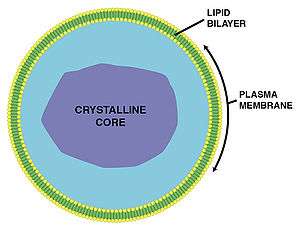
Acatalasia (also called acatalasemia, or Takahara's disease[1]:809) is an autosomal recessive peroxisomal disorder caused by a complete lack of catalase.
Presentation
The disorder is relatively benign, although it causes an increased incidence of periodontal infections, and can under rare circumstances lead to gangrene.[2]
Genetic Basis
Occurrence of acatalasia is often the result of mutation in the CAT gene which codes for the enzyme catalase.[3]
Occurrence
Researchers estimate that the condition occurs in every 12,500th person in Japan, every 20,000th in Hungary, and every 20,000th person in Switzerland.[3]
History
In 1948, Dr. Shigeo Takahara (1908–1994), a Japanese otolaryngologist first reported this new disease.[4] He had examined a patient with an oral ulcer. He had spread hydrogen peroxide on the diseased part, but oxygen was not generated due to the lack of catalase.
See also
References
- ↑ James, William D.; Berger, Timothy G.; et al. (2006). Andrews' Diseases of the Skin: Clinical Dermatology. Saunders Elsevier. ISBN 0-7216-2921-0.
- ↑ Takahara, Shigeo; Hamilton, H. B.; Neel, J. V.; Kobara, T. Y.; Ogura, Y.; Nishimura, E. T. (1960). "Hypocatalasemia: a new genetic carrier state". Journal of Clinical Investigation. 39 (4). doi:10.1172/JCI104075.
- 1 2 "Acatalasemia". Genetics Home Reference. Retrieved 2015-09-28.
- ↑ Takahara, S.; Miyamoto, H. Three cases of progressive oral gangrene due to lack of catalase in the blood. Nippon Jibi-Inkoka Gakkai Kaiho 51: 163 only, 1948.