Adele aus der Ohe
| Adele aus der Ohe | |
|---|---|
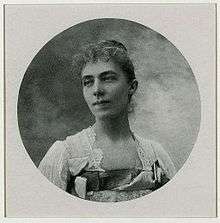 Adele aus der Ohe | |
| Background information | |
| Born |
11 February 1861 Hanover, Germany |
| Died |
8 December 1937 (aged 76) Berlin, Germany |
| Genres | Classical |
| Occupation(s) | Pianist, composer |
Adele (Adelheit Johanne Auguste Hermine) aus der Ohe (11 February 1861 – 8 December 1937) was a German concert pianist and composer.[1][n 1] Her compositions, including the Suite No. 2 in E major, Op. 8, were published by G. Schirmer Inc.
Life
Adele aus der Ohe was born in Hanover. She initially studied with Theodor Kullak, where American pianist and chronicler Amy Fay heard her. Calling her "a little fairy of a scholar, ten years old," Fay wrote, "I heard her play a concerto of Beethoven the other day with orchestral accompaniment and a great cadenza by Moscheles, absolutely perfectly. She never missed a note all the way through."[2] She was one of the few child prodigies accepted as a pupil by Franz Liszt; she began studying with him at the age of 12 and stayed with him seven years (1877–1884),[3] making her American debut playing his First Piano Concerto in the Steinway Hall in New York on 23 December 1886.[4] Aus der Ohe promoted Liszt's music throughout her career; and Richard Watson Gilder wrote a poem about such interpretations.
Aus der Ohe was a friend of Pyotr Ilyich Tchaikovsky, whose First Piano Concerto she performed under the composer's baton at the inaugural concert of Carnegie Hall in New York,[5] as well as at his final concert in St. Petersburg, where the Pathétique Symphony was premiered. She subsequently settled in the United States, touring there 17 consecutive seasons.[2] She returned to Germany in 1906 and died in Berlin in 1937.
Aus der Ohe's repertory was large and included both Brahms concertos, the second of which she played as early as 1899 in Boston. She specialized in large-scale works; a typical program she played in Boston consisted of Beethoven's Waldstein Sonata, Chopin's Funeral March Sonata, Schumann's Fantasie in C and Liszt's Réminiscences de Don Juan.[6]
Works for piano
| Title | Opus | Number | Key | Words | Year | Publishing |
|---|---|---|---|---|---|---|
| Four songs from The new day | 1 | The birds were singing | — | Richard Watson Gilder | 1895 | G. Schirmer |
| A birthday song | — | |||||
| Not from the whole wide World | — | |||||
| Thistle-down | — | |||||
| Suite No. 1 for Piano | 2 | Bourrée | — | — | 1895 | G. Schirmer |
| Sarabande | — | |||||
| Menuet | — | |||||
| Gavotte | — | |||||
| Konzertetüde No. 1 für Klavier | 3 | — | C major | — | 1895 | G. Schirmer |
| Compositions for the Piano | 4 | Melody | F major | — | 1897 | G. Schirmer |
| Slumber Song | — | |||||
| Rustic Dance | — | |||||
| Five Songs for Soprano or Tenor | 5 | Rose-dark the solemn Sunset | — | Richard Watson Gilder | 1897 | G. Schirmer |
| After Sorrow's Night | F minor | |||||
| Cradle-song | — | |||||
| I care not if the Skies are white | — | |||||
| Winds to the silent Morn | — | |||||
| Two Songs with Piano Accompaniment | 6 | The Orphans | — | Adelbert von Chamisso | 1897 | G. Schirmer |
| I grieve to see these Tears | — | Robert Underwood Johnson | ||||
| Two Songs with Piano Accompaniment | 7 | I begged a Kiss from a little Maid | — | Robert Underwood Johnson | 1897 | G. Schirmer |
| Some said they did but play at War | — | |||||
| Suite No. 2 in E major | 8 | Prelude | — | — | — | Ries & Erler |
| Sarabande | — | |||||
| à la Bourrée | — | |||||
| Air | — | |||||
| Gavotte | — | |||||
| Gigue | — | |||||
| Vier Klavierstücke | 9 | Eine Sage | — | — | 1901 | Ries & Erler |
| Walzer | — | |||||
| Novelette | — | |||||
| Spinnlied | — | |||||
| Two Pieces for Piano | 10 | Melodie | — | — | 1902 | G. Schirmer |
| Berceuse | — | |||||
| Mazurka | 11 | — | — | — | 1902 | G. Schirmer |
| Three Pieces for Violin and Piano | 12 | Mazurka | — | — | 1903 | G. Schirmer |
| Romanze | — | |||||
| Elfe Tanzt (Dancing Elf) | — | |||||
| Konzertetüde No. 2 für Klavier | 13 | Am Springbrunnen; eine Erinnerung an die Villa d'Este | — | — | 1906 | G. Schirmer |
| Fünf Klavierstücke | 14 | Morgenliedchen | — | — | 1906 | G. Schirmer |
| Pastorale | — | |||||
| Walzer | — | |||||
| Lustiges Intermezzo | — | |||||
| Am Sommerabend | — | |||||
| Concerto for Piano and Orchestra | 15 | — | — | — | — | — |
| Sonata for Violin and Piano | 16 | — | F-sharp major | — | 1906 | G. Schirmer |
| Suite for Piano | WoO | — | B minor | — | 1910 | Printing unknown |
Notes
- ↑ The church baptismal records from Hannover provide the correct date of February 11, 1861.
References
- ↑ "Ohe, Adele aus der, Adelheit (Johanne Auguste Hermine)". Sophie Drinker Institut (in German). Retrieved 8 December 2014.
- 1 2 Schonberg, The Great Pianists, 263.
- ↑ Schonberg, Harold C. (1987). Great Pianists. Simon and Schuster. p. 263. ISBN 0671638378.
- ↑ Lachmund, Carl (1995). Living with Liszt: From the Diary of Carl Lachmund, an American Pupil of Liszt, 1882-1884. Pendragon Press. p. 194. ISBN 0945193564.
- ↑ CLASSICAL MUSIC; Extra! Read All About It - Carnegie's $1.25 Million Hall, Harold C. Schonberg, The New York Times
- ↑ Schonberg, The Great Pianists, 265.
External links
- Musik under Gender im Internet (German)
- A Critical Study, Polish Music Journal
Further reading
- Schonberg, Harold C., The Great Pianists (New York: Simon & Schuster, 1987, 1963). ISBN 0-671-64200-6.