Agaricus arorae
| Agaricus arorae | |
|---|---|
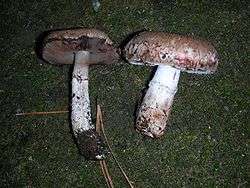 | |
| A pair of Agaricus arorae | |
| Scientific classification | |
| Kingdom: | Fungi |
| Division: | Basidiomycota |
| Class: | Agaricomycetes |
| Order: | Agaricales |
| Family: | Agaricaceae |
| Genus: | Agaricus |
| Species: | A. arorae |
| Binomial name | |
| Agaricus arorae Kerrigan | |
Agaricus arorae is a moderate-sized, forest-dwelling mushroom that exhibits distinctive color changes. It fruits early in the mushroom season. Unusually within the genus Agaricus, the mushroom's cap cuticle turns yellow when exposed to a base such as potassium hydroxide or sodium hydroxide but stains red when cut.[1] In the field, it has a brownish, fibrillose/squamulose cap, which tuns red when bruised. Agaricus arorae was first described from Santa Cruz County but since has been found in San Mateo and Alameda counties.[2][3] [4] Agaricus arorae can be distinguished by its scales and a conspicuous stipe.[5]
A. arorae was named after American mycologist and author David Arora.
Description
Pileus
The cap is 3-8 cm broad, and varies from hemispheric to convex. The margin starts curved, but then decurved. The cuticle slowly bruises a reddish colour, and yellows with KOH. With a dry surface, the cap's disc can be glabrous or tomentose. Toward the margin, either minute fibers or scales develop. The cap's fibrils are generally a brownish colour. The cap has an indistinct odor with a mild taste. The context can be as large as 5 mm thick, soft, and bruises irregularly a vinaceous colour where cut.[6]
Lamelae
The gills are free, close, and broad. At first, they are buff-brown, but turn a darker brown in age.
Stipe
The stipe is 4-9 cm long and 0.5-2.5 cm thick. At the base, it is slightly enlarged and becomes stuffed at maturity. The white veil is rather membranous and yields a thin ring. When cut, the cortex discolours to pinkish-orange. The stipe base changes brown to rusty-brown from handling. The margin is sometimes light brown. The apex surface is white, and patchy fibrillose over a dull-buff ground color.[7]
Spores
Spores are 4.5-5.0 x 3.0-3.5 µm, elliptical, and inequilateral in profile. In addition, they are moderately thick-walled, lacking a germ pore.[8]
See also
References
- Arora, David (1986). Mushrooms Demystified (2 ed.).
- Specific
- ↑ Arora, p. 313, p. 326
- ↑ Kerrigan, Richard W. (1985)
- ↑ Arora, p. 311
- ↑ Studies in Agaricus III. New species from California. Mycotaxon 12: 419-434.
- ↑ Kerrigan, Richard W. (1986). The Agaricales (Gilled Fungi) of California. 6. Agaricaceae. Mad River Press: Eureka, CA. 62 p.
- ↑ Wood, Michael; Fred Stevens (1998). "Bovista aestivalis". Retrieved 2009-07-07.
- ↑ Arora, p. 325-326
- ↑ Arora, p. 320