Aguja Formation
| Aguja Formation Stratigraphic range: Campanian-Maastrichtian, 80.5–72 Ma | |
|---|---|
| Type | Geological formation |
| Unit of | Tornillo Group |
| Sub-units |
|
| Underlies | Javelina Formation |
| Overlies | Pen Formation |
| Location | |
| Region |
 Texas Texas  Chihuahua Chihuahua |
| Country |
 USA USA  Mexico Mexico |
The Aguja Formation is a geological formation in North America, exposed in Texas, whose strata date back to the Late Cretaceous. Dinosaur remains are among the fossils that have been recovered from the formation.[1]
Age
The ages of the Aguja Formation and its primary fossil-bearing unit, the Upper Shale, are not well understood. Two radiometric dates have been taken from different sections of the upper shale, yielding ages of 72.6 Ma +/- 1.5 Ma old, and 76.9 Ma +/- 1.2 Ma old, respectively.[2] The contact with the overlying Javelina Formation has been estimated at about 70 Ma ago[3] but also as recently as 68.5 million years ago.[4] The base of the entire Aguja Formation has been estimated at about 80.5 million years old.[5]
Invertebrate paleofauna
Ammonites
| Ammonites of the Aguja Formation | ||||||
|---|---|---|---|---|---|---|
| Genus | Species | Location | Member | Abundance | Notes | Images |
|
B. mclearni |
|
| ||||
|
Hoplitoplacenticeras |
H. plasticum |
|
||||
|
P. paulsoni |
|
|||||
Vertebrate paleofauna
Crurotarsans
| Crurotarsans of the Aguja Formation | ||||||
|---|---|---|---|---|---|---|
| Genus | Species | Location | Member | Material | Notes | Images |
|
D. riograndensis[6] |
osteoderm and mandible fragment |
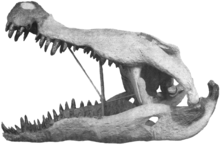 Deinosuchus skull reconstruction. | ||||
|
P. riograndensis[6] |
|
Reclassified as a Deinosuchus species. | ||||
Ornithischians
Color key
|
Notes Uncertain or tentative taxa are in small text; |
| Ornithischians of the Aguja Formation | ||||||
|---|---|---|---|---|---|---|
| Genus | Species | Location | Member | Material | Notes | Images |
|
A. mariscalensis[8] |
|
|
The type species, A. mariscalensis, was formerly considered a species of Chasmosaurus.[8] |
| ||
|
A. daviesi[9] |
|
|||||
|
C. mariscalensis[11] |
|
"[Twelve] disarticulated skull (sic), postcrania, juvenile."[12] |
Considered by paleontologists Lucas, Sullivan, and Hunt to be distinct enough from the Chasmosaurus type species, C. belli to warrant being split off to a new genus, Agujaceratops.[8] | |||
|
Indeterminate[13] |
|
|||||
|
Unnamed species[14] |
|
|||||
|
Unnamed species[11] |
|
|||||
|
Unnamed genus and species[15] |
|
Formerly referred to Kritosaurus and Gryposaurus, appears to be an unnamed species related to Secernosaurus.[16] | ||||
|
Indeterminate[10] |
|
|||||
|
T. langstoni[18] |
|
|
||||
Saurischians
Indeterminate ornithomimid remains are known from the Upper Aguja Formation.[5] Indeterminate tyrannosaurid fossils are known from the Upper Aguja Formation of Texas and Mexico.[19]
Color key
|
Notes Uncertain or tentative taxa are in small text; |
| Saurischians of the Aguja Formation | ||||||
|---|---|---|---|---|---|---|
| Genus | Species | Location | Member | Material | Notes | Images |
|
Indeterminate[19] |
|
|||||
|
Indeterminate[20] |
|
|||||
|
L. gaddisi |
|
A caenagnathid. |
| |||
|
R. cf. gilmorei[23] |
|
|||||
|
R. isosceles[22] |
|
|||||
|
S. cf. langstoni[24] |
|
|||||
|
Indeterminate[25] |
|
|||||

Turtles
| Testudines of the Aguja Formation | ||||||
|---|---|---|---|---|---|---|
| Genus | Species | Location | Member | Material | Notes | |
|
T. fischbecki[6] |
|
|
||||
See also
Footnotes
- ↑ Weishampel, David B; et al. (2004). "Dinosaur distribution (Late Cretaceous, North America)." In: Weishampel, David B.; Dodson, Peter; and Osmólska, Halszka (eds.): The Dinosauria, 2nd, Berkeley: University of California Press. Pp. 574-588. ISBN 0-520-24209-2.
- 1 2 3 Longrich, N. R.; Sankey, J.; Tanke, D. (2010). "Texacephale langstoni, a new genus of pachycephalosaurid (Dinosauria: Ornithischia) from the upper Campanian Aguja Formation, southern Texas, USA". Cretaceous Research. 31 (2): 274. doi:10.1016/j.cretres.2009.12.002.
- ↑ Woodward, H. N. (2005). Bone histology of the sauropod dinosaur Alamosaurus sanjuanensis from the Javelina Formation, Big Bend National Park, Texas.
- ↑ Sankey, J. (2010). Faunal composition and significance of high–diversity, mixed bonebeds containing Agujaceratops mariscalensis and other dinosaurs, Aguja Formation (Upper Cretaceous), Big Bend, Texas. In New Perspectives on Horned Dinosaurs: The Royal Tyrrell Museum Ceratopsian Symposium (pp. 520-537).
- 1 2 Sullivan, R.M., and Lucas, S.G. 2006. "The Kirtlandian land-vertebrate "age" – faunal composition, temporal position and biostratigraphic correlation in the nonmarine Upper Cretaceous of western North America." New Mexico Museum of Natural History and Science, Bulletin 35:7-29.
- 1 2 3 4 5 6 7 8 9 "Aguja Formation (Upper Shale Member), Big Bend Region, Texas," in Sullivan and Lucas (2006). Page 16.
- ↑ "The first mandible fragment of Deinosuchus (Eusuchia: Alligatoroidea) discovered in Coahuila, Mexico". ResearchGate. Retrieved 2016-03-27.
- 1 2 3 4 5 "Abstract," Lucas, Sullivan, and Hunt. (2006).
- 1 2 3 Wagner and Lehman (2009).
- 1 2 3 "Dinosaur distribution (Texas and Chihuahua)." Weishampel, et al. (2004). Page 582 and 588.
- 1 2 3 4 5 6 7 8 9 10 11 12 "Dinosaur distribution (Late Cretaceous; North America; Texas)." Weishampel, et al. (2004). Page 582.
- ↑ "Table 23.1," in Weishampel, et al. (2004). Page 496.
- 1 2 Listed as ?Chasmosaurus sp. in "Dinosaur distribution (Late Cretaceous; North America; Chihuahua)." Weishampel, et al. (2004). Page 588.
- ↑ Listed as Edmontonia cf. rugosidens in "Dinosaur distribution (Late Cretaceous; North America; Texas)." Weishampel, et al. (2004). Page 582.
- ↑ Listed as ?Gryposaurus sp. in "Dinosaur distribution (Late Cretaceous; North America; Texas)." Weishampel, et al. (2004). Page 582.
- ↑ Prieto-Márquez, A. (2013). "Skeletal morphology of Kritosaurus navajovius (Dinosauria:Hadrosauridae) from the Late Cretaceous of the North American south-west, with an evaluation of the phylogenetic systematics and biogeography of Kritosaurini." Journal of Systematic Palaeontology, (advance online publication) doi:10.1080/14772019.2013.770417
- ↑ "Dinosaur distribution (Late Cretaceous; North America; Chihuahua)." Weishampel, et al. (2004). Page 588.
- 1 2 3 "Abstract," Longrich, Sankey, and Tanke (2010).
- 1 2 3 4 Mortimer, M (2004). "Tyrannosauroidea". The Theropod Database. Retrieved 2007-08-21.
- 1 2 Listed as cf. Dromaeosaurus sp. in "Dinosaur distribution (Late Cretaceous; North America; Texas)." Weishampel, et al. (2004). Page 582.
- ↑ Longrich, N. R.; Barnes, K.; Clark, S.; Millar, L. (2013). "Caenagnathidae from the Upper Campanian Aguja Formation of West Texas, and a Revision of the Caenagnathinae". Bulletin of the Peabody Museum of Natural History 54: 23. doi:10.3374/014.054.0102. edit
- 1 2 3 4 "Dinosaur distribution (Late Cretaceous; North America; Texas)." Weishampel, et al. (2004). Page 581.
- ↑ Listed as R. cf. gilmorei in "Dinosaur distribution (Late Cretaceous; North America; Texas)." Weishampel, et al. (2004). Page 581.
- ↑ Listed as Saurornitholestes cf. langstoni in "Dinosaur distribution (Late Cretaceous; North America; Texas)." Weishampel, et al. (2004). Page 582.
- 1 2 Listed as cf. Troodon sp. in "Dinosaur distribution (Late Cretaceous; North America; Texas)." Weishampel, et al. (2004). Page 582.
References
- Lehman, Thomas M.; Susan L. Tomlinson (2004). "Terlinguachelys fischbecki, a new genus and species of sea turtle (Chelonioidea: Protostegidae) from the Upper Cretaceous of Texas". Journal of Paleontology. The Paleontological Society. 78 (6): 1163–1178. doi:10.1666/0022-3360(2004)078<1163:TFANGA>2.0.CO;2.
- Longrich, N.R., Sankey, J., and Tanke, D. (2010) Texacephale langstoni, a new genus of pachycephalosaurid (Dinosauria: Ornithischia) from the upper Campanian Aguja Formation, southern Texas, USA. Cretaceous Research. doi:10.1016/j.cretres.2009.12.002.
- Sullivan, R.M., and Lucas, S.G. 2006. "The Kirtlandian land-vertebrate "age" – faunal composition, temporal position and biostratigraphic correlation in the nonmarine Upper Cretaceous of western North America." New Mexico Museum of Natural History and Science, Bulletin 35:7-29.
- Spencer G. Lucas, Robert M. Sullivan and Adrian P. Hunt: Re-evaluation of Pentaceratops and Chasmosaurus (Ornithischia: Ceratopsidae) in the Upper Cretaceous of the Western Interior. In: New Mexico Museum of Natural History and Science Bulletin 35 (2006), S. 367-370.PDF
- Wagner, Jonathan R.; Lehman, Thomas M. (2009). "An Enigmatic New Lambeosaurine Hadrosaur (Reptilia: Dinosauria) from the Upper Shale Member of the Campanian Aguja Formation of Trans-Pecos Texas". Journal of Vertebrate Paleontology. 29 (2): 605–611. doi:10.1671/039.029.0208.
- Weishampel, David B.; Dodson, Peter; and Osmólska, Halszka (eds.): The Dinosauria, 2nd ed., Berkeley: University of California Press. ISBN 0-520-24209-2.