Alectryon connatus
| Alectryon connatus | |
|---|---|
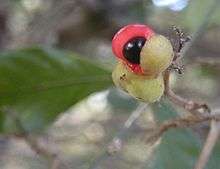 | |
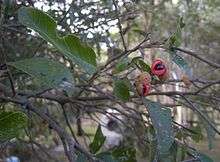
| Fruits, with smooth red arils and black seeds, and foliage (above and below) | |
 | |
| Scientific classification | |
| Kingdom: | Plantae |
| (unranked): | Angiosperms |
| (unranked): | Eudicots |
| (unranked): | Rosids |
| Order: | Sapindales |
| Family: | Sapindaceae |
| Subfamily: | Sapindoideae |
| Genus: | Alectryon |
| Species: | A. connatus |
| Binomial name | |
| Alectryon connatus (F.Muell.) Radlk.[1] | |
| Synonyms[1] | |
| |
Alectryon connatus, sometimes named hairy alectryon, is a species of small trees, constituting part of the plant family Sapindaceae.
They grow naturally in Australia, in eastern Queensland from the south-east to the northernmost Cape York Peninsula,[2][3] Western Australia, perhaps in north-eastern New South Wales,[3] and in New Guinea.[4][5][6][7] They grow in littoral rainforests, vine thickets, tropical monsoon forests (seasonal rainforests) and similar vegetation assemblages, in the lowlands, and in the tropics the uplands recorded up to 800 m (2,600 ft) altitude.[2][3]
Naming and classification
European science formally described the species under the name Spanoghea connata in 1859, authored by German–Australian botanist Ferdinand von Mueller.[1][5]
In 1878 Bavarian botanist Ludwig A. T. Radlkofer formally renamed this species to Alectryon connatus.[1][5]
Description
They grow to a small trees 12–20 m (40–70 ft) tall or sometimes as a shrub only.[2][3][6][7]
References
- 1 2 3 4 "Alectryon connatus (F.Muell.) Radlk.". Australian Plant Name Index (APNI), IBIS database. Centre for Plant Biodiversity Research, Australian Government. Retrieved 14 Dec 2013.
- 1 2 3 Hyland, B. P. M.; Whiffin, T.; Zich, F. A.; et al. (Dec 2010). "Factsheet – Alectryon connatus". Australian Tropical Rainforest Plants. Edition 6.1, online version [RFK 6.1]. Cairns, Australia: Commonwealth Scientific and Industrial Research Organisation (CSIRO), through its Division of Plant Industry; the Centre for Australian National Biodiversity Research; the Australian Tropical Herbarium, James Cook University. Retrieved 14 Dec 2013.
- 1 2 3 4 Cooper, Wendy; Cooper, William T. (June 2004). "Alectryon connatus (F.Muell.) Radlk.". Fruits of the Australian Tropical Rainforest. Clifton Hill, Victoria, Australia: Nokomis Editions. p. 476. ISBN 9780958174213. Retrieved 12 Dec 2013.
- ↑ Conn, Barry J. (2008). "Alectryon". Census of Vascular Plants of Papua New Guinea. (search result listing, matching all starting with "Alectryon", via www.pngplants.org). Retrieved 12 Dec 2013.
- 1 2 3 Edwards, Karen J.; Gadek, Paul A. (2001). "Evolution and Biogeography of Alectryon (Sapindaceae)". Molecular Phylogenetics and Evolution. 20 (1): 14–26. doi:10.1006/mpev.2001.0952. (subscription required (help)).
- 1 2 Leenhouts, Pieter W. (1994). "Alectryon connatus (F.Muell.) Radlk.". In Adema, F.; Leenhouts, P. W.; van Welzen, P. C. Flora Malesiana (Digitised, online). Series I, Spermatophyta : Flowering Plants. Vol. 11 pt. 3: Sapindaceae. Leiden, The Netherlands: Rijksherbarium / Hortus Botanicus, Leiden University. p. 454. ISBN 90-71236-21-8. Retrieved 14 Dec 2013.
- 1 2 Reynolds, Sally T. (1985). "Alectryon connatus (F.Muell.) Radlk.". Flora of Australia: Volume 25: (online version). Flora of Australia series. CSIRO Publishing / Australian Biological Resources Study. 25, Fig. 4, Map 25. ISBN 978-0-644-03724-2. Retrieved 14 Dec 2013.