Allium scorodoprasum
| Sand leek, rocambole | |
|---|---|
 | |
| Allium scorodoprasum[1] | |
Scientific classification  | |
| Kingdom: | Plantae |
| Clade: | Angiosperms |
| Clade: | Monocots |
| Order: | Asparagales |
| Family: | Amaryllidaceae |
| Subfamily: | Allioideae |
| Tribe: | Allieae |
| Genus: | Allium |
| Species: | A. scorodoprasum |
| Binomial name | |
| Allium scorodoprasum L. | |
| Synonyms[2] | |
|
Synonymy
| |
The sand leek (Allium scorodoprasum), also known as rocambole, is a Eurasian species of wild onion with a native range extending across much of Europe and the Middle East.[2][3][4][5][6][7] The species should not be confused with rocambole garlic, which is A. sativum var. ophioscorodon.
Description
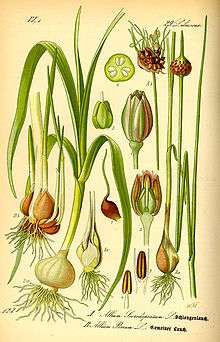
The sand leek is a perennial plant with an egg-shaped bulb. The plant produces two to five unstalked leaves, the bases of which are sheath-like. Each leaf blade is linear, 7-20 mm wide,[8] flat with a slight keel, an entire margin and parallel veins. The edges of the leaf and the central vein are rough to the touch. The flowering stem is cylindrical, growing to a height of 30 to 90 cm (12 to 35 in) and the upper half is leafless. The whole plant has an onion-like aroma. The inflorescence is a globular cluster surrounded by membranous bracts in bud which wither when the flowers open. Each individual flower is stalked and has a purple perianth 4 to 7 mm (0.16 to 0.28 in) long. There are six tepals, six stamens and a pistil formed from three fused carpels. Mixed with the flowers are a number of purple bulbils. The fruit is a capsule, but the seeds seldom set, and propagation usually takes place when the bulbils are knocked off and grow into new plants.[9]
Habitat
The natural habitat of A. scorodoprasum is damp broad-leaved woodland, forest margins, shores, hillside meadows and hedgerows. It was at one time used as a kitchen herb and can sometimes be found near old habitations.[9][10]
Cultivation
A. scorodoprasum is edible but seldom cultivated, and has a shorter flower stalk and fewer and more inconsistently shaped cloves than Rocambole garlic. Sand leek also has a dark violet bulb wrapper.[11]
Elephant garlic (properly A. ampeloprasum var. ampeloprasum) is also sometimes incorrectly sold as A. scorodoprasum.
References
- ↑ 1885 illustration from Prof. Dr. Otto Wilhelm Thomé Flora von Deutschland, Österreich und der Schweiz 1885, Gera, Germany
- 1 2 Kew World Checklist of Selected Plant Families
- ↑ Altervista Flora Italiana, Aglio romano, sand leek, Allium scorodoprasum L. includes photos, drawings, European distribution map
- ↑ Komarov, V.L. (ed.) (1935). Flora SSSR 4: 1-586. Izdatel'stov Akademii Nauk SSSR, Leningrad.
- ↑ Davis, P.H. (ed.) (1984). Flora of Turkey and the East Aegean Islands 8: 1-632. Edinburgh University Press, Edinburgh.
- ↑ Danin, A. (2004). Distribution Atlas of Plants in the Flora Palaestina area: 1-517. The Israel Academy of Sciences and Humanities, Jerusalem.
- ↑ Dimpoulos, P., Raus, T., Bergmeier, E., Constantinidis, T., Iatrou, G., Kokkini, S., Strid, A., & Tzanoudakis, D. (2013). Vascular plants of Greece. An annotated checklist: 1-372. Botanic gardens and botanical museum Berlin-Dahlem, Berlin and Hellenic botanical society, Athens.
- ↑ Stace, C.A. (2010). New flora of the British isles (Third ed.). Cambridge, U.K.: Cambridge University Press. p. 903. ISBN 9780521707725.
- 1 2 "Sand leak: Allium scorodoprasum". NatureGate. Retrieved 2013-12-31.
- ↑ "Allium scorodoprasum". Plants For A Future. Retrieved 2013-12-31.
- ↑ Growing Great Garlic, 2nd Edition, Filaree Productions, 1992, p. 7.