Anecdote of the Jar
"Anecdote of the Jar" is a poem from Wallace Stevens's first book of poetry, Harmonium. First published in 1919, it is in the public domain.[1]
I placed a jar in Tennessee,
And round it was, upon a hill.
It made the slovenly wilderness
Surround that hill.
The wilderness rose up to it,
And sprawled around, no longer wild.
The jar was round upon the ground
And tall and of a port in air.
It took dominion everywhere.
The jar was gray and bare.
It did not give of bird or bush,
Like nothing else in Tennessee.
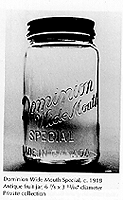
This famous, much-anthologized poem succinctly accommodates a remarkable number of different and plausible interpretations, as Jacqueline Brogan observes in a discussion of how she teaches it to her students.[2] It can be approached from a New Critical perspective as a poem about writing poetry and making art generally. From a poststructuralist perspective the poem is concerned with temporal and linguistic disjunction, especially in the convoluted syntax of the last two lines. A feminist perspective reveals a poem concerned with male dominance over a traditionally feminized landscape. A cultural critic might find a sense of industrial imperialism. Brogan concludes: "When the debate gets particularly intense, I introduce Roy Harvey Pearce's discovery of the Dominion canning jars (a picture[3] of which is then passed around)."[4]
Buttel suggests that the speaker would arrange the wild landscape into the order of a still life, and though his success is qualified, art and imagination do at least impose an idea of order on the sprawling reality.
Helen Vendler, in a reading that contradicts Brogan's and Buttel's, asserts that the poem is incomprehensible except as understood as a commentary on Keats's "Ode on a Grecian Urn." The poem alludes to Keats, she argues, as a way of discussing the predicament of the American artist "who cannot feel confidently the possessor, as Keats felt, of the Western cultural tradition."[5] Shall he use language imported from Europe ("of a port in air", to "give of"), or "plain American that cats and dogs can read" (as Marianne Moore put it), like "The jar was round upon the ground"?[5] The poem is a palinode, retracting the Keatsian conceits of "Sunday Morning" and vowing "to stop imitating Keats and seek a native American language that will not take the wild out of the wilderness."[6]
Wallace Stevens wrote the poem in 1918 when he was in the town of Elizabethton, Tennessee.
Notes
References
- Brogan, Jacqueline Vaught. "Introducing Stevens: Or, the Sheerly Playful and the Display of Theory." In Teaching Wallace Stevens, ed. John Serio and B. Leggett. 1994: University of Tennessee Press.
- Buttel, Robert. Wallace Stevens: The Making of Harmonium. 1967: Princeton University Press.
- Vendler, Helen. Words Chosen Out of Desire. 1984: University of Tennessee Press.