Aphrodite of the Gardens
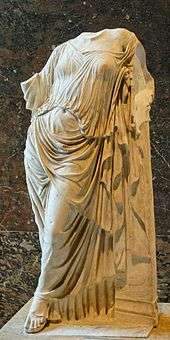
Aphrodite of the Gardens (Ancient Greek: ἐν κήποις en kí̱pois) is an epithet of the Greek goddess Aphrodite. The epithet describes her patronage over vegetation and garden fertility.[2]
According to Pausanias, there was a sanctuary of Aphrodite ἐν κήποις at the Acropolis of Athens. It was said to have held a cult statue of Aphrodite by Alcamenes and a herm of Aphrodite near the temple. It is unsure whether the statue of Aphrodite and the herm of Aphrodite were the same sculpture or two separate sculptures.[3]
The herm of Aphrodite may be linked to the later mythological character, Hermaphroditos.[4][5] There are numerous references to a male aspect of Aphrodite, called Aphroditos, which was imported to Athens from Cyprus in the late 5th century BC and also a temple of Hermaphroditos was spoken of by Alciphron at Athens.[6]
See also
Notes
- ↑ "Leaning Aphrodite known as Aphrodite of the Gardens". The Macao Museum of Art.
- ↑ Elisabeth B. MacDougall (1981). Ancient Roman Gardens. Dumbarton Oaks. p. 24. ISBN 0-88402-100-9.
- ↑ Arthur Bernard Cook (1925). Zeus: A Study in Ancient Religion. Cambridge University Press. p. 171.
- ↑ Yulia Ustinova (1999). The Supreme Gods of the Bosporan Kingdom. Brill. p. 38. ISBN 90-04-11231-6.
- ↑ Simon Goldhill (2006). Rethinking Revolutions through Ancient Greece. Cambridge University Press. p. 63.
- ↑ Alciphron. literally and completely translated from the Greek, with introduction and notes. Athenian Society. p. 142.
References
- Jeffrey M. Hurwit (1999). The Athenian Acropolis. Cambridge University Press. ISBN 0-521-41786-4.
- Rachel Rosenzweig (2004). Worshipping Aphrodite. University of Michigan Press. ISBN 0-472-11332-1.
- Jennifer Lynn Larson (2007). Ancient Greek Cults: A Guide. Routledge. ISBN 0-415-32448-3.
External links
- Aphrodite in the Gardens (sculpture) at Perseus Project
- Ancient texts pertaining to Aphrodite of the Gardens