Artin–Mazur zeta function
In mathematics, the Artin–Mazur zeta function, named after Michael Artin and Barry Mazur, is a function that is used for studying the iterated functions that occur in dynamical systems and fractals.
It is defined as the formal power series
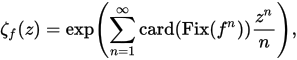
where Fix(ƒ n) is the set of fixed points of the nth iterate of the function ƒ, and card(Fix(ƒ n)) is the number of fixed points (i.e. the cardinality of that set).
Note that the zeta function is defined only if the set of fixed points is finite for each n. This definition is formal in that the series does not always have a positive radius of convergence.
The Artin–Mazur zeta function is invariant under topological conjugation.
The Milnor–Thurston theorem states that the Artin–Mazur zeta function is the inverse of the kneading determinant of ƒ.
Analogues
The Artin–Mazur zeta function is formally similar to the local zeta function, when a diffeomorphism on a compact manifold replaces the Frobenius mapping for an algebraic variety over a finite field.
The Ihara zeta function of a graph can be interpreted as an example of the Artin–Mazur zeta function.
See also
References
- Artin, Michael; Mazur, Barry (1965), "On periodic points", Annals of Mathematics. Second Series, Annals of Mathematics, 81 (1): 82–99, doi:10.2307/1970384, ISSN 0003-486X, JSTOR 1970384, MR 0176482
- David Ruelle, Dynamical Zeta Functions and Transfer Operators (2002) (PDF)
- Kotani, Motoko; Sunada, Toshikazu (2000). "Zeta functions of finite graphs". J. Math. Sci. Univ. Tokyo. 7: 7–25.
- Terras, Audrey (2010), Zeta Functions of Graphs: A Stroll through the Garden, Cambridge Studies in Advanced Mathematics, 128, Cambridge University Press, ISBN 0-521-11367-9, Zbl 1206.05003