Arundel Formation
| Arundel Formation Stratigraphic range: Lower Cretaceous | |
|---|---|
| Type | sedimentary |
| Unit of | Potomac Group |
| Underlies | Patapsco Formation |
| Overlies | Patuxent Formation |
| Thickness | up to 125 feet[1] |
| Lithology | |
| Primary | clay |
| Location | |
| Region |
 Maryland, Washington D. C. Maryland, Washington D. C. |
| Country | United States |
| Type section | |
| Named by | W. B. Clark, 1897[1] |
The Arundel Formation, also known as the Arundel Clay, is a clay-rich sedimentary rock formation, within the Potomac Group, found in Maryland[2] of the United States of America. It is of Aptian age (Lower Cretaceous). This rock unit had been economically important as a source of iron ore, but is now more notable for its dinosaur fossils. Although often considered a formation, it may be only oxbow swamp facies within the Potomac Group.[3]
Vertebrate paleofauna
Dinosaurs
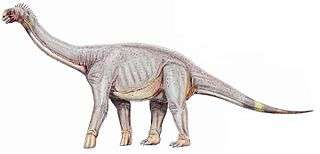
Dinosaurs present include cf. Acrocanthosaurus,[4][5] the poorly known theropods "Allosaurus" medius, "Creosaurus" potens, and "Coelurus" gracilis, the ornithomimosaurian "Dryosaurus" grandis,[6] as well as other indeterminate ornithomimosauria,[7] the sauropods Astrodon and Pleurocoelus, the nodosaurid Priconodon,[8] a possible basal ceratopsian,[9] and potentially the ornithopod Tenontosaurus.[3] Other vertebrates are not as well-known from the formation, but include a freshwater shark, a lungfish.,[10] at least three genera of turtles, and at least one crocodilian.[3]
Color key
|
Notes Uncertain or tentative taxa are in small text; |
| Dinosaurs reported from the Arundel Formation | ||||||
|---|---|---|---|---|---|---|
| Genus | Species | Location | Stratigraphic position | Material | Notes | Images |
|
|
"A." medius[11] |
|
"Tooth."[12] |
An indeterminate theropod tooth. |
| |
|
A. johnstoni[13] |
"Tooth."[15] |
|||||
|
"C." potens |
|
"Vertebra."[12] |
A neotheropod. | |||
|
|
"C." gracilis |
"Manual ungual and teeth."[12] |
Probably a dromaeosaurid. | |||
|
|
"C." potens[11] |
Reclassified as "Capitalsaurus" potens | ||||
|
cf. Deinonychus[11] |
Indeterminate[11] |
|
A dromaeosaurid | |||
|
|
"D." grandis |
|
"Limb elements."[17] |
An indeterminate member of Ornithomimosauria. | ||
|
|
"O." affinis |
Junior synonym of "Dryosaurus" grandis | ||||
|
P. altus[11] |
|
"Tibia [and] fibula."[18] |
||||
|
P. nanus[11] |
|
|||||
|
P. crassus[11] |
|
"Teeth, tibia."[19] |
||||
|
Indeterminate[20] |
|
|||||
Pterosaurs
Unassigned pteradactyloid tracks.[21]
Color key
|
Notes Uncertain or tentative taxa are in small text; |
| Pterosaurs of the Arundel Formation | ||||||
|---|---|---|---|---|---|---|
| Genus | Species | Location | Stratigraphic position | Abundance | Notes | Images |
Other fossils
W. B. Clark (1897) described lignitized trunks of trees often found in upright positions with their roots still intact.[1]
G. J. Brenner (1963) described spores and pollen within the formation.[22]
See also
Footnotes
- 1 2 3 Clark, W.B., 1897, Outline of present knowledge of the physical features of Maryland: Maryland Geological Survey Volume Series, v. 1, pt. 3, p. 172-188.
- ↑ "Geologic Map Legends". Coastal Plain Rocks and Sediments. Maryland Geological Survey. Archived from the original on 26 May 2011. Retrieved 27 June 2011.
- 1 2 3 Kranz, Peter M. (1998). "Mostly dinosaurs: a review of the vertebrates of the Potomac Group (Aptian Arundel Formation), USA". In Lucas, Spencer G.; Kirkland, James I.; Estep, J.W. Lower and Middle Cretaceous Terrestrial Ecosystems. New Mexico Museum of Natural History and Science Bulletin 14. pp. 235–238.
- ↑ Harris, Jerald D. (1998). "Large, Early Cretaceous theropods in North America". In Lucas, Spencer G.; Kirkland, James I.; Estep, J.W. Lower and Middle Cretaceous Terrestrial Ecosystems. New Mexico Museum of Natural History and Science Bulletin 14. pp. 225–228.
- ↑ Lipka, Thomas R. (1998). "The affinities of the enigmatic theropods of the Arundel Clay facies (Aptian), Potomac Formation, Atlantic Coastal Plain of Maryland". In Lucas, Spencer G.; Kirkland, James I.; Estep, J.W. Lower and Middle Cretaceous Terrestrial Ecosystems. New Mexico Museum of Natural History and Science Bulletin 14. pp. 229–234.
- ↑ Brownstein, Chase D. "Redescription of Arundel formation Ornithomimosaur material and a reinterpretation of Nedcolbertia justinhofmanni as an "Ostrich Dinosaur": Biogeographic implications". PeerJ Preprints. e2308v1.
- ↑ Gilmore, Charles W. (24 October 1919). "AN ORNITHOMIMID DINOSAUR IN THE POTOMAC OF MARYLAND". Science. 50 (1295): 394–395. doi:10.1126/science.50.1295.394.
- ↑ Weishampel, David B.; Barrett, Paul M.; Coria, Rodolfo A.; Le Loueff, Jean; Xu Xing; Zhao Xijin; Sahni, Ashok; Gomani, Elizabeth M.P.; Noto, Christopher N. (2004). "Dinosaur distribution". In Weishampel, David B.; Dodson, Peter; Osmólska, Halszka. The Dinosauria (2nd ed.). Berkeley: University of California Press. pp. 517–606. ISBN 0-520-24209-2.
- ↑ Chinnery, Brenda J.; Lipka, Thomas R.; Kirkland, James I.; Parrish, Michael J.; Brett-Surman, Michael K. "Neoceratopsian teeth from the Lower to Middle Cretaceous of North America". http://terpconnect.umd.edu/. Lower and Middle Cretaceous Terrestrial Ecosystems. New Mexico Museum of Natural History and Science Bulletin No. 14. 297-302 pp. Retrieved 1998. Check date values in:
|access-date=(help); External link in|website=(help) - ↑ Frederickson, J. A., Lipka, T. R., & Cifelli, R. L. (2016). A new species of the lungfish Ceratodus (Dipnoi) from the Early Cretaceous of the eastern USA. Journal of Vertebrate Paleontology, e1136316.
- 1 2 3 4 5 6 7 8 9 10 11 12 13 14 15 16 17 18 19 20 21 "3.25 Maryland, United States; 1. Arundel Clay," in Weishampel, et al. (2004). Page 556.
- 1 2 3 "Table 4.1," in Weishampel, et al. (2004). Page 78.
- 1 2 "3.25 Maryland, United States; 1. Arundel Clay" and "3.34 Washington D. C., United States; 1. Arundel Clay," in Weishampel, et al. (2004). Page 556.
- ↑ "3.34 Washington D. C., United States; 1. Arundel Clay," in Weishampel, et al. (2004). Page 556.
- ↑ "Table 13.1," in Weishampel, et al. (2004). Page 270.
- ↑ Kranz, D. 1998. Mostly Dinosaurs: A Review of the Vertebrates of the Potomac Group (Aptian Arundel Formation), USA, in Lucas, Kirkland and Estep, eds., 1998: 235-238.
- ↑ "Table 6.1," in Weishampel, et al. (2004). Page 139.
- ↑ "Table 13.1," in Weishampel, et al. (2004). Page 266.
- ↑ "Table 17.1," in Weishampel, et al. (2004). Page 368.
- 1 2 Listed as "?Tenontosaurus sp." in "3.25 Maryland, United States; 1. Arundel Clay," in Weishampel, et al. (2004). Page 556.
- 1 2 3 Lockley, M.; Harris, J.D.; and Mitchell, L. 2008. "A global overview of pterosaur ichnology: tracksite distribution in space and time." Zitteliana. B28. p. 187-198. ISSN 1612-4138.
- ↑ Brenner, Gilbert J., 1963, The spores and pollen of the Potomac Group of Maryland: Maryland Geological Survey Bulletin, no. 27, 215 p.
References
- Weishampel, David B.; Dodson, Peter; and Osmólska, Halszka (eds.): The Dinosauria, 2nd, Berkeley: University of California Press. 861 pp. ISBN 0-520-24209-2.
Coordinates: 39°3′N 76°38′W / 39.050°N 76.633°W