Ascoli Satriano
| Ascoli Satriano | ||
|---|---|---|
| Comune | ||
| Comune di Ascoli Satriano | ||
| ||
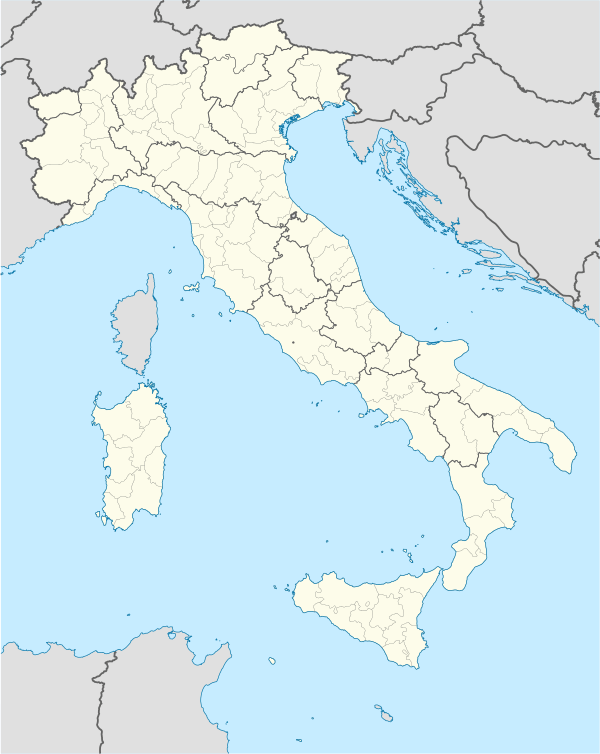  Ascoli Satriano Location of Ascoli Satriano in Italy | ||
| Coordinates: 41°12′56″N 15°33′28″E / 41.21556°N 15.55778°ECoordinates: 41°12′56″N 15°33′28″E / 41.21556°N 15.55778°E | ||
| Country | Italy | |
| Region |
 Apulia Apulia | |
| Province / Metropolitan city | Foggia (FG) | |
| Frazioni | San Carlo | |
| Area | ||
| • Total | 334 km2 (129 sq mi) | |
| Elevation | 376 m (1,234 ft) | |
| Population (December 31, 2004)[1] | ||
| • Total | 6,359 | |
| • Density | 19/km2 (49/sq mi) | |
| Demonym(s) | Ascolani | |
| Time zone | CET (UTC+1) | |
| • Summer (DST) | CEST (UTC+2) | |
| Postal code | 71022 | |
| Dialing code | 0885 | |
| Patron saint | San Potito | |
| Saint day | January 14 | |
| Website | Official website | |
Ascoli Satriano is a town and comune in the province of Foggia in the Apulia region of southeast Italy.
History
Ascoli (known as Asculum) was a city of the Dauni.[2] It was the site of two early Roman battles (see Battle of Asculum).[3] Later Sulla established a military colony there.
In the mid-9th century the Saracens razed the city. In 1040 it rebelled against the Byzantines and, the following year, a decisive battle was fought nearby which granted the Normans control over southern Italy.
Main sights
- The Romanesque-Gothic Cathedral (12th century)
- Church of St. John the Baptist (12th century)
- Church of the Incoronata (15th century)
Americans from Ascoli Satriano
- Biagio Ciotto (known as "Billy" to Americans) served as a state senator from Connecticut from 1995 to 2007.
See also
- Ascoli Satriano (Italian language Wikipedia)
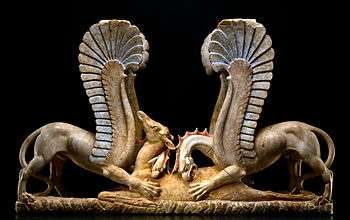
- it: Marmi di Ascoli Satriano (Marbles of Ascoli Satriano)
References
- ↑ All demographics and other statistics from the Italian statistical institute (Istat)
- ↑ Edlund Berry, I.; A. Small; DARMC; R. Talbert; S. Gillies; T. Elliott; J. Becker. "Places: 442487 (Ausculum)". Pleiades. Retrieved December 28, 2013.
- ↑ Information about this war can be found in Plutarch's Lives (Pyrrus 2 1), Polybius, Dionysius of Halicarnassus (XX 1—3), and Livy.
For further reading see Daniel R. Curtis, 'Is there an ‘agro-town’ model for Southern Italy? Exploring the diverse roots and development of the agro-town structure through a comparative case study in Apulia', https://www.academia.edu/1933250/Is_there_an_agro-town_model_for_Southern_Italy_Exploring_the_diverse_roots_and_development_of_the_agro-town_structure_through_a_comparative_case_study_in_Apulia
External links
A late Roman villa at Faragola (Ascoli Satriano), ITALY
- https://web.archive.org/web/20070927064238/http://www.archeologia.unifg.it/ric/scavi/farEng.asp
- http://ascoli.altervista.org/index.php?ind=gallery&op=foto_show&ida=9