Astroblepus
| Astroblepus | |
|---|---|
 | |
| Astroblepus sabalo | |
| Scientific classification | |
| Kingdom: | Animalia |
| Phylum: | Chordata |
| Class: | Actinopterygii |
| Order: | Siluriformes |
| Family: | Astroblepidae Bleeker, 1862 |
| Genus: | Astroblepus Humboldt, 1805 |
| Type species | |
| Astroblepus grixalvii Humboldt, 1805 | |
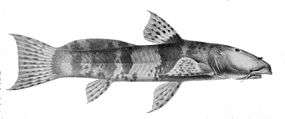
Astroblepus is a genus of fish in the family Astroblepidae found in South America and Panama. This genus is the only member of its family.[1] These catfishes are primarily found in torrential streams in the Andean area.[1] Astroblepus pholeter and A. riberae are troglobites adapted to living in subterranean water systems.[2] These species are typically small, less than 10 cm (0.33 ft).[1] The largest species reaches 30 cm (0.98 ft).[1] These fish have suckermouths like those of loricariids. They have two pairs of barbels, maxillary and nasal. The dorsal fin spine lacks a locking mechanism.[3] These fish also have odontodes, tiny teeth on their skin. All species exhibit a conical, pointy type on their fin rays like that found in other loricarioids; other species also exhibit a blunt type that is only found on their skin.[3]
Some of these fish are able to live in high altitude and climb the faces of waterfalls.[3] Their climbing ability comes from specially developed pelvic fins, as well as their suckermouths.[3] In their neotropical Andean habitat, dry and wet seasons are quite extreme, and odontodes may help in sensing food, mates and water flow, as well as help cling to surfaces.[3] They feed upon invertebrates, such as caterpillars and annelids.[3]
Species
There are currently 80 recognized species in this genus:
- Astroblepus acostai Ardila Rodríguez, 2011 [4]
- Astroblepus ardiladuartei Ardila Rodríguez, 2015 [5]
- Astroblepus ardilai Ardila Rodríguez, 2012 [6]
- Astroblepus bellezaensis Ardila Rodríguez, 2015 [5]
- Astroblepus boulengeri (Regan, 1904)
- Astroblepus brachycephalus (Günther, 1859)
- Astroblepus cacharas Ardila Rodríguez, 2011 [7]
- Astroblepus cajamarcaensis Ardila Rodríguez, 2013 [8]
- Astroblepus caquetae Fowler, 1943
- Astroblepus chapmani (C. H. Eigenmann, 1912)
- Astroblepus chimborazoi (Fowler, 1915)
- Astroblepus chinchaoensis Ardila Rodríguez, 2014 [9]
- Astroblepus chotae (Regan, 1904)
- Astroblepus cirratus (Regan, 1912)
- Astroblepus curitiensis Ardila Rodríguez, 2015 [10]
- Astroblepus cyclopus (Humboldt, 1805)
- Astroblepus eigenmanni (Regan, 1904)
- Astroblepus festae (Boulenger, 1898)
- Astroblepus fissidens (Regan, 1904)
- Astroblepus floridablancaensis Ardila Rodríguez, 2016 [11]
- Astroblepus floridaensis Ardila Rodríguez, 2013 [8]
- Astroblepus formosus Fowler, 1945
- Astroblepus frenatus C. H. Eigenmann, 1918
- Astroblepus grixalvii Humboldt, 1805
- Astroblepus guentheri (Boulenger, 1887)
- Astroblepus heterodon (Regan, 1908)
- Astroblepus hidalgoi Ardila Rodríguez, 2013 [8]
- Astroblepus homodon (Regan, 1904)
- Astroblepus huallagaensis Ardila Rodríguez, 2013 [8]
- Astroblepus itae Ardila Rodríguez, 2011 [4]
- Astroblepus jimenezae Ardila Rodríguez, 2013 [12]
- Astroblepus jurubidae Fowler, 1944
- Astroblepus labialis N. E. Pearson, 1937
- Astroblepus latidens C. H. Eigenmann, 1918
- Astroblepus longiceps N. E. Pearson, 1924
- Astroblepus longifilis (Steindachner, 1882)
- Astroblepus mancoi C. H. Eigenmann, 1928
- Astroblepus mariae (Fowler, 1919)
- Astroblepus marmoratus (Regan, 1904)
- Astroblepus martinezi Ardila Rodríguez, 2013 [12]
- Astroblepus mendezi Ardila Rodríguez, 2014 [13]
- Astroblepus micrescens C. H. Eigenmann, 1918
- Astroblepus mindoensis (Regan, 1916)
- Astroblepus mojicai Ardila Rodríguez, 2015 [5]
- Astroblepus moyanensis Ardila Rodríguez, 2014 [9]
- Astroblepus nettoferreirai Ardila Rodríguez, 2015 [5]
- Astroblepus nicefori G. S. Myers, 1932
- Astroblepus onzagaensis Ardila Rodríguez, 2015 [10]
- Astroblepus orientalis (Boulenger, 1903)
- Astroblepus ortegai Ardila Rodríguez, 2012 [14]
- Astroblepus peruanus (Steindachner, 1876)
- Astroblepus phelpsi L. P. Schultz, 1944
- Astroblepus pholeter Collette, 1962
- Astroblepus pirrensis (Meek & Hildebrand, 1913)
- Astroblepus pradai Ardila Rodríguez, 2015 [10]
- Astroblepus praeliorum W. R. Allen, 1942
- Astroblepus prenadillus (Valenciennes, 1840)
- Astroblepus putumayoensis Ardila Rodríguez, 2015 [5]
- Astroblepus quispei Ardila Rodríguez, 2012 [14]
- Astroblepus regani (Pellegrin, 1909)
- Astroblepus rengifoi Dahl, 1960
- Astroblepus retropinnus (Regan, 1908)
- Astroblepus riberae Cardona & Guerao, 1994
- Astroblepus rosei C. H. Eigenmann, 1922
- Astroblepus sabalo (Valenciennes, 1840)
- Astroblepus santanderensis C. H. Eigenmann, 1918
- Astroblepus simonsii (Regan, 1904)
- Astroblepus stuebeli (Wandolleck, 1916)
- Astroblepus supramollis N. E. Pearson, 1937
- Astroblepus taczanowskii (Boulenger, 1890)
- Astroblepus tamboensis Ardila Rodríguez, 2014 [9]
- Astroblepus theresiae (Steindachner, 1907)
- Astroblepus trifasciatus (C. H. Eigenmann, 1912)
- Astroblepus ubidiai (Pellegrin, 1931)
- Astroblepus unifasciatus (C. H. Eigenmann, 1912)
- Astroblepus vaillanti (Regan, 1904)
- Astroblepus vanceae (C. H. Eigenmann, 1913)
- Astroblepus ventralis (C. H. Eigenmann, 1912)
- Astroblepus verai Ardila Rodríguez, 2015 [10]
- Astroblepus whymperi (Boulenger, 1890)
References
- 1 2 3 4 Froese, Rainer, and Daniel Pauly, eds. (2016). Species of Astroblepus in FishBase. June 2016 version.
- ↑ Romero, A. (2001). The biology of hypogean fishes. Developments in Environmental Biology of Fishes. Springer Netherlands. p. 376. ISBN 978-1-4020-0076-8.
- 1 2 3 4 5 6 Schaefer, S.A. & Buitrago-Suárez, U.A. (2002): Odontode morphology and skin surface features of Andean astroblepid catfishes (Siluriformes, Astroblepidae). Journal of Morphology, 254 (2): 139–148.
- 1 2 Ardila Rodríguez, C.A. (2011): Astroblepus itae, Astroblepus acostai. Dos nuevas especies del Río Cáchira y Río Sinú, Colombia. Universidad Metropolitana de Barranquilla. Barranquilla, Colombia. 16 pp.
- 1 2 3 4 5 Ardila Rodríguez, C.A. (2015): Five new species of astroblepid fish for Colombian Andes. Revista de la Asociación Colombiana de Ciencias Biológicas, 27 (1): 124-135.
- ↑ Ardila Rodríguez, C.A. (2012): Astroblepus ardilai sp. nov. Una nuevas especie de pez del los Andes del Municipio de Floridablanca, Departamento de Norte de Santander – Colombia. Peces del Departamento de Santander – Colombia, 5: 1-21.
- ↑ Ardila Rodríguez, C.A. (2011): Astroblepus cacharas (Teleostei: Siluriformes: Astroblepidae), nueva especie del río Cáchira, cuenca del río Magdalena, Colombia. Dahlia, 11: 23–33.
- 1 2 3 4 Ardila Rodríguez, C.A. (2013): Astroblepus hidalgoi – A. floridaensis – A. huallagaensis y A. cajamarcaensis: Cuatro nuevas especies de los Andes del Peru. Universidad Metropolitana de Barranquilla. Barranquilla, Colombia. 22pp.
- 1 2 3 Ardila Rodríguez, C.A. (2014): Astroblepus tamboensis – A. chinchaoensis y A. moyanensis: Tres nuevas especies de los Andes del Peru. Universidad Metropolitana de Barranquilla. Barranquilla, Colombia. 22pp.
- 1 2 3 4 Ardila Rodríguez, C.A. (2015): Astroblepus verai sp. nov. – A. pradai, A. curitiensis y A. onzagaensis. Cuatro nuevas especies del Departamento de Santander – Colombia. Barranquilla, Departamento del Atlántico, 2015 (7): 1-24.
- ↑ Ardila Rodríguez, C.A. (2016): Astroblepus floridablancaensis sp. nov. una nueva Especie de Janbonero (Siluriformes: Astroblepidae) del Municipio de Floridablanca, Departamento de Santander – Colombia. Peces del Departamento de Santander – Colombia, 8: 1-20.
- 1 2 Ardila Rodríguez, C.A. (2013): Astroblepus martinezi y Astroblepus jimenezae: Dos nuevas especies del Río Sinú y Río Atrato, Colombia. Universidad Metropolitana de Barranquilla. Barranquilla, Colombia. 20pp.
- ↑ Ardila Rodríguez, C.A. (2014): Astroblepus mendezi sp. nov. una nueva especie de pez de Panamá. Universidad Metropolitana de Barranquilla. Barranquilla, Colombia. 17pp.
- 1 2 Ardila Rodríguez, C.A. (2012): Astroblepus ortegai y Astroblepus quispei. Dos nuevas especies des los Andes del Perú. Universidad Metropolitana de Barranquilla. Barranquilla, Colombia. 16 pp.