Baude Cordier
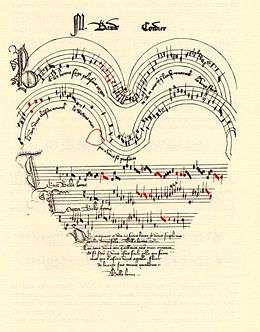
Baude Cordier (born c. 1380 in Rheims, died before 1440) was a French composer from Rheims; it has been suggested that Cordier was the nom de plume of Baude Fresnel.[1] Cordier's works are considered among the prime examples of ars subtilior. In line with that cultural trend, he was fond of using red note notation, also known as coloration, a technique stemming from the general practice of mensural notation. The change in color adjusts the rhythm of a particular note from its usual form. (This musical style and type of notation has also been termed "mannerism" and "mannered notation.")[2]
Ten of Cordier's secular pieces survive, most of which are rondeaux:
- some are in the rhythmically complex late fourteenth-century French style of ars subtilior, such as "Amans amés secretement" (Lovers, love discreetly).[3]
- others are simpler, with greater emphasis on lyrical melody, such as "Belle, Bonne, Sage", also transcribed in HAM, and characterized with "Amans" as a rondeau.
Two of the composer's chansons are in the Chantilly Manuscript and are well-known examples of eye music:
- the love song "Belle, Bonne, Sage" ("Beautiful, Good, Wise"). The manuscript is in the shape of a heart.[4][5]

- a circular canon "Tout par compas suy composés" ("With a compass was I composed")—more eye music, in which the manuscript is written in a circle.[6][7]
His mass movement in the Apt MS is in the later, simpler fifteenth-century style.
References
- ↑ Wright, Craig, "Tapissier and Cordier: New Documents and Conjectures", Quarterly, The Musical 59, no. 2 (April 1973): 177–89. References on 179–80, 186–89; Reaney, Gilbert, "Cordier, Baude" The New Grove Dictionary of Music and Musicians, ed. Stanley Sadie. London, Macmillan, 1980. (20 vol.) ISBN 1-56159-174-2
- ↑ See Parrish, Carl. The Notation of Medieval Music. W. W. Norton, 1957.)
- ↑ Transcribed with commentary in Archibald T. Davison and Willi Apel: Historical Anthology of Music (HAM): Oriental, Medieval and Renaissance Music (Harvard University Press)
- ↑ A modern transcription and music media file of "Belle, Bonne, Sage."
- ↑ The text and English translation of the song
- ↑ More details on text and performance and links to recorded performances of "Tout par compas
- ↑ Bergsagel, John. "Cordier's Circular Canon," The Musical Times, 113, No. 1558 (Dec., 1972), pp. 1175-1177
External links
- Free scores by Baude Cordier at the International Music Score Library Project
- Free scores by Baude Cordier in the Choral Public Domain Library (ChoralWiki)