Beechcraft Travel Air
| Model 95 Travel Air | |
|---|---|
 | |
| Tied down at EAA AirVenture 2008, Oshkosh, Wisconsin | |
| Role | Light twin aircraft |
| National origin | United States of America |
| Manufacturer | Beechcraft |
| First flight | 6 August 1956 [1] |
| Introduction | 1958 |
| Status | Out of production, in service |
| Produced | 1958–1968 |
| Number built | 720 |
| Unit cost |
$49,500 in 1959 |
| Developed from | Beechcraft Bonanza, Beechcraft Twin Bonanza, Beechcraft Mentor |
The Beechcraft Travel Air was a twin-engine development of the Beechcraft Bonanza. It was designed to fill the gap between the single engine Model 35 Bonanza and the much larger Model 50 Twin-Bonanza, and ultimately served as the basis for its replacement, the Beech Baron.[2]
Design and development
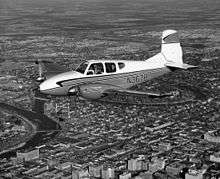
Designed as a competitor to the Cessna 310 and the Piper Apache, the Travel Air (developed as the Badger)[3] took many design features from previous Beechcraft airplanes.[4] It took its basic design from the Model 35 Bonanza,[5] fitted with the vertical stabilizer from the T-34 Mentor, and two four-cylinder engines. Its wing spar was borrowed from the large Model 50 Twin Bonanza, along with thicker gauge aluminum on the leading edge; landing gear systems had been taken from the United States Navy Mentor, which was a stronger structure built for training pilots for later aircraft carrier landings. Power came from, in the 1958 model year, two Lycoming O-360-A1A at 180 horsepower (130 kW) at 2700rpm each. With 75% power, the Travel Air was capable of 200mph at 7,500ft.[6]
Although developed and initially marketed as the Badger, a 1956 letter from the United States Air Force notified Beechcraft that the name had been previously chosen as a reporting name for the Soviet Tupolev Tu-16 bomber; therefore, Beechcraft elected to reuse the Travel Air name, which came from the predecessor company to Beechcraft, the Travel Air Manufacturing Company.[7] Beechcraft set in initial pricing of the Travel Air at $49,500; $10,450 below Cessna's 310 price, yet still $13,510 higher than Piper's Apache pricing.[7]
Variants
During its ten-year model run, between 1958 and 1968, the Travel Air saw four distinct variants emerge.
Model 95
The initial model was built for the 1958 and 1959 model years; the 1959 model had a fifth 'jumpseat' added. A total production of the 95 for 1958 and 1959 were 173 and 128, respectively.[2][8]
Model B95/B95A
Changes in the B95 version included a 19-inch (480 mm) cabin stretch to increase rear cabin area and the horizontal stabilizer and elevators were enlarged for better pitch control. A curved vertical stabilizer dorsal fairing is the most noticeable change. It also included a fifth seat, wider chord flaps, and an increased gross weight of 100 pounds. The 1961 Model B95A featured fuel injected Lycoming IO-360-B1A engines. A total 150 B95's were built in 1960, and 81 B95A's were built between 1961 and 1962 (serial numbers TD-453 through TD-533).[9] The 1960 model was priced at $51,500 and the 1961-62 model was priced at $49,500.[10]
Model D95A
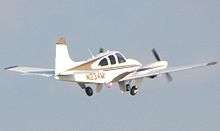
In 1963 the Travel Air featured a larger rear window that is common with the Model A55/B55 Barons. The nose cone was lengthened for improved baggage space. Interior features such as the instrument panel, and heaters were redesigned. A total of 174 D95's between 1963 and 1967.[2][11]
Model E95
The E95 featured a one piece, 'speed-slope' windshield and a more pointed spinner design. The interior design was fully re-done. A total of 14 Model E95's were built in 1968; with pricing of $53,500.[12] The production drop off was due to the more costly but faster and powerful Model 55 Baron (developed from the Model 95, and initially designated Model 95-55). .[2]
Specifications (D95A)
Data from Janes's All The World's Aircraft 1965-66 [13][14]
General characteristics
- Crew: one
- Capacity: four passengers
- Length: 25 ft 11 in (7.90 m)
- Wingspan: 37 ft 10 in (11.53 m)
- Height: 9 ft 6 in. (2.90 m)
- Wing area: 199.2 sq. ft. (18.50 m²)
- Empty weight: 2,555 lb (1,159 kg)
- Max. takeoff weight: 4,200 lb (1,905 kg)
- Powerplant: 2 × Lycoming IO-360-B1B air-cooled flat-four, 180 hp (134 kW) each
Performance
- Never exceed speed: 209 knots (240 mph, 386 km/h)
- Maximum speed: 183 knots (210 mph, 338 km/h) at sea level
- Cruise speed: 170 knots (195 mph, 314 km/h) (economy cruise (65% power, 2,450rpm) at 11,000 ft (3,350 m))
- Stall speed: 61 knots (70 mph, 113 km/h) (flaps 28 degrees, gear down, zero thrust)
- Range: 1,017 nmi (1,170 mi, 1,880 km)
- Service ceiling: 18,100 ft (5,500 m)
- Rate of climb: 1,250 ft/min (6.3 m/s)
- Wing loading: 21.1 lb/sq ft (103 kg/m²)
See also
- Related development
- Aircraft of comparable role, configuration and era
References
 |
Wikimedia Commons has media related to Beechcraft Travel Air. |
- Notes
- ↑ Taylor 1965, p.182.
- 1 2 3 4 Phillips, Edward H., : Beechcraft - Staggerwing to Starship, page 62–63
- ↑ "Beech Badger - Light Twin". Flying. New York, New York: Ziff-Davis. October 1956. Retrieved October 17, 2014.
- ↑ Ball 1994, p.viii.
- ↑ Jacobshagen, Norman (October 1957). "FLYING Check Pilot Report on the Beechcraft Travel Air". Flying. New York, New York: Ziff-Davis. Retrieved October 17, 2014.
- ↑ Ball 1994, p.2.
- 1 2 Ball 1994, p.x.
- ↑ Ball 1994, p.13.
- ↑ Ball 1994, p.17, 21, 25.
- ↑ Ball 1994, p.21, 25.
- ↑ Ball 1994, p.29, 45.
- ↑ Ball 1994, p.48.
- ↑ Taylor 1965, pp. 182–183.
- ↑ Ball 1994, p.30, 31.
- Bibliography
- Ball, Larry A: From Travel Air to Baron...How Beech Created a Classic, Ball Publications, 1994. ISBN 0-9641514-0-5
- Phillips, Edward H., : Beechcraft - Staggerwing to Starship, Flying Books, 1987. ISBN 0-911139-06-0.
- Taylor, John W. R. Jane's All The World's Aircraft 1965-66. London: Samson Low, Marston, 1965.