Benz(e)acephenanthrylene
 | |
| Names | |
|---|---|
| Other names
Benzo[b]fluoranthene; Benzo[e]fluoranthene; 2,3-Benzofluoranthrene; benzo[e]acephenanthrylene; B(b)F; 2,3-Benzofluoranthene; 4,5-Benzofluoranthene; 2,3-Benzfluoranthene; 3,4-Benzfluoranthene; 3,4-Benzofluoranthene; Benz[b]fluoranthene[1] | |
| Identifiers | |
| 205-99-2 [1] | |
| 3D model (Jmol) | [2]: Interactive image |
| ChemSpider | 8799 [2] |
| Properties | |
| C20H12 | |
| Molar mass | 252.32 g·mol−1 |
| Appearance | Off-white to tan powder[2] |
| Melting point | 166 °C (331 °F; 439 K)[2] |
| Except where otherwise noted, data are given for materials in their standard state (at 25 °C [77 °F], 100 kPa). | |
| Infobox references | |
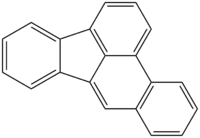
Benz[e]acephenanthrylene is an organic compound with the chemical formula C20H12. It is a polycyclic aromatic hydrocarbon (PAH) made of four benzene rings around a 5-membered ring.
On February 22, 2014, NASA announced a greatly upgraded database[3][4] for detecting and monitoring polycyclic aromatic hydrocarbons (PAHs), including benz[e]acephenanthrylene (as benzo[b]fluoranthene, a synonym), in the universe. According to NASA scientists, over 20% of the carbon in the universe may be associated with PAHs, possible starting materials for the formation of life.[3] PAHs seem to have been formed shortly after the Big Bang, are abundant in the universe,[5][6][7] and are associated with new stars and exoplanets.[3]
See also
References
- 1 2 3 4 5 Staff (2011). "Benz[e]acephenanthrylene". NIST. Retrieved March 5, 2014.
- 1 2 3 4 5 6 Staff (2014). "Benzo[e]acephenanthrylene". ChemSpider. Retrieved March 5, 2014.
- 1 2 3 Hoover, Rachel (February 21, 2014). "Need to Track Organic Nano-Particles Across the Universe? NASA's Got an App for That". NASA. Retrieved February 22, 2014.
- ↑ Staff (October 29, 2013). "PAH IR Spectral Database". NASA. Retrieved March 12, 2014.
- ↑ Carey, Bjorn (October 18, 2005). "Life's Building Blocks 'Abundant in Space'". Space.com. Retrieved March 3, 2014.
- ↑ Hudgins, Douglas M.; Bauschlicher Jr, Charles W.; Allamandola, L. J. (October 10, 2005). "Variations in the Peak Position of the 6.2 μm Interstellar Emission Feature: A Tracer of N in the Interstellar Polycyclic Aromatic Hydrocarbon Population". Astrophysical Journal. 632: 316–332. doi:10.1086/432495. Retrieved March 3, 2014.
- ↑ Allamandola, Louis; et al. (April 13, 2011). "Cosmic Distribution of Chemical Complexity". NASA. Retrieved March 3, 2014.
External links
- International Chemical Safety Card 0720
- National Pollutant Inventory - Polycyclic Aromatic Hydrocarbon Fact Sheet
This article is issued from Wikipedia - version of the 11/11/2016. The text is available under the Creative Commons Attribution/Share Alike but additional terms may apply for the media files.