Beonex Communicator
 | |
|
Beonex Communicator 0.6 displaying the Book of Mozilla | |
| Original author(s) | Ben Bucksch |
|---|---|
| Developer(s) | Beonex Business Services |
| Initial release | Never |
| Preview release |
0.8.2-stable
/ 21 March 2003 |
| Development status | discontinued |
| Written in | C++, XUL, XBL, JavaScript |
| Operating system | Microsoft Windows, Mac OS X, Linux, FreeBSD |
| Available in | English, German |
| Type | Internet suite |
| License | MPL/Netscape Public License[1] |
| Website |
www |
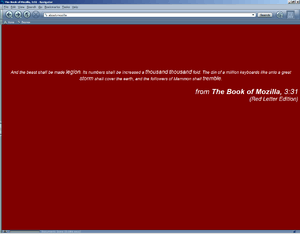
Beonex Communicator is a discontinued open-source Internet suite based on the Mozilla Application Suite (MAS) by Ben Bucksch, a German Mozilla developer.[2] It was intended to have a higher security and privacy level than other commercial products.[3][4][5] The Internet suite contains a Web browser, an email and news client, an HTML editor (based on Mozilla Composer) and an IRC client (based on ChatZilla).[4][5][6]
Beonex Business Services offered the suite for free and provided documentation, easy install routines for third-party plug-ins, and tried to sell support and customer-specific changes on the browser.[7][8] The main goal was to implement Kerberos, OpenPGP, and LDAP in Beonex,[9] but that was marked as failed in mid-2004.[10] It was discontinued before reaching production release stage.
History
Overall, this project seems most interested in staying as true to Mozilla as possible.[11]
Mozilla Organization stated that the Mozilla Application Suite was only for developers and testing purposes and was not meant for end users.[12][13][14][15]
On 5 January 2001 Beonex was included in the Linux distribution kmLinux version S-0.4, but was removed in version S-0.5 released on 23 March 2001.[16] Beonex 0.8 was released in June 2002 received positive reviews about its speed.[17][18]
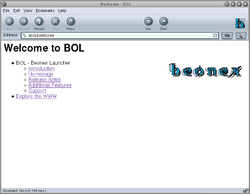
Beonex Launcher (BeOL, spoken B-O-L), was an additional upcoming product that never left alpha status; it was a stripped-down version of Beonex Communicator: a Web browser combined with an email client and a chat client.[19]
With a few preview releases of version 0.9 in mid-2002, Bucksch showed some new features he wanted to integrate, but before this version gained a stable status, he announced on 2 March 2004 that no new releases were planned until the Mozilla Foundation decided its future policy.[20] In 2005, the Mozilla Foundation officially changed its policies and created the Mozilla Corporation to provide end-user support.
Beonex Communicator 0.8.2-stable has several known security issues.[21] Beonex never received much market share.[13]
Comparison with Netscape and MAS
The browser does not transmit referrers by default and has the possibility to create a fake referrers.[22] The browser deletes all cookies upon exiting and disables several JavaScript functions which could have served as attack vectors.[5][23][24] Beonex also allows changing the user agent.[25]
In the following comparison table not all releases of Netscape and MAS are included. For a more complete table see Gecko (layout engine).
| Mozilla Application Suite | Netscape | Beonex Communicator | |
|---|---|---|---|
| Version | Release date | ||
| 0.6 | 6.0 | 0.6[26] | 14 November 2000 |
| 0.9.2 | 6.1 | ||
| 0.9.4 | 6.2 | ||
| 0.9.4.1 | 6.2.2 | 0.7[26] | 8 November 2001 |
| 1.0 | 0.8[27] | 5 June 2002 | |
| 1.0.1 | 7.0 | 0.8.1[28] | 19 September 2002 |
| 1.0.2 | 7.01 and 7.02 | 0.8.2[29] | 10 March 2003 |
| 1.1 | 0.9pre | 27 August 2002[26] | |
Differences from Netscape
In contrast with Netscape, Beonex has included nearly the same features except the proprietary parts like the integrated Net2Phone,[30] and the AOL Instant Messenger.[30] For online chatting, ChatZilla was integrated[31] and the sidebar and the search engines are also pre-configured.[2][18] Beonex is less resource-intensive than Netscape.[32]
Beonex includes a migration tool to import old profiles from Netscape Communicator.[5][18]
Differences from MAS
Beonex Communicator was not a fork of MAS; rather, it was a separate branch, so no significant changes were made.[33] HTML email and JavaScript are turned off by default and thus, it displays email only in plain text with bold and cursive additions[5][34] which were added later in MAS 1.1.[35] The search engines is compatible with the Mycroft project and is located in the sidebar providing more features.[36]
References
- ↑ Bucksch, Ben. "Legal notices". Beonex Communicator. Retrieved 28 January 2011.
- 1 2 "Mozilla-Entwickler mit eigener Browser-Distribution" (in German). Heinz Heise. 14 November 2000. Retrieved 29 January 2011.
- ↑ Huchler, Andreas (February 2001). "Frische Ware" (in German). LinuxUser. Retrieved 1 February 2011.
- 1 2 "Beonex". Kefk Network. 4 June 2002. Retrieved 1 February 2011.
- 1 2 3 4 5 D'Hollander, Peter (February 2004). "Alternative Browsers". Personal Computer Magazine (in Dutch): 96, 97. ISSN 0772-8077.
- ↑ "Beonex User Agent Strings". UserAgentString.Com. Retrieved 1 February 2011.
- ↑ "Vielversprechender Netscape 6 Konkurrent" (in German). Blindschleiche.de. 26 November 2000. Archived from the original on 16 October 2004. Retrieved 29 January 2011.
- ↑ Foster-Johnson, Eric (30 November 2003). "Just browsing, thanks". ComputerUser. IDG. Retrieved 4 April 2011.
- ↑ "Announcing Beonex". Mozillazine. Mozilla. 29 November 2000. Retrieved 29 January 2011.
- ↑ "Bug 124026 - Roaming - funding via Beonex". Mozilla. 24 May 2004. Retrieved 30 January 2011.
- ↑ "Beonex Communicator 0.6 Pre". Tucows. 30 November 2000. Archived from the original on 14 November 2002.
- ↑ "технологии – Mozilla празднует 10-летие" (in Russian). CyberSecurity.ru. 23 January 2008. Retrieved 30 January 2011.
- 1 2 Metzger, Holger. "Über Mozilla" (in German). Retrieved 30 January 2011.; shorten English version available here Archived 19 July 2011 at the Wayback Machine.
- ↑ Violka, Karsten (2002). "Zahmes Monster". C't (in German). Heinz Heise. 13: 218.
- ↑ Bager, Jo (2002). "Surfen ohne e - Mit Opera und Mozilla sicherer ins Netz". C't (in German). Heinz Heise. 25: 106.
- ↑ "Entwicklungsgeschichte". Schleswig-Holstein. 6 December 2004. Retrieved 1 February 2011.
- ↑ Kluge, Oliver (2002). "Jagdgesellschaft" (in German) (12). Linux-Magazin: 2. Archived from the original on 28 September 2011. Retrieved 29 January 2011.
- 1 2 3 Behrens, Fionn (2 December 2000). "Slimfast für Mozilla" (in German). Linux-Community.de. Archived from the original on 12 June 2002. Retrieved 29 January 2011.
- ↑ Bucksch, Ben. "BeOL". Beonex Communicator. Retrieved 7 February 2011.
- ↑ Kluge, Oliver (September 2005). "Soll der Fuchs ihn holen" (in German). 9. LinuxUser. Retrieved 7 February 2011.
- ↑ "Mozilla Browser Cross Domain Violation Vulnerability". Security Focus. 16 April 2003. Retrieved 29 January 2011.
- ↑ Schulzki-Haddouti, Christiane (31 January 2003). "Digitale Spuren - Surfer hinterlassen im Netz Spuren". Telepolis (in German). Heinz Heise. Retrieved 1 February 2011.
- ↑ "Beonex-Browser: Mozilla 1.0 mit mehr Sicherheitsfunktionen". Golem.de. 7 June 2002. Retrieved 30 January 2011.
- ↑ Huchler, Andreas (March 2001). "Tore zur WWWelt - Sieben aktuelle Web-Browser im Vergleich" (in German). 3. LinuxUser. Retrieved 8 February 2011.
- ↑ Лепихов, Константин (17 March 2004). Прыткая ящерица (in Russian). Computerra.ru.
- 1 2 3 Bucksch, Ben (12 March 2003). "News". Beonex Communicator. Retrieved 28 January 2011.
- ↑ "Open-Source-Browser Beonex Communicator in Version 0.8" (in German). Heinz Heise. 7 June 2002. Retrieved 5 April 2011.
- ↑ Bucksch, Ben. "0.8.1". Beonex Communicator. Retrieved 29 January 2011.
- ↑ Bucksch, Ben. "Release-notes". Beonex Communicator. Retrieved 29 January 2011.
- 1 2 "Zweiter Ableger vom Mozilla" (in German). GIGA Television. Archived from the original on 3 December 2002. Retrieved 29 January 2011.
- ↑ Behme, Henning (2001). "World Wide Web". iX (in German). Heinz Heise. 1: 26.
- ↑ "Netscape 6: Fett, aber schnell (Update)" (in German). Heinz Heise. 14 November 2000. Retrieved 29 January 2011.
- ↑ Bucksch, Ben. "We are accepting patches". Beonex Communicator. Retrieved 30 January 2011.
- ↑ Violka, Karsten (2002). "Nur-Text-Mails im Mozilla". C't (in German). Heinz Heise. 17: 188. Retrieved 7 February 2011.
- ↑ "Mozilla 1.1 Alpha ist da" (in German). Golem.de. 12 June 2002. Retrieved 7 March 2011.
- ↑ Krause, Ralph (1 March 2002). "Browser Comparison". Linux Journal. Retrieved 29 January 2011.
External links
| |||||||||||||||||||||||||||||
| |||||||||||||||||||||||||||||
| |||||||||||||||||||||||||||||
| |||||||||||||||||||||||||||||
| |||||||||||||||||||||||||||||


