Blue-green shan shui
The blue-green shan shui (simplified Chinese: 青绿山水; traditional Chinese: 青綠山水; Pinyin: Qīng-Lǜ Shān-Shuǐ.), is a Chinese painting style of "Shan shui". It tends to refer a "ancient style" rather than modern ones. The main colour of the painting are blues and greens, and in the early period it was painted by mineral dyes. It's a said this style was first formulated by Li Sixun (simplified Chinese: 李思训; traditional Chinese: 李思訓; Pinyin: Lǐ Sī-Xùn ),[1] a general, politician and famous painter in Tang Dynasty.[2]
History and sub-styles
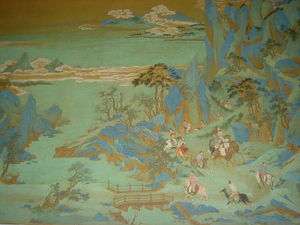
Similar styles were appeared before the Tang Dynasty, especially in the period of the Six Dynasties.[2] Many historic records show that Li father and sons - Li Sixun (father) and Li Zhaodao (son, Chinese: 李昭道; Pinyin: Lǐ Zhāo-Dào, son of Li Sixun), largely developed the painting techniques and formulated the style.[1]
There are mainly two styles of this painting:[2]
- Shibi Qingyuan (simplified Chinese:式笔青綠; traditional Chinese: 式筆青綠; Pinyin: Shì-Bǐ Qīng-Lǜ )
- Yibi Qingyuan (simplified Chinese:意笔青綠; traditional Chinese: 意笔青綠; Pinyin: Yì-bǐ Qīng-Lǜ)
Schools
- General blue-green shan shui.
Late Northern Song Dynasty:
- Bright green shan shui (Chinese: 金碧山水; Pinyin: Jīn-Bì Shān-Shuǐ)
- Great blue-green shan shui (simplified Chinese: 大青绿山水; traditional Chinese: 大青綠山水; Pinyin: Dà Qīng-Lǜ Shān-Shuǐ)
- Little blue-green shan shui (simplified Chinese: 小青绿山水; traditional Chinese: 小青綠山水; Pinyin: Xiǎo Qīng-Lǜ Shān-Shuǐ)
Yuan Dynasty, Ming Dynasty and Qing Dynasty:
- The little blue-green shan shui is the dominant style/school. Especially in the Late Ming Dynasty, the painter Lan Ying (Chinese: 蓝瑛; Pinyin: Lán Yīng) from Zhe School (Chinese: 浙派) developed the style to the historic climax.[2][3]
Quotations
ZHANG Geng (simplified Chinese: 张庚; traditional Chinese: 張庚; Pinyin: Zhāng Gēng) in Qing Dynasty, said:
| “ | 畫,繪事也,古來無不設色,且多青綠。(simplified Chinese: “画,绘事也,古来无不设色,且多青绿”. English translation: Painting, drawing events, in ancient time was all in colour, mostly in blue and green) | ” |
TANG Hou (simplified Chinese: 汤垕; traditional Chinese: 湯垕; Pinyin: Tāng Hòu) in Yuan Dynasty, said:
| “ | 李思訓著色山水,用金碧輝映,自爲一家法。(simplified Chinese: “李思训著色山水,用金碧辉映,自为一家法”. English translation: Li Sixun painted shan shui in colour, using bright shining blue and green, developed his own techniques and formed his own school.) | ” |
See also
References
- 1 2 "李思训 (Li Sixun (Tang Dynasty general, politician and painter))" (in Chinese). Baidu.com Chinese Encyclopedia. Retrieved January 1, 2010.
- 1 2 3 4 "青绿山水 (Blue-green Shan Shui)" (in Chinese). Baidu.com Chinese Encyclopedia. Retrieved January 1, 2010.
- ↑ "蓝瑛 (Lan Ying (painter))" (in Chinese). Baidu.com Chinese Encyclopedia. Retrieved January 1, 2010.