Bokbunja ju
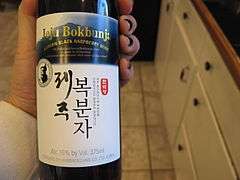
Bokbunja ju (hangul: 복분자주; hanja: 覆盆子酒; also spelled bokbunjaju, bokbunja-ju, or bokbunjajoo, and also called bokbunja wine) is a Korean fruit wine made from wild and/or cultivated Korean black raspberries called bokbunja (hangul: 복분자; hanja: 覆盆子; cultivated fruit is Rubus occidentalis ). It is produced in Gochang County, Jeollabuk-do, in Damyang, Jeollanam-do,[1] and in Jeju Island, South Korea.[2] It is made by fermenting berries with water.[3][4] Some varieties also contain rice and jicho herb.[5]
The wine is deep red in color and moderately sweet. It ranges between 15% and 19% alcohol by volume, depending on the brand.[6] It is believed to be healthful [7] and to promote male sexual stamina.[8]
Since 2008, South Korean scientists have searched for ways to utilize bokbunja seeds, which are a by-product of bokbunja ju production. The carbonized seeds can be used as potential adsorbent for industrial dye removal from wastewaters.[9]
References
- ↑ "Daenamugol Bokbunja-ju 16%". Chusungkoul.en.ecplaza.net. Retrieved 16 February 2015.
- ↑ Seoul. Books.google.com. Retrieved 24 January 2015.
- ↑ "Official Site of Korea Tourism Org.: Korean Traditional Liquor". English.visitkorea.or.kr. Retrieved 16 February 2015.
- ↑ "All sizes — BokBunJa: Korean black raspberry wine — Flickr — Photo Sharing!". Flickr.com. Retrieved 16 February 2015.
- ↑ "Jindo Bokbunja Hongju". Eckorea.ecplaza.net. Retrieved 16 February 2015.
- ↑
- ↑ "Official Site of Korea Tourism Org.: Korean Traditional Liquor". English.visitkorea.or.kr. Retrieved 24 January 2015.
- ↑ "Fermentation Filtrates of Rubus coreanus Relax the Corpus Cavernosum and Increase Sperm Count and Motility". Liebertonline.com. Retrieved 24 January 2015.
- ↑ Bokbunja Wine Industry Waste as Precursor Material for Carbonization and Its Utilization for the Removal of Procion Red MX-5B from Aqueous Solutions. Arthur Raj Binupriya, Muthuswany Sathishkumar, Sung Hun Jung, Sun Hwa Song and Soon-Il Yun, CLEAN – Soil, Air, Water, November 2008, Volume 36, Issue 10-11, pages 879–886, doi:10.1002/clen.200700202