Borwein's algorithm
In mathematics, Borwein's algorithm is an algorithm devised by Jonathan and Peter Borwein to calculate the value of 1/π. They devised several other algorithms. They published a book: Jonathon M. Borwein, Peter B. Borwein, Pi and the AGM – A Study in Analytic Number Theory and Computational Complexity, Wiley, New York, 1987. Many of their results are available in: Jorg Arndt, Christoph Haenel, Pi Unleashed, Springer, Berlin, 2001, ISBN 3-540-66572-2.
Jonathan Borwein and Peter Borwein's version (1993)
Start out by setting
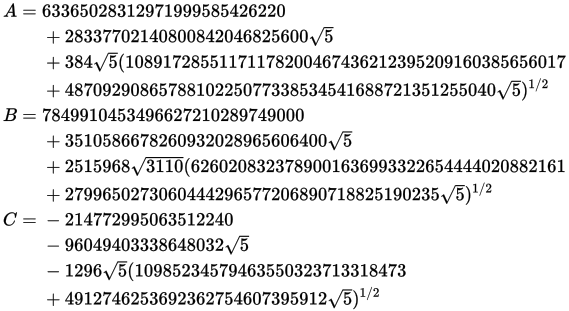
Then
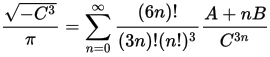
Each additional term of the series yields approximately 50 digits. This is an example of a Ramanujan–Sato series.
Cubic convergence (1991)
Start out by setting
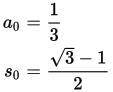
Then iterate
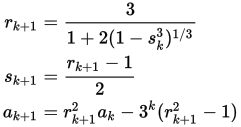
Then ak converges cubically to 1/π; that is, each iteration approximately triples the number of correct digits.
Another formula for π (1989)
Start out by setting

Then

Each additional term of the partial sum yields approximately 25 digits.
Quartic algorithm (1985)
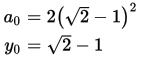
Start out by setting[1]
Then iterate
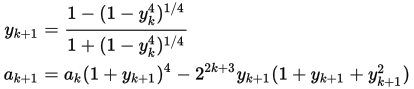
Then ak converges quartically against 1/π; that is, each iteration approximately quadruples the number of correct digits. The algorithm is not self-correcting; each iteration must be performed with the desired number of correct digits for π's final result.
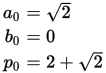
Quadratic convergence (1984)
Then iterate
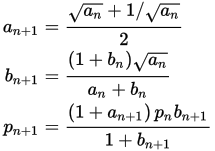
Then pk converges quadratically to π; that is, each iteration approximately doubles the number of correct digits. The algorithm is not self-correcting; each iteration must be performed with the desired number of correct digits for π's final result.
Quintic convergence
Start out by setting
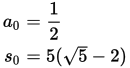
Then iterate
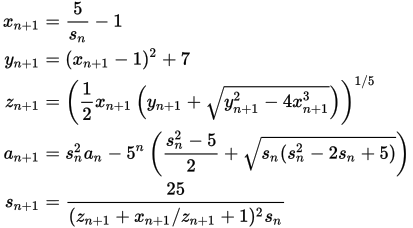
Then ak converges quintically to 1/π (that is, each iteration approximately quintuples the number of correct digits), and the following condition holds:

Nonic convergence
Start out by setting
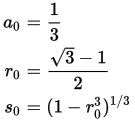
Then iterate
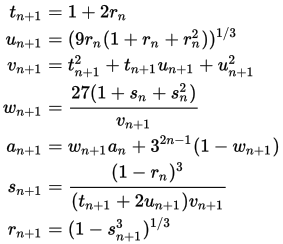
Then ak converges nonically to 1/π; that is, each iteration approximately multiplies the number of correct digits by nine.
See also
- Gauss–Legendre algorithm – another algorithm to calculate π
- Bailey–Borwein–Plouffe formula
References
- ↑ Mak, Ronald (2003). The Java Programmers Guide to Numerical Computation. Pearson Educational. p. 353. ISBN 0-13-046041-9.
- ↑ Arndt, Jörg; Haenel, Christoph (1998). π Unleashed. Springer-Verlag. p. 236. ISBN 3-540-66572-2.
- ↑ Template:Pi Unleashed
- ↑ http://www.cecm.sfu.ca/organics/papers/garvan/paper/html/node12.html
- Pi Formulas from Wolfram MathWorld