Bugula neritina
| Bugula neritina | |
|---|---|
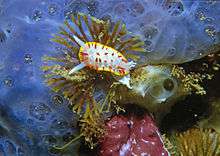 | |
| The nudibranch Diaphorodoris papillata Portmann & Sandmeier, 1960 feeding on Bugula neritina (Linnaeus, 1758) | |
| Scientific classification | |
| Kingdom: | Animalia |
| Phylum: | Bryozoa |
| Class: | Gymnolaemata |
| Order: | Cheilostomata |
| Family: | Bugulidae |
| Genus: | Bugula |
| Species: | B. neritina |
| Binomial name | |
| Bugula neritina (Linnaeus, 1758)[1] | |
| Synonyms[2] | |
|
Sertularia neritina Linnaeus, 1758 (basionym) | |
Bugula neritina (commonly known as brown bryozoan or common bugula) is a cryptic species complex of sessile marine animal in the Bugula genus. [2]
It is invasive with a cosmopolitan distribution.[1]
Bugula neritina is of interest from a drug discovery perspective because it produces the bryostatins, a group of around twenty bioactive natural products. The bryostatins are under investigation as possible therapies for cancer[3][4] and Alzheimer's disease.[4][5]
Bugula neritina is also of interest in materials science, where it is used as a model organism in biofouling studies.[6]
References
- 1 2 "Bugula neritina (brown bryozoan)". CABI (organisation). 3 May 2013. Retrieved 14 March 2015.
- 1 2 Gordon, D. (2015). Bugula neritina (Linnaeus, 1758). In: Bock, P.; Gordon, D. (2015) World List of Bryozoa. Accessed through: World Register of Marine Species at http://www.marinespecies.org/aphia.php?p=taxdetails&id=111158 on 2015-09-02
- ↑ Singh R, Sharma M, Joshi P, Rawat DS (2008). "Clinical status of anti-cancer agents derived from marine sources". Anticancer Agents Med Chem. 8 (6): 603–617. doi:10.2174/187152008785133074. PMID 18690825.
- 1 2 Ruan BF, Zhu HL (2012). "The chemistry and biology of the bryostatins: potential PKC inhibitors in clinical development". Curr Med Chem. 19 (16): 2652–64. doi:10.2174/092986712800493020. PMID 22506770.
- ↑ "Bryostatin – Phase II clinical testing of a non-toxic PKC activator". Blanchette Rockefeller Neurosciences Institute (West Virginia University). Retrieved 14 March 2015.
- ↑ Yua X, Yana Y, Gua JD (2007). "Attachment of the biofouling bryozoan Bugula neritina larvae affected by inorganic and organic chemical cues". Int Biodeterior Biodegradation. 60 (2): 81–89. doi:10.1016/j.ibiod.2006.12.003.
This article is issued from Wikipedia - version of the 9/17/2015. The text is available under the Creative Commons Attribution/Share Alike but additional terms may apply for the media files.