Bun'ei
This article is about the Japanese era. For the Ryukyuan king, see Bunei (Ryukyu).
| History of Japan |
|---|
 |
Bun'ei (文永) was a Japanese era name (年号, nengō,, lit. "year name") after Kōchō and before Kenji. This period spanned the years from February 1264 to April 1275.[1] The reigning emperor was Kameyama-tennō (亀山天皇).[2]
Change of era
- 1264 Bun'ei gannen (文永元年); 1264: The new era name was created to mark an event or a number of events. The previous era ended and a new one commenced in Kōchō 4.
Events of the Bun'ei era
- 1274 (Bun'ei 11, 1st month): In the 15th year of Kameyama-tennō 's reign (亀山天皇15年), the emperor abdicated; and the succession (senso) was received by his cousin.[3]
- 1274 (Bun'ei 11, 3rd month): Emperor Go-Uda is said to have acceded to the throne (sokui).[4] The retired Emperor Kameyama continued to exercise power as cloistered emperor.
- 1274 (Bun'ei 11, 10th month): Hirohito-shinnō was named Crown Prince and heir to his first cousin, the Daikakuji-tō Emperor Go-Uda. This was the result of political maeuvering by Hirohito's father, the Jimyōin-tō Emperor Go-Fukakusa.[5]
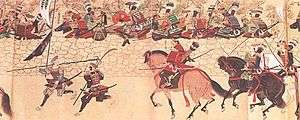
Japanese samurai defending the stone barrier -- from the narrative picture scroll Mōko Shūrai Ekotoba, which was painted between 1275 and 1293.
- November 19, 1274 (Bun'ei 11, 20th day of the 10th month): Battle of Bun'ei -- Kublai Khan's Mongol forces land at Hakata Bay near Fukuoka in Kyūshū. After landing and some armed skirmishes, the invaders withdraw to spend the night on shipboard. That night, a storm sinks several ships, and the fleet retreats to Korea rather than pressing their initial advantage.[6] In the course of the day's fighting, the Hakozaki Shrine was burned to the ground.[7] Nihon Ōdai Ichiran explains that the invaders were defeated because they lacked arrows.[8]
See also
- Mongol invasions of Japan
- Battle of Kōan - the second invasion attempt by Kublai Khan, in 1281.
Notes
- ↑ Nussbaum, Louis-Frédéric. (2005). "Bun'ei" in Japan Encyclopedia, p. 90, p. 90, at Google Books; n.b., Louis-Frédéric is pseudonym of Louis-Frédéric Nussbaum, see Deutsche Nationalbibliothek Authority File.
- ↑ Titsingh, Isaac. (1834). Annales des empereurs du Japon, pp. 253-261, p. 253, at Google Books; Varley, H. Paul. (1980). Jinnō Shōtōki. p. 232-233.
- ↑ Titsingh, p. 261, p. 261, at Google Books; Varley, p. 44; a distinct act of senso is unrecognized prior to Emperor Tenji; and all sovereigns except Jitō, Yōzei, Go-Toba, and Fushimi have senso and sokui in the same year until the reign of Emperor Go-Murakami.
- ↑ Titsingh, p. 262, p. 262, at Google Books; Varley, p. 44.
- ↑ Titsingh, p. 262, 270., p. 262, at Google Books
- ↑ Davis, Paul K. (2001). 100 Decisive Battles: From Ancient Times to the Present, p. 147.
- ↑ Turnbull, Stephen R. (2003). Genghis Khan & the Mongol Conquests 1190–1400, p. 66.
- ↑ Titsingh, p. 262, p. 262, at Google Books.
References
- Davis, Paul K. (1999). 100 Decisive Battles: From Ancient Times to the Present. Oxford: Oxford University Press. ISBN 978-0-19-514366-9; OCLC 0195143663
- Nussbaum, Louis-Frédéric and Käthe Roth. (2005). Japan encyclopedia. Cambridge: Harvard University Press. ISBN 978-0-674-01753-5; OCLC 58053128
- Titsingh, Isaac. (1834). Nihon Odai Ichiran; ou, Annales des empereurs du Japon. Paris: Royal Asiatic Society, Oriental Translation Fund of Great Britain and Ireland. OCLC 5850691
- Turnbull, Stephen R. (2003). Genghis Khan & the Mongol Conquests, 1190-1400. London: Routledge. ISBN 9780415968621; ISBN 9780203489505; OCLC 53948747
- Varley, H. Paul. (1980). A Chronicle of Gods and Sovereigns: Jinnō Shōtōki of Kitabatake Chikafusa. New York: Columbia University Press. ISBN 9780231049405; OCLC 6042764
External links
- National Diet Library, "The Japanese Calendar" -- historical overview plus illustrative images from library's collection
| Preceded by Kōchō |
Era or nengō Bun'ei 1264–1275 |
Succeeded by Kenji |
This article is issued from Wikipedia - version of the 11/10/2016. The text is available under the Creative Commons Attribution/Share Alike but additional terms may apply for the media files.