Myanmar nationality law
Myanmar nationality law currently recognises three categories of citizens, namely citizen, associate citizen and naturalised citizen, according to the 1982 Citizenship Law.[1][2] Citizens, as defined by the 1947 Constitution, are persons who belong to an "indigenous race", have a grandparent from an "indigenous race", are children of citizens, or lived in British Burma prior to 1942. Under this law, citizens are required to obtain a National Registration Card (နိုင်ငံသားစိစစ်ရေးကတ်ပြား, NRC), while non-citizens are given a Foreign Registration Card (နိုင်ငံခြားသားစိစစ်ရေးကတ်ပြား, FRC). Citizens whose parents hold FRCs are not allowed to run for public office.[3]
Myanmar has a stratified citizenship system (from the 1982 Citizenship Law), based on how one's forebears obtained it:
- Full citizens are descendants of residents who lived in Burma prior to 1823 or were born to parents who were citizens at the time of birth.
- Associate citizens are those who acquired citizenship through the 1948 Union Citizenship Law.
- Naturalized citizens are those who lived in Burma before 4 January 1948 and applied for citizenship after 1982.
Dual citizenship is not recognised by Myanmar. Naturalization in another country immediately voids Myanmar citizenship.
Foreigners cannot become naturalised citizens of Myanmar, unless they can prove a close familial connection to the country.[4]
Travel freedom
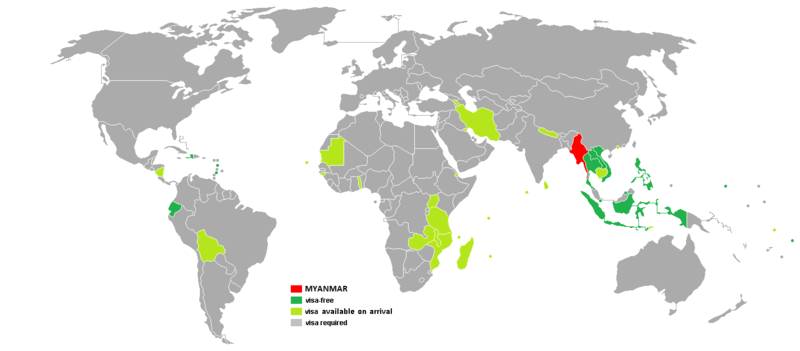
In 2016, Myanmar citizens had visa-free or visa on arrival access to 42 countries and territories, ranking the Myanmar passport 95th in the world according to the Visa Restrictions Index.
References
- ↑ Tun Tun Aung (March 2007). "An Introduction to Citizenship Card under Myanmar Citizenship Law" (PDF). 現代社會文化研究 (38): 265–290.
- ↑ "Burma Citizenship Law". Government of Burma. UNHCR. 15 October 1982. Retrieved 15 March 2012.
- ↑ Soe Than Lynn; Shwe Yinn Mar Oo (20 September 2010). "Citizenship criteria trips up election candidates". Myanmar Times. Retrieved 15 March 2012.
- ↑ "Myanmar Immigration Policies". eHow. Retrieved 15 March 2012.
| By continent |
| ||||||||||||||||||||||||||||||||||||
|---|---|---|---|---|---|---|---|---|---|---|---|---|---|---|---|---|---|---|---|---|---|---|---|---|---|---|---|---|---|---|---|---|---|---|---|---|---|
| By type | |||||||||||||||||||||||||||||||||||||
| Other | |||||||||||||||||||||||||||||||||||||
| Defunct | |||||||||||||||||||||||||||||||||||||
1 British Overseas Territories. 2 Open border with Schengen Area. 3 Russia is a transcontinental country in Eastern Europe and Northern Asia. The vast majority of its population (80%) lives in European Russia, therefore Russia as a whole is included as a European country here. 4 Turkey is a transcontinental country in the Middle East and Southeast Europe. Has a small part of its territory (3%) in Southeast Europe called Turkish Thrace. 5 Azerbaijan and Georgia (Abkhazia; South Ossetia) are transcontinental countries. Both have a small part of their territories in the European part of the Caucasus. 6 Kazakhstan is a transcontinental country. Has a small part of its territories located west of the Urals in Eastern Europe. 7 Armenia (Nagorno-Karabakh) and Cyprus (Northern Cyprus) are entirely in Southwest Asia but having socio-political connections with Europe. 8 Egypt is a transcontinental country in North Africa and the Middle East. Has a small part of its territory in the Middle East called Sinai peninsula. 9 Partially recognized.
| |||||||||||||||||||||||||||||||||||||
