Butterfly theorem

The butterfly theorem is a classical result in Euclidean geometry, which can be stated as follows:[1]:p. 78
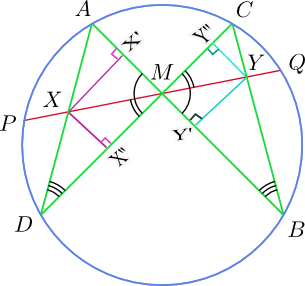
Let M be the midpoint of a chord PQ of a circle, through which two other chords AB and CD are drawn; AD and BC intersect chord PQ at X and Y correspondingly. Then M is the midpoint of XY.
Proof
A formal proof of the theorem is as follows: Let the perpendiculars XX′ and XX″ be dropped from the point X on the straight lines AM and DM respectively. Similarly, let YY′ and YY″ be dropped from the point Y perpendicular to the straight lines BM and CM respectively.
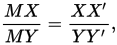
Now, since


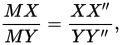

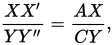

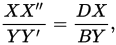
From the preceding equations, it can be easily seen that
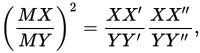
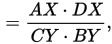
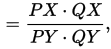

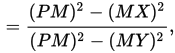
since PM = MQ.
Now,
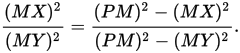
So, it can be concluded that MX = MY, or M is the midpoint of XY.
Other proofs exist,[2] including one using projective geometry.[3]
History
Proving the butterfly theorem was posed as a problem by William Wallace in The Gentlemen's Mathematical Companion (1803). Three solutions were published in 1804, and in 1805 Sir William Herschel posed the question again in a letter to Wallace. Rev. Thomas Scurr asked the same question again in 1814 in the Gentlemen's Diary or Mathematical Repository.[4]
References
- ↑ Johnson, Roger A., Advanced Euclidean Geometry, Dover Publ., 2007 (orig. 1929).
- ↑ Martin Celli, "A Proof of the Butterfly Theorem Using the Similarity Factor of the Two Wings", Forum Geometricorum 16, 2016, 337–338. http://forumgeom.fau.edu/FG2016volume16/FG201641.pdf
- ↑ , problem 8.
- ↑ William Wallace's 1803 Statement of the Butterfly Theorem, cut-the-knot, retrieved 2015-05-07.
External links
- The Butterfly Theorem at cut-the-knot
- A Better Butterfly Theorem at cut-the-knot
- Proof of Butterfly Theorem at PlanetMath
- The Butterfly Theorem by Jay Warendorff, the Wolfram Demonstrations Project.
- Weisstein, Eric W. "Butterfly Theorem". MathWorld.