CD160
| CD160 | |||||||||||||||||
|---|---|---|---|---|---|---|---|---|---|---|---|---|---|---|---|---|---|
| Identifiers | |||||||||||||||||
| Aliases | CD160, BY55, NK1, NK28, CD160 molecule | ||||||||||||||||
| External IDs | MGI: 1860383 HomoloGene: 5122 GeneCards: CD160 | ||||||||||||||||
| |||||||||||||||||
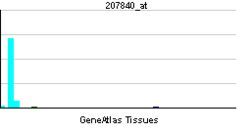
| RNA expression pattern | |||||||||||||||||
 | |||||||||||||||||
| More reference expression data | |||||||||||||||||
| Orthologs | |||||||||||||||||
| Species | Human | Mouse | |||||||||||||||
| Entrez | |||||||||||||||||
| Ensembl | |||||||||||||||||
| UniProt | |||||||||||||||||
| RefSeq (mRNA) | |||||||||||||||||
| RefSeq (protein) | |||||||||||||||||
| Location (UCSC) | Chr 1: 145.72 – 145.74 Mb | Chr 3: 96.8 – 96.83 Mb | |||||||||||||||
| PubMed search | [1] | [2] | |||||||||||||||
| Wikidata | |||||||||||||||||
| View/Edit Human | View/Edit Mouse |
CD160 antigen is a protein that in humans is encoded by the CD160 gene.[3][4][5]
CD160 is a 27 kDa glycoprotein which was initially identified with the monoclonal antibody BY55. Its expression is tightly associated with peripheral blood NK cells and CD8 T lymphocytes with cytolytic effector activity. The cDNA sequence of CD160 predicts a cysteine-rich, glycosylphosphatidylinositol-anchored protein of 181 amino acids with a single Ig-like domain weakly homologous to KIR2DL4 molecule. CD160 is expressed at the cell surface as a tightly disulfide-linked multimer. RNA blot analysis revealed CD160 mRNAs of 1.5 and 1.6 kb whose expression was highly restricted to circulating NK and T cells, spleen and small intestine. Within NK cells CD160 is expressed by CD56dimCD16+ cells whereas among circulating T cells its expression is mainly restricted to TCRgd bearing cells and to TCRab+CD8brightCD95+CD56+CD28-CD27-cells. In tissues, CD160 is expressed on all intestinal intraepithelial lymphocytes. CD160 shows a broad specificity for binding to both classical and nonclassical MHC class I molecules.[5]
Clinical significance
CD160 as a potential new target in cases of human pathological ocular and tumor neoangiogenesis that do not respond or become resistant to existing antiangiogenic drugs.
Related gene problems
See also
References
- ↑ "Human PubMed Reference:".
- ↑ "Mouse PubMed Reference:".
- ↑ Anumanthan A, Bensussan A, Boumsell L, Christ AD, Blumberg RS, Voss SD, Patel AT, Robertson MJ, Nadler LM, Freeman GJ (Oct 1998). "Cloning of BY55, a novel Ig superfamily member expressed on NK cells, CTL, and intestinal intraepithelial lymphocytes". J Immunol. 161 (6): 2780–90. PMID 9743336.
- ↑ Agrawal S, Marquet J, Freeman GJ, Tawab A, Bouteiller PL, Roth P, Bolton W, Ogg G, Boumsell L, Bensussan A (Apr 1999). "Cutting edge: MHC class I triggering by a novel cell surface ligand costimulates proliferation of activated human T cells". J Immunol. 162 (3): 1223–6. PMID 9973372.
- 1 2 "Entrez Gene: CD160 CD160 molecule".
- ↑ Klopocki E, Schulze H, Strauss G, et al. (February 2007). "Complex inheritance pattern resembling autosomal recessive inheritance involving a microdeletion in thrombocytopenia-absent radius syndrome". Am. J. Hum. Genet. 80 (2): 232–40. doi:10.1086/510919. PMC 1785342
 . PMID 17236129.
Further reading
- Bensussan A, Gluckman E, el Marsafy S, et al. (1994). "BY55 monoclonal antibody delineates within human cord blood and bone marrow lymphocytes distinct cell subsets mediating cytotoxic activity.". Proc. Natl. Acad. Sci. U.S.A. 91 (19): 9136–40. doi:10.1073/pnas.91.19.9136. PMC 44762. PMID 8090781.
- Nikolova M, Marie-Cardine A, Boumsell L, Bensussan A (2002). "BY55/CD160 acts as a co-receptor in TCR signal transduction of a human circulating cytotoxic effector T lymphocyte subset lacking CD28 expression.". Int. Immunol. 14 (5): 445–51. doi:10.1093/intimm/14.5.445. PMID 11978774.
- Strausberg RL, Feingold EA, Grouse LH, et al. (2003). "Generation and initial analysis of more than 15,000 full-length human and mouse cDNA sequences.". Proc. Natl. Acad. Sci. U.S.A. 99 (26): 16899–903. doi:10.1073/pnas.242603899. PMC 139241. PMID 12477932.
- Tanaka J, Toubai T, Tsutsumi Y, et al. (2004). "Cytolytic activity and regulatory functions of inhibitory NK cell receptor-expressing T cells expanded from granulocyte colony-stimulating factor-mobilized peripheral blood mononuclear cells.". Blood. 104 (3): 768–74. doi:10.1182/blood-2003-11-3870. PMID 15073036.
- Gerhard DS, Wagner L, Feingold EA, et al. (2004). "The status, quality, and expansion of the NIH full-length cDNA project: the Mammalian Gene Collection (MGC).". Genome Res. 14 (10B): 2121–7. doi:10.1101/gr.2596504. PMC 528928. PMID 15489334.
- Barakonyi A, Rabot M, Marie-Cardine A, et al. (2004). "Cutting edge: engagement of CD160 by its HLA-C physiological ligand triggers a unique cytokine profile secretion in the cytotoxic peripheral blood NK cell subset.". J. Immunol. 173 (9): 5349–54. doi:10.4049/jimmunol.173.9.5349. PMID 15494480.
- Abecassis S, Giustiniani J, Meyer N, et al. (2007). "Identification of a novel CD160+ CD4+ T-lymphocyte subset in the skin: a possible role for CD160 in skin inflammation.". J. Invest. Dermatol. 127 (5): 1161–6. doi:10.1038/sj.jid.5700680. PMID 17218942.
- Giustiniani J, Marie-Cardine A, Bensussan A (2007). "A soluble form of the MHC class I-specific CD160 receptor is released from human activated NK lymphocytes and inhibits cell-mediated cytotoxicity.". J. Immunol. 178 (3): 1293–300. doi:10.4049/jimmunol.178.3.1293. PMID 17237375.
External links
- CD160 Antigen at the US National Library of Medicine Medical Subject Headings (MeSH)
Skin Research Center lab Hopital St Louis, Paris (France) Dir. Dr. A. Bensussan