CXCL10
| View/Edit Human | View/Edit Mouse |
C-X-C motif chemokine 10 (CXCL10) also known as Interferon gamma-induced protein 10 (IP-10) or small-inducible cytokine B10 is an 8.7 kDa protein that in humans is encoded by the CXCL10 gene.[3][4] C-X-C motif chemokine 10 is a small cytokine belonging to the CXC chemokine family.
Gene
The gene for CXCL10 is located on human chromosome 4 in a cluster among several other CXC chemokines.[5]
Function
CXCL10 is secreted by several cell types in response to IFN-γ. These cell types include monocytes, endothelial cells and fibroblasts.[3] CXCL10 has been attributed to several roles, such as chemoattraction for monocytes/macrophages, T cells, NK cells, and dendritic cells, promotion of T cell adhesion to endothelial cells, antitumor activity, and inhibition of bone marrow colony formation and angiogenesis.[6][7]
This chemokine elicits its effects by binding to the cell surface chemokine receptor CXCR3.[8]
Structure
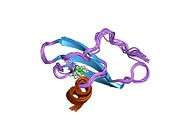
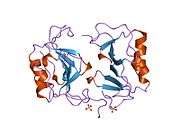
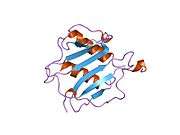
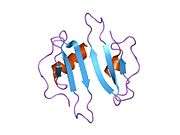
The three-dimensional crystal structure of this chemokine has been determined under 3 different conditions to a resolution of up to 1.92 Å.[9] The Protein Data Bank accession codes for the structures of CXCL10 are 1lv9, 1o7y, and 1o80.
Clinical significance
Baseline pre-treatment plasma levels of CXCL10 are elevated in patients chronically infected with hepatitis C virus (HCV) of genotypes 1 or 4 who do not achieve a sustained viral response (SVR) after completion of antiviral therapy.[10][11] CXCL10 in plasma is mirrored by intrahepatic CXCL10 mRNA, and both strikingly predict the first days of elimination of HCV RNA (“first phase decline”) during interferon/ribavirin therapy for all HCV genotypes.[12] This also applies for patients co-infected with HIV, where pre-treatment IP-10 levels below 150 pg/mL are predictive of a favorable response, and may thus be useful in encouraging these otherwise difficult-to-treat patients to initiate therapy.[13] CXCL10 is one of the 23 genes used in a qRT-PCR panel to diagnose melanoma (Myriad myPath® Melanoma).[12]
References
- ↑ "Human PubMed Reference:".
- ↑ "Mouse PubMed Reference:".
- 1 2 Luster AD, Unkeless JC, Ravetch JV (1985). "Gamma-interferon transcriptionally regulates an early-response gene containing homology to platelet proteins". Nature. 315 (6021): 672–6. doi:10.1038/315672a0. PMID 3925348.
- ↑ Luster AD, Jhanwar SC, Chaganti RS, Kersey JH, Ravetch JV (May 1987). "Interferon-inducible gene maps to a chromosomal band associated with a (4;11) translocation in acute leukemia cells". Proc. Natl. Acad. Sci. U.S.A. 84 (9): 2868–71. doi:10.1073/pnas.84.9.2868. PMC 304761
 . PMID 2437586.
 - ↑ O'Donovan N, Galvin M, Morgan JG (1999). "Physical mapping of the CXC chemokine locus on human chromosome 4". Cytogenet. Cell Genet. 84 (1–2): 39–42. doi:10.1159/000015209. PMID 10343098.
- ↑ Dufour JH, Dziejman M, Liu MT, Leung JH, Lane TE, Luster AD (April 2002). "IFN-gamma-inducible protein 10 (IP-10; CXCL10)-deficient mice reveal a role for IP-10 in effector T cell generation and trafficking". J. Immunol. 168 (7): 3195–204. PMID 11907072.
- ↑ Angiolillo AL, Sgadari C, Taub DD, Liao F, Farber JM, Maheshwari S, Kleinman HK, Reaman GH, Tosato G (July 1995). "Human interferon-inducible protein 10 is a potent inhibitor of angiogenesis in vivo". J. Exp. Med. 182 (1): 155–62. doi:10.1084/jem.182.1.155. PMC 2192108. PMID 7540647.
- ↑ Booth V, Keizer DW, Kamphuis MB, Clark-Lewis I, Sykes BD (August 2002). "The CXCR3 binding chemokine IP-10/CXCL10: structure and receptor interactions". Biochemistry. 41 (33): 10418–25. doi:10.1021/bi026020q. PMID 12173928.
- ↑ Swaminathan GJ, Holloway DE, Colvin RA, Campanella GK, Papageorgiou AC, Luster AD, Acharya KR (May 2003). "Crystal structures of oligomeric forms of the IP-10/CXCL10 chemokine". Structure. 11 (5): 521–32. doi:10.1016/S0969-2126(03)00070-4. PMID 12737818.
- ↑ Romero AI, Lagging M, Westin J, Dhillon AP, Dustin LB, Pawlotsky JM, Neumann AU, Ferrari C, Missale G, Haagmans BL, Schalm SW, Zeuzem S, Negro F, Verheij-Hart E, Hellstrand K (October 2006). "Interferon (IFN)-gamma-inducible protein-10: association with histological results, viral kinetics, and outcome during treatment with pegylated IFN-alpha 2a and ribavirin for chronic hepatitis C virus infection". J. Infect. Dis. 194 (7): 895–903. doi:10.1086/507307. PMID 16960776.
- ↑ Lagging M, Romero AI, Westin J, Norkrans G, Dhillon AP, Pawlotsky JM, Zeuzem S, von Wagner M, Negro F, Schalm SW, Haagmans BL, Ferrari C, Missale G, Neumann AU, Verheij-Hart E, Hellstrand K (December 2006). "IP-10 predicts viral response and therapeutic outcome in difficult-to-treat patients with HCV genotype 1 infection". Hepatology. 44 (6): 1617–25. doi:10.1002/hep.21407. PMID 17133471.
- ↑ Askarieh G, Alsiö A, Pugnale P, Negro F, Ferrari C, Neumann AU, Pawlotsky JM, Schalm SW, Zeuzem S, Norkrans G, Westin J, Söderholm J, Hellstrand K, Lagging M (May 2010). "Systemic and intrahepatic interferon-gamma-inducible protein 10 kDa predicts the first-phase decline in hepatitis C virus RNA and overall viral response to therapy in chronic hepatitis C". Hepatology. 51 (5): 1523–30. doi:10.1002/hep.23509. PMID 20186843.
- ↑ Falconer K, Askarieh G, Weis N, Hellstrand K, Alaeus A, Lagging M (July 2010). "IP-10 predicts the first phase decline of HCV RNA and overall viral response to therapy in patients co-infected with chronic hepatitis C virus infection and HIV". Scand J Infect Dis. 42 (11–12): 100824014139078. doi:10.3109/00365548.2010.498019. PMID 20608766.
Further reading
- Farber JM (1997). "Mig and IP-10: CXC chemokines that target lymphocytes". J. Leukoc. Biol. 61 (3): 246–57. PMID 9060447.
- Neville LF, Mathiak G, Bagasra O (1998). "The immunobiology of interferon-gamma inducible protein 10 kD (IP-10): a novel, pleiotropic member of the C-X-C chemokine superfamily". Cytokine Growth Factor Rev. 8 (3): 207–19. doi:10.1016/S1359-6101(97)00015-4. PMID 9462486.
PDB gallery | ||||||||||
|---|---|---|---|---|---|---|---|---|---|---|
| ||||||||||