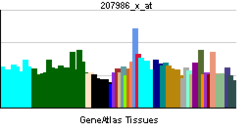
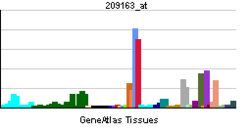
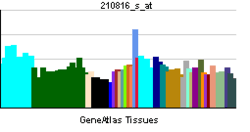
CYB561
Cytochrome b561 is a protein that in humans is encoded by the CYB561 gene.[3][4]
Model organisms
Model organisms have been used in the study of CYB561 function. A conditional knockout mouse line, called Cyb561tm1a(EUCOMM)Wtsi[11][12] was generated as part of the International Knockout Mouse Consortium program — a high-throughput mutagenesis project to generate and distribute animal models of disease to interested scientists.[13][14][15]
Male and female animals underwent a standardized phenotypic screen to determine the effects of deletion.[9][16] Twenty three tests were carried out on mutant mice and one significant abnormality was observed: female homozygotes displayed a decreased circulating glucose level after a glucose tolerance test.[9]
References
- ↑ "Human PubMed Reference:".
- ↑ "Mouse PubMed Reference:".
- ↑ McBride OW, Yi HF, Srivastava M (Nov 1994). "The human cytochrome b561 gene (CYB561) is located at 17q11-qter". Genomics. 21 (3): 662–3. doi:10.1006/geno.1994.1332. PMID 7959749.
- ↑ "Entrez Gene: CYB561 cytochrome b-561".
- ↑ "Dysmorphology data for Cyb561". Wellcome Trust Sanger Institute.
- ↑ "Glucose tolerance test data for Cyb561". Wellcome Trust Sanger Institute.
- ↑ "Salmonella infection data for Cyb561". Wellcome Trust Sanger Institute.
- ↑ "Citrobacter infection data for Cyb561". Wellcome Trust Sanger Institute.
- 1 2 3 Gerdin AK (2010). "The Sanger Mouse Genetics Programme: High throughput characterisation of knockout mice". Acta Ophthalmologica. 88: 925–7. doi:10.1111/j.1755-3768.2010.4142.x.
- ↑ Mouse Resources Portal, Wellcome Trust Sanger Institute.
- ↑ "International Knockout Mouse Consortium".
- ↑ "Mouse Genome Informatics".
- ↑ Skarnes, W. C.; Rosen, B.; West, A. P.; Koutsourakis, M.; Bushell, W.; Iyer, V.; Mujica, A. O.; Thomas, M.; Harrow, J.; Cox, T.; Jackson, D.; Severin, J.; Biggs, P.; Fu, J.; Nefedov, M.; De Jong, P. J.; Stewart, A. F.; Bradley, A. (2011). "A conditional knockout resource for the genome-wide study of mouse gene function". Nature. 474 (7351): 337–342. doi:10.1038/nature10163. PMC 3572410
 . PMID 21677750.
 - ↑ Dolgin E (2011). "Mouse library set to be knockout". Nature. 474 (7351): 262–3. doi:10.1038/474262a. PMID 21677718.
- ↑ Collins FS, Rossant J, Wurst W (2007). "A Mouse for All Reasons". Cell. 128 (1): 9–13. doi:10.1016/j.cell.2006.12.018. PMID 17218247.
- ↑ van der Weyden L, White JK, Adams DJ, Logan DW (2011). "The mouse genetics toolkit: revealing function and mechanism.". Genome Biol. 12 (6): 224. doi:10.1186/gb-2011-12-6-224. PMC 3218837. PMID 21722353.
Further reading
- Duong LT, Fleming PJ (1982). "Isolation and properties of cytochrome b561 from bovine adrenal chromaffin granules.". J. Biol. Chem. 257 (15): 8561–4. PMID 7096323.
- Srivastava M (1995). "Genomic structure and expression of the human gene encoding cytochrome b561, an integral protein of the chromaffin granule membrane.". J. Biol. Chem. 270 (39): 22714–20. doi:10.1074/jbc.270.39.22714. PMID 7559396.
- Srivastava M, Gibson KR, Pollard HB, Fleming PJ (1994). "Human cytochrome b561: a revised hypothesis for conformation in membranes which reconciles sequence and functional information". Biochem. J. 303 (Pt 3): 915–21. PMC 1137633. PMID 7980462.
- Strausberg RL, Feingold EA, Grouse LH, et al. (2003). "Generation and initial analysis of more than 15,000 full-length human and mouse cDNA sequences". Proc. Natl. Acad. Sci. U.S.A. 99 (26): 16899–903. doi:10.1073/pnas.242603899. PMC 139241. PMID 12477932.
- Bashtovyy D, Bérczi A, Asard H, Páli T (2004). "Structure prediction for the di-heme cytochrome b561 protein family". Protoplasma. 221 (1–2): 31–40. doi:10.1007/s00709-002-0065-0. PMID 12768339.
- Kang MK, Kameta A, Shin KH, et al. (2003). "Senescence-associated genes in normal human oral keratinocytes". Exp. Cell Res. 287 (2): 272–81. doi:10.1016/S0014-4827(03)00061-2. PMID 12837283.
- Vargas JD, Herpers B, McKie AT, et al. (2003). "Stromal cell-derived receptor 2 and cytochrome b561 are functional ferric reductases". Biochim. Biophys. Acta. 1651 (1–2): 116–23. doi:10.1016/S1570-9639(03)00242-5. PMID 14499595.
- Ota T, Suzuki Y, Nishikawa T, et al. (2004). "Complete sequencing and characterization of 21,243 full-length human cDNAs". Nat. Genet. 36 (1): 40–5. doi:10.1038/ng1285. PMID 14702039.
- Gerhard DS, Wagner L, Feingold EA, et al. (2004). "The Status, Quality, and Expansion of the NIH Full-Length cDNA Project: The Mammalian Gene Collection (MGC)". Genome Res. 14 (10B): 2121–7. doi:10.1101/gr.2596504. PMC 528928. PMID 15489334.