Cerithideopsis californica
| Cerithideopsis californica | |
|---|---|
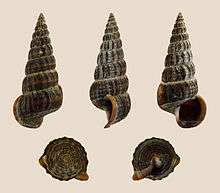 | |
| A shell of Cerithideopsis californica | |
| Scientific classification | |
| Kingdom: | Animalia |
| Phylum: | Mollusca |
| Class: | Gastropoda |
| (unranked): | clade Caenogastropoda clade Sorbeoconcha |
| Superfamily: | Cerithioidea |
| Family: | Potamididae |
| Genus: | Cerithideopsis |
| Species: | C. californica |
| Binomial name | |
| Cerithideopsis californica (Haldeman, 1840)[1] | |
| Synonyms | |
| |
Cerithideopsis californica, common name the California hornsnail[2] or the California horn snail,[3] is a species of sea snail, a marine gastropod mollusk in the family Potamididae.[4] This series was previously known as Cerithidea californica.
Distribution
The distribution of Cerithideopsis californica is from central California, USA to Baja California Sur, Mexico.[3]
The type locality is "California, in brackish water".[1]
Description
The shape of the shell is turriform and is about 1 inch (25 mm) in length.[1]
Ecology
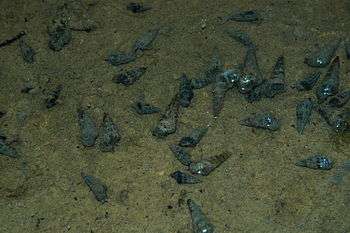
Cerithideopsis californica lives in salt-marsh dominated estuaries.[3]
The snails primarily feed on benthic diatoms.[3]
Throughout its range in California, these snails grow and reproduce from spring through fall (March–October) and cease growth and reproduction during the winter (November–February).[3] Maximum longevity for these snails is at least 6–10 years, and this appears to be the case for uninfected as well as infected snails.[3]
At least 18 trematode species parasitically castrate California horn snails.[3] A trematode infects a snail with a miracidium larva that either swims to infect the snail, or hatches after the snail ingests the trematode egg.[3] After infection, the trematode parthenitae clonally replicate and produce free-swimming offspring (cercariae).[3] These offspring infect second intermediate hosts (various invertebrates and fishes) where they form cysts (metacercariae).[3] The trematodes infect bird final hosts when birds eat second intermediate hosts.[3]
References
This article incorporates CC-BY-2.0 text from the reference[3]
- 1 2 3 Haldeman S. S. (1840). A monograph of the Limniades and other freshwater univalve shells of North America. number 1, Philadelphia, J. Dobson. an unnumbered page.
- ↑ "Cerithidea californica (Haldeman, 1840)". ITIS, accessed 10 February 2011.
- 1 2 3 4 5 6 7 8 9 10 11 12 Hechinger R. F. (2010). "Mortality affects adaptive allocation to growth and reproduction: field evidence from a guild of body snatchers". BMC Evolutionary Biology 10: 136. doi:10.1186/1471-2148-10-136.
- ↑ Bouchet, P. (2014). Cerithideopsis californica (Haldeman, 1840). Accessed through: World Register of Marine Species at http://www.marinespecies.org/aphia.php?p=taxdetails&id=758597 on 2014-03-20
Further reading
- Driscoll A. L. (1972). "Structure and function of the alimentary tract of Batillaria zonalis and Cerithidea californica: style-bearing mesogastropods". Veliger 14: 375-386.
- Lafferty K. D. (1993). "Effects of parasitic castration on growth, reproduction and population dynamics of the marine snail Cerithidea californica". Marine Ecology Progress Series 96: 229-237. doi:10.3354/meps096229.
- Lafferty K. D. (1993). "The marine snail, Cerithidea californica, matures at smaller sizes where parasitism is high". Oikos 68(1): 3-11. JSTOR.
- Martin W. E. (1972). "An annotated key to the cercariae that develop in the snail Cerithidea californica". Bulletin of the Southern California Academy of Sciences 71: 39-43.
- McCloy M. J. (1979). "Population regulation in the deposit feeding mesogastropod Cerithidea californica as it occurs in a San Diego salt marsh habitat". MS. University of California, San Diego.
- Race M. S. (1981). "Field ecology and natural history of Cerithidea californica (Gastropoda: Prosobranchia) in San Francisco Bay". Veliger 24: 18-27.
- Sousa W. P. (1983). "Host life history and the effect of parasitic castration on growth a field study of Cerithidea californica (Gastropoda: Prosobranchia) and its trematode parasites". Journal of Experimental Marine Biology and Ecology 73(3): 273-296. doi:10.1016/0022-0981(83)90051-5.
- Sousa W. P. (1993). "Size-dependent predation on the salt-marsh snail Cerithidea californica Haldeman". Journal of Experimental Marine Biology & Ecology 166: 19-37.
- Sousa W. P & Gleason M. (1989). "Does parasitic infection compromise host survival under extreme environmental conditions: the case for Cerithidea californica (Gastropoda: Prosobranchia)". Oecologia, Berlin 80: 456-464. doi:10.1007/BF00380066.
External links
 |
Wikimedia Commons has media related to Cerithideopsis californica. |