Calotes jerdoni
| Calotes jerdoni | |
|---|---|
 | |
| Scientific classification | |
| Kingdom: | Animalia |
| Phylum: | Chordata |
| Subphylum: | Vertebrata |
| Class: | Reptilia |
| Order: | Squamata |
| Suborder: | Iguania |
| Family: | Agamidae |
| Subfamily: | Draconinae |
| Genus: | Calotes |
| Species: | C. jerdoni |
| Binomial name | |
| Calotes jerdoni Günther, 1870[1] | |
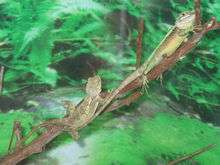
Calotes jerdoni, commonly known as the Indo-Chinese forest lizard, is a species of agamid lizard endemic to China and South Asia.
Etymology
The specific name, jerdoni, is in honor of British biologist Thomas C. Jerdon.[2]
Description/Identification
Physical Structure: A compressed bodied lizard. This species resembles Calotes maria in pholidostic and other characters except that 45-57 scales round the body; gular scales much larger than the ventral scales; there is an oblique curved fold covered with small granular scales in front of the shoulders; nuchal crest less prominent; the hind-limb reaches to the eye or not quite so far. [3] Dorsal and lateral scales directed upward.
Color Pattern: Deep-green dorsal coloration with yellow, orange or brown spots, [4] but in many cases can make the body into a dark brown within a few seconds.
Length: Maximum: 38.5 cm, [5] Common: 32 cm. (Snout to vent 9 cm.).
Maximum published weight: ? g.
Distribution
Bangladesh, Bhutan, China (W Yunnan, Xizang = Tibet), India (Khasi Hills in Assam & Shillong) and Myanmar.
Vernacular names
Bengali: সবুজ গিরিগিটি (Sabuj girigiti), সবুজ রক্তচোষা।
Bhutanese: ?
Burmese: ?
Chinese: ?
English: Green forest lizard, Green garden lizard, Indo-Chinese forest lizard and Jerdon's forest lizard.
Hindi & Assamese: ?
Habit & Habitat
Terrestrial & arboreal; diurnal; [6] found in many types of forested land. prefers dense and bushy hill forest. [7] A skilful and an adept climber, it moves over trees and bushes rather swiftly. It is active during the day time. [8]
Diet
Insectivorous; feeds largely on insects but at times bird-eggs, nestlings, and frogs too are eaten up. [9]
Reproduction
Oviparous; breeding season begins around April when males develop bright coloration in the forebody and begin to chase females. Female digs a small hollow in soft earth and lays 11-23 eggs in it for incubation and safety. [10]
Uses
No known practical uses. Play rolls in ecosystem by eating various types of insects and otherwise.
Threat to humans
Non-venomous and completely harmless to humans.
IUCN threat status
Not Evaluated (NE).
References
- ↑ Calotes jerdoni, The Reptile Database
- ↑ Beolens B, Watkins M, Grayson M. 2011. The Eponym Dictionary of Reptiles. Baltimore: Johns Hopkins University Press. xiii + 296 pp. ISBN 978-1-4214-0135-5. (Calotes jerdoni, p. 134).
- ↑ http://faunaofindia.nic.in/PDFVolumes/hpg/007/index.pdf
- ↑ Deep-green dorsal coloration with yellow, orange or brown spots (Click), but in many cases can make the body into a dark brown within a few seconds (Click).
- ↑ http://faunaofindia.nic.in/PDFVolumes/hpg/007/index.pdf
- ↑ http://faunaofindia.nic.in/PDFVolumes/hpg/007/index.pdf
- ↑ http://sikkim.nic.in/sikkimroot/html/reptiles.pdf
- ↑ http://sikkim.nic.in/sikkimroot/html/reptiles.pdf
- ↑ http://sikkim.nic.in/sikkimroot/html/reptiles.pdf
- ↑ http://sikkim.nic.in/sikkimroot/html/reptiles.pdf
Further reading
- Annandale, Nelson. 1905. Contributions to Oriental Herpetology. Suppl. II. Notes on the Oriental lizards in the Indian Museum, with a list of the species recorded from British India and Ceylon. J. Proc. Asiatic Soc. Bengal 1 (2): 81-93.
- Günther, Albert. 1870. Descriptions of a New Indian Lizard of the Genus Calotes. Proc. Zool. Soc. London 1870: 778-779 + Plate XLV. (Calotes jerdoni, new species).