Calotes mystaceus
| Indo-Chinese forest lizard | |
|---|---|
 | |
| Calotes mystaceus | |
| Scientific classification | |
| Kingdom: | Animalia |
| Phylum: | Chordata |
| Subphylum: | Vertebrata |
| Class: | Reptilia |
| Order: | Squamata |
| Suborder: | Iguania |
| Family: | Agamidae |
| Subfamily: | Draconinae |
| Genus: | Calotes |
| Species: | C. mystaceus |
| Binomial name | |
| Calotes mystaceus Duméril & Bibron, 1837[1] | |
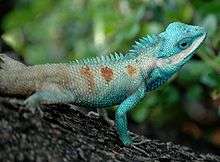
Calotes mystaceus, the Indo-Chinese forest lizard is an agamid lizard found in China, South Asia and Southeast Asia.[2]
Description/Identification

Physical Structure: Upper head-scales smooth or feebly keeled, imbricate, scarcely enlarged on supraorbital region; a few small spines on each side of the head above the tympanum; latter measuring at least half the diameter of the orbit. Gular sac small; gular scales feebly keeled, as large as dorsals. An oblique fold in front of the shoulder. Dorso-nuchal crest well developed in the male,composed of falciform spines directed backwards, the longest measuring the diameter of the orbit; it gradually decreases in height on the back, being reduced to a mere denticulation on the sacrum. 45-53 scales round the middle of the body; dorsal scales keeled, nearly twice as large as ventrals, all directed upwards and backwards; ventral scales strongly keeled. The adpressed hind limb reaches the tympanum or the posterior border of the orbit; fourth finger slightly longer than the third. Tail a little compressed, at the base with a slightly serrated upper ridge.
Color Pattern: Background color grey to olive, frequently with large transverse red spots on the back; lips yellowish.[3]
Length: Maximum: 42 cm., Common: 28 cm. (Snout to vent 9.5 cm.). [4]
Maximum published weight: ? g.
Distribution
Cambodia, China (Yunnan), India (Mizoram), Laos, Myanmar (Tenasserim to Mandalay = Mandale and Kachin State [26°00N, 97°30E]), Thailand (north of the Istmus of Kra), & Vietnam (South).[2] And possibly found in Bangladesh (Chittagong Hill tracts), adjacent to Mizoram province of India.
Vernacular names
Bengali: নীল-মাথা গিরিগিটি (Neel-matha girigiti), নীলা রক্তচোষা (proposed)।
Burmese: ပုတ္သင္ညိဳ (Pote Thin Nyo)
Chinese: 白唇树蜥
English: Blue-crested lizard, Indo-Chinese bloodsucker, Indo-Chinese forest lizard, White-lipped calotes.
Hindi & Mizo: ?
Khmer (Cambodian): ?
Lao: ?
Thai: Ging-ga Hua Si Fa, Ging-ga Suan.
Vietnamese: ?
Habitat
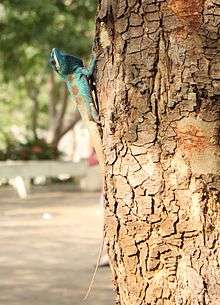
Terrestrial & arboreal; diurnal; naturally found in forest, but can be found in treed neighborhoods and city parks.
Diet
Feeds on crickets, grasshoppers, moths, and other insects.
Reproduction
Uses
No known practical uses. Plays an insectivorous role in its ecosystem.
Threat to humans
Non-venomous and harmless to humans. Can give a painful bite if handled, but is not dangerous.
IUCN threat status
Not Evaluated (NE).
References
- ↑ Duméril, A. M. C. and G. Bibron. 1837 Erpétologie Générale ou Histoire Naturelle Complete des Reptiles. Vol. 4. Libr. Encyclopédique Roret, Paris.
- 1 2 3 Calotes mystaceus at the Reptarium.cz Reptile Database. Accessed 22 July 2014.
- ↑ Boulenger, G. A. 1890. Fauna of British India. Reptilia and Batrachia.
- ↑ http://news.nationalgeographic.com/news/colorful-new-lizard-vietnam-animals-science/
- Hallermann, J. 2005 Mit Hörnern, Kämmen und Gleithäuten - die bizarren Baumagamen. Reptilia (Münster) 10 (1): 18-25
External links
- Calotes mystaceus at the Reptarium.cz Reptile Database
- http://itgmv1.fzk.de/www/itg/uetz/herp/photos/Calotes_mystaceus.jpg
