Candelariella vitellina
| Candelariella vitellina | |
|---|---|
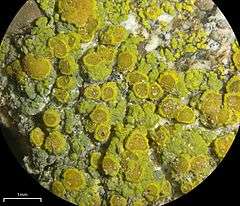 | |
| Candelariella vitellina on granite, magnification 30x | |
| Scientific classification | |
| Kingdom: | Fungi |
| Division: | Ascomycota |
| Class: | Lecanoromycetes |
| Order: | Candelariales |
| Family: | Candelariaceae |
| Genus: | Candelariella |
| Species: | C. vitellina |
| Binomial name | |
| Candelariella vitellina (Ehrh.) Müll.Arg. (1894) | |
| Synonyms | |
| |
Candelariella vitellina is a common and widespread green-yellow to orange-yellow crustose areolate lichen that grows on rock, wood, and bark, all over the world.[1] It grows on non-calcareous rock, wood, and bark.[1] It often has tiny lobate areoles in the shape of lion claws.[1] The areoles may be flat or convex.[1] Its sexual reproduction structures (apothecia) are a 0.35–1.0 mm-wide disc, darker yellow than the thallus, rimmed with thallus-like tissue lecanorine, flat but becoming convex with age.[1] Lichen spot tests are K+ reddish, KC-, and C-.[1] It produces calycin, pulvinic acid, pulvinic dilactone and vulpinic acid as secondary metabolites.[1]
In California, it prefers growing on granite, but can also be found on wood (rarely on bark) and other kinds of rock.[2]:251
Candelariella vitellina looks like a miniature version of C. rosulans.[1] It can be distinguished by C. vitanela having a visible exciple (the rim around the apothecia disc), which C. rosulans does not have.[1] It is usually much larger and thicker than the similar C. lutella.[1]
References
External links
 |
Wikimedia Commons has media related to Candelariella vitellina. |