Cape longclaw
| Cape longclaw | |
|---|---|
 | |
| Scientific classification | |
| Kingdom: | Animalia |
| Phylum: | Chordata |
| Class: | Aves |
| Order: | Passeriformes |
| Family: | Motacillidae |
| Genus: | Macronyx |
| Species: | M. capensis |
| Binomial name | |
| Macronyx capensis (Linnaeus, 1766) | |
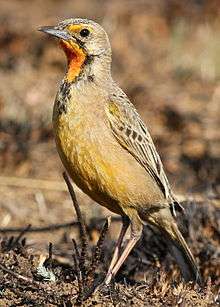
The Cape longclaw or orange-throated longclaw (Macronyx capensis) is a passerine bird in the family Motacillidae, which comprises the longclaws, pipits and wagtails.[2] It occurs in Southern Africa in Zimbabwe and southern and eastern South Africa. This species is found in coastal and mountain grassland, often near water.[2]
The Cape longclaw is a 19–20 cm long.[2] The adult male has a grey head with a buff supercilium and a streaked blackish back. It has a bright orange gorget, black breast band and otherwise yellow underparts. The female is duller, having a yellow throat and much weaker breast band. The juvenile has a dirty yellow throat, indistinct breast band, and yellowish white underparts.[2]
The Cape longclaw is usually found in pairs throughout the year. It feeds on the ground on insects and some seeds. The song is a musical cheewit cheewit, the contact call is tsweet, and there is also a mewling alarm call. Typically not found in larger groups than two, a breeding pair or more often singly.[2] Another behavioural characteristic is the tendency of birds to stand on top of stones, anthills or large grass clumps. While doing so birds stand upright with their breast extended.[2]
This species has a striking resemblance to the unrelated icterid meadowlarks, grassland birds of the Americas. This is presumably due to convergent evolution.
References
- ↑ BirdLife International (2012). "Macronyx capensis". IUCN Red List of Threatened Species. Version 2013.2. International Union for Conservation of Nature. Retrieved 26 November 2013.
- 1 2 3 4 5 6 Newman, Vanessa (2010). Newman's Birds of Southern Africa. Cape Town, South Africa: Pippa Parker. p. 328. ISBN 9781770078765.
- Sinclair, Hockey and Tarboton, SASOL Birds of Southern Africa, ISBN 1-86872-721-1
External links
- Cape/Orangethroated Longclaw - Species text in The Atlas of Southern African Birds.