Carex eburnea
| Carex eburnea | |
|---|---|
 | |
| A drawing from a flora in 1913 | |
| Scientific classification | |
| Kingdom: | Plantae |
| (unranked): | Angiosperms |
| (unranked): | Monocots |
| (unranked): | Commelinids |
| Order: | Poales |
| Family: | Cyperaceae |
| Genus: | Carex |
| Species: | C. eburnea |
| Binomial name | |
| Carex eburnea Boott | |
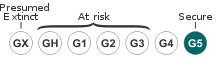
Carex eburnea (ivory sedge[1] or bristleleaf sedge)[2][3] is a small and slender sedge native to North America.
Description
The leaves are only 0.2 to 1 mm (0.008 to 0.039 in) wide and 3 to 21 cm (1 to 8 in) long.[4] The flowering stems (culms) are longer than the leaves, up to 12 inches (30 cm) tall.[1] There are 3 to 10 perigynia (pistils) per spike. Pollinated perigynia produce seeds (achenes) that are glossy blackish-brown when ripe.[5]
Ecology
Ivory sedge usually grows in coniferous or mixed woodlands, sometimes in fens, stable dunes, or alvar (shallow soil above limestone).[4] It prefers sandy or gravelly soil with a neutral to alkaline pH.[1]
References
- 1 2 3 Katy Chayka (2016). "Carex eburnea (Ivory Sedge)". MinnesotaWildflowers.info.
- ↑ "Carex eburnea". Natural Resources Conservation Service PLANTS Database. USDA. Retrieved 26 August 2016.
- ↑ "Carex eburnea". Native Plant Identification Network (NPIN). Lady Bird Johnson Wildflower Center, University of Texas at Austin. Retrieved 26 August 2016.
- 1 2 Ball, Peter W.; Reznicek, A. A. "Carex eburnea". Flora of North America (FNA). Missouri Botanical Garden – via eFloras.org.
- ↑ "Carex eburnea (bristle-leaved sedge)". Go Botany. New England Wild Flower Society. 2011–2016.
External links
-
 Data related to Carex eburnea at Wikispecies
 -
 Media related to Carex eburnea at Wikimedia Commons
 - Carex eburnea in the CalPhotos Photo Database, University of California, Berkeley
This article is issued from Wikipedia - version of the 11/12/2016. The text is available under the Creative Commons Attribution/Share Alike but additional terms may apply for the media files.