Carleman's inequality
Carleman's inequality is an inequality in mathematics, named after Torsten Carleman, who proved it in 1923[1] and used it to prove the Denjoy–Carleman theorem on quasi-analytic classes.[2][3]
Statement
Let a1, a2, a3, ... be a sequence of non-negative real numbers, then
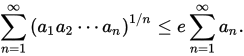
The constant e in the inequality is optimal, that is, the inequality does not always hold if e is replaced by a smaller number. The inequality is strict (it holds with "<" instead of "≤") if some element in the sequence is non-zero.
Integral version
Carleman's inequality has an integral version, which states that

for any f ≥ 0.
Carleson's inequality
A generalisation, due to Lennart Carleson, states the following:[4]
for any convex function g with g(0) = 0, and for any -1 < p < ∞,

Carleman's inequality follows from the case p = 0.
Proof
An elementary proof is sketched below. From the inequality of arithmetic and geometric means applied to the numbers


where MG stands for geometric mean, and MA — for arithmetic mean. The Stirling-type inequality applied to implies


- for all


Therefore,

whence

proving the inequality. Moreover, the inequality of arithmetic and geometric means of non-negative numbers is known to be an equality if and only if all the numbers coincide, that is, in the present case, if and only if for . As a consequence, Carleman's inequality is never an equality for a convergent series, unless all vanish, just because the harmonic series is divergent.


One can also prove Carleman's inequality by starting with Hardy's inequality

for the non-negative numbers a1,a2,... and p > 1, replacing each an with a1/p
n, and letting p → ∞.
Notes
- ↑ T. Carleman, Sur les fonctions quasi-analytiques, Conférences faites au cinquième congres des mathématiciens Scandinaves, Helsinki (1923), 181-196.
- ↑ Duncan, John; McGregor, Colin M. (2003). "Carleman's inequality". Amer. Math. Monthly. 110 (5): 424–431. doi:10.2307/3647829. MR 2040885.
- ↑ Pečarić, Josip; Stolarsky, Kenneth B. (2001). "Carleman's inequality: history and new generalizations". Aequationes Math. 61 (1–2): 49–62. doi:10.1007/s000100050160. MR 1820809.
- ↑ Carleson, L. (1954). "A proof of an inequality of Carleman" (PDF). Proc. Amer. Math. Soc. 5: 932–933. doi:10.1090/s0002-9939-1954-0065601-3.
References
- Hardy, G. H.; Littlewood J.E.; Pólya, G. (1952). Inequalities, 2nd ed. Cambridge University Press. ISBN 0-521-35880-9.
- Rassias, Thermistocles M., editor (2000). Survey on classical inequalities. Kluwer Academic. ISBN 0-7923-6483-X.
- Hörmander, Lars (1990). The analysis of linear partial differential operators I: distribution theory and Fourier analysis, 2nd ed. Springer. ISBN 3-540-52343-X.
External links
- Hazewinkel, Michiel, ed. (2001), "Carleman inequality", Encyclopedia of Mathematics, Springer, ISBN 978-1-55608-010-4