Carpolestes
| Carpolestes Temporal range: late Paleocene[1] | |
|---|---|
 | |
| Carpolestes simpsoni | |
| Scientific classification | |
| Kingdom: | Animalia |
| Phylum: | Chordata |
| Class: | Mammalia |
| Order: | †Plesiadapiformes |
| Superfamily: | †Carpolestoidea |
| Family: | †Carpolestidae |
| Genus: | †Carpolestes Simpson, 1928 |
| Type species | |
| †Carpolestes nigridens | |
| Paleospecies[1] | |
|
†C. dubius Jepsen, 1930 | |
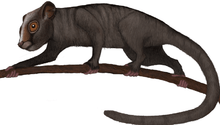
Carpolestes is a genus of extinct primate-like mammals from the late Paleocene of North America. It first existed around 58 million years ago. The three species of Carpolestes appear to form a lineage, with the earliest occurring species, C. dubius, ancestral to the type species, C. nigridens, which, in turn, was ancestral to the most recently occurring species, C. simpsoni.[1] It had flattened fingernails on its feet but with claws on its fingers.[2] Morphologically it supports Robert Sussman´s theory[3] of the co-evolution of tropical fruiting Angiosperms and early primates where Angiosperms provide nectar and fruits in return for dispersing the seed for tropical rainforest plans. It appears to have been a distant relative of the Plesiadapiforms such as Plesiadapis.
References
- 1 2 3 Bloch, J.I., D.C. Fisher,K.D. Rose,and P.D. Gingerich (2001). "Stratocladistic analysis of Paleocene Carpolestidae (Mammalia, Plesiadapiformes) with description of a new late Tiffanian genus". Journal of Vertebrate Paleontology. 21 (1): 119–131. doi:10.1671/0272-4634(2001)021[0119:SAOPCM]2.0.CO;2.
- ↑ Helen Pilcher "Flower CHild" in New Scientist, The Collection, The Human Story (2014)
- ↑ Sussman, Robert “Primate rigins and te Evotion of Angiosperms” in American Journal of Primatology Vol 23, No.4 (1991) pp209-223