Castilla (plant)
| Castilla | |
|---|---|
 | |
| Castilla elastica | |
| Scientific classification | |
| Kingdom: | Plantae |
| (unranked): | Angiosperms |
| (unranked): | Eudicots |
| (unranked): | Rosids |
| Order: | Rosales |
| Family: | Moraceae |
| Tribe: | Castilleae |
| Genus: | Castilla Cerv. |
| Species | |
|
See text | |
| Synonyms | |
|
Castilloa (lapsus) | |
Castilla (sometimes incorrectly spelled Castilloa) is a genus of 3 species of large trees in the flowering plant family Moraceae. The genus is native to Central and South America.[1]
Etymology
This genus is named after Juan Diego del Castillo (d. 1793), a Spanish botanist who was a friend of Vicente Cervantes, who chose the name in his friend's honor.[2][3]
Description
Castilla species are monoecious or dioecious trees up to 40 meters tall, with butressed trunks and abundant white latex of commercial value.[1] The branchlets have scars left by the fallen stipules. The leaves are oblong to elliptic, with entire margins.[1][4] The inflorescences are surrounded by bracts and have small flowers. The male flowers are borne in lengthwise-folded kidney-shaped inflorescences and female flowers in globose inflorescences.[1][4] The infrutescence varies in shape and has orange or red fruits.[1]
Ecology
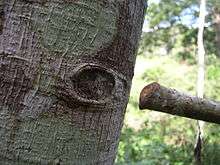
Castilla species exhibit a phenomenon known as cladoptosis, the regular shedding of branches. This may be an adaptation to prevent the growth of climbing plants.[5]
Castilla elastica is a weedy tree which has become invasive in areas where it has been introduced, such as in Tanzania and the South Pacific.[4][6]
Uses
The main species is Castilla elastica, one of several plants from which rubber has been extracted. The vernacular name is Panama rubber tree or castilloa rubber. The pre-Columbian MesoAmericans used the latex of this plant to make a ball used in a ceremonial game.
Species
- Castilla elastica Sessé (Panama rubber tree, Castilloa rubber, palo de hule, olicuáhuitl)
- Castilla tunu Hemsl.
- Castilla ulei Warb. (Caucho rubber)
See also
References
- 1 2 3 4 5 Cardona–Peña, Victor; Fuentes, Alfredo; Cayola, Leslie (2005). "Las moráceas de la región de Madidi, Bolivia" (PDF). Ecología en Bolivia (in Spanish). Retrieved 23 May 2016.
- ↑ González, J. "Explicación Etimológica de las Plantas de La Selva" (PDF). Flórula Digital de la Estación Biológica La Selva (in Spanish). Retrieved 23 May 2016.
- ↑ Loadman, John (2005). Tears of the Tree: The Story of Rubber –a Modern Marvel. Oxford University Press. p. 25. ISBN 9780198568407.
- 1 2 3 "Castilla elastica (PIER species info)". www.hear.org. Retrieved 2016-05-23.
- ↑ Berg, C.C. (1977). "Castilleae, a tribe of the Moraceae, renamed and redefined due to the exclusion of the type genus Olmedia from the Olmedieae". Acta Botanica Neerlandica: 75. Retrieved 23 May 2016.
- ↑ "Castilla elastica (Panama Rubber Tree)". BioNET-EAFRINET Keys and Fact Sheets. BioNET-EAFRINET. Retrieved 23 May 2016.
 |
Wikimedia Commons has media related to Castilla. |