Cat state
In quantum computing, the cat state, named after Schrödinger's cat,[1] is the special pure quantum state where the qubits are in an equal superposition of all being |0> and all being |1>, i.e. (in bra–ket notation): |00⋯0> + |11⋯1>.
In other quantum mechanics contexts, according to The New York Times for example, physicists view the cat state as composed of two diametrically opposed conditions at the same time,[2] such as the possibilities that a horse can have two hooves in a bay and two out be at the same time. This is sometimes connected to the many worlds hypothesis by proponents of the many worlds interpretation of quantum mechanics. More prosaically, a cat state might be the possibilities that six atoms be spin up and spin down, as published by a team led by David Wineland at NIST, December 1, 2005.[3] Large cat states have also been experimentally created using photons by a team led by Jian-Wei Pan at University of Science and Technology of China, for instance, four-photon entanglement,[4] five-photon entanglement,[5] six-photon entanglement,[6] eight-photon entanglement,[7] and five-photon ten-qubit cat state.[8] This spin up/down formulation was proposed by David Bohm, who conceived of spin as an observable in a version of thought experiments formulated in the 1935 EPR paradox.[9]
In quantum optics

In quantum optics, a cat state is defined as the coherent superposition of two coherent states with opposite phase:
- ,

where
- ,

and
- ,
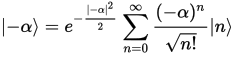
are coherent states defined in the number (Fock) basis. Notice that if we add the two states together, the resulting cat state only contains even Fock state terms
- .

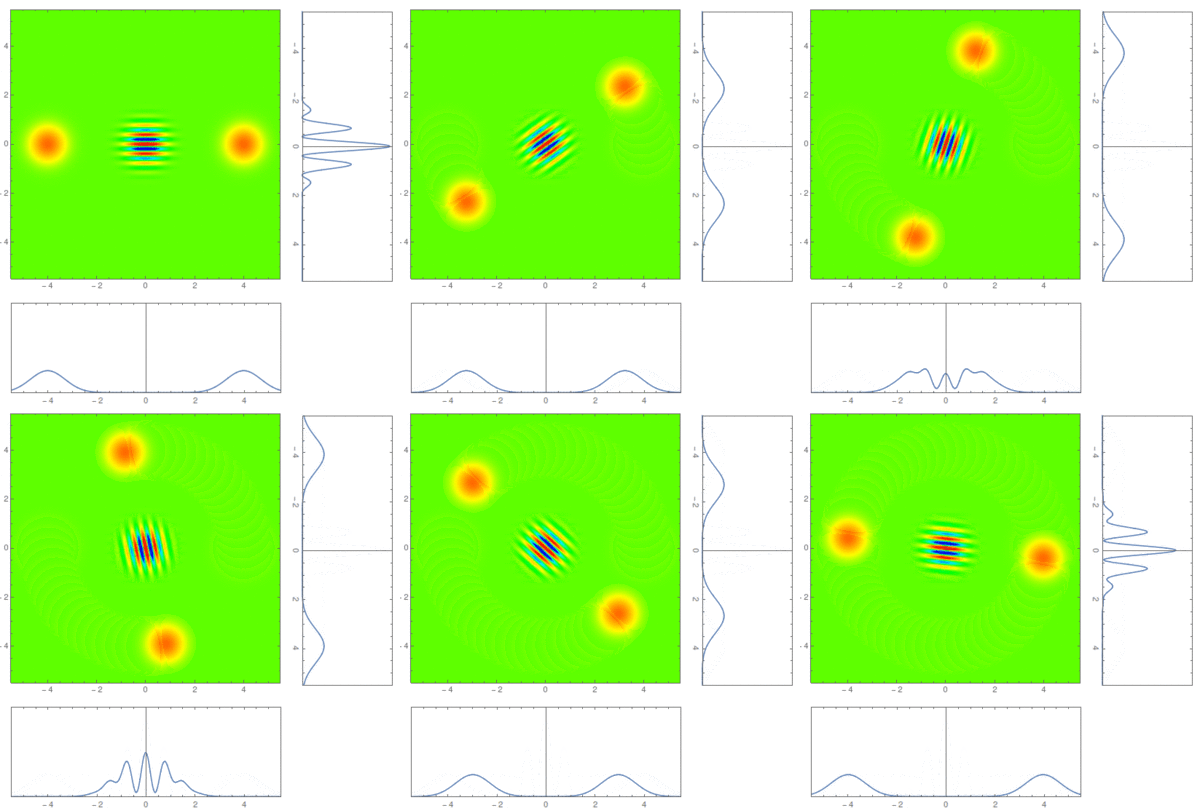
As a result of this property, the above cat state is often referred to as an even cat state. Alternatively, we can define an odd cat state as
- ,

which only contains odd Fock states
- .

Even and odd coherent states were first introduced by Dodonov, Malkin, and Man'ko in 1974.[10]
Linear superposition of coherent states
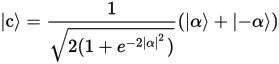
A simple example of a cat state is a linear superposition of coherent states with opposite phases, when each state has the same weight:

Notes
- ↑ John Gribbin (1984), In Search of Schrödinger's Cat, ISBN 0-552-12555-5, 22 February 1985, Transworld Publishers, Ltd, 318 pages.
- ↑ Dennis Overbye, "Quantum Trickery: Testing Einstein's Strangest Theory". New York Times Tuesday (Science Times), December 27, 2005 pages D1,D4.
- ↑ D. Leibfried, E. Knill, S. Seidelin, J. Britton, R.B. Blakestad, J. Chiaverini, D. Hume, W.M. Itano, J.D. Jost, C. Langer, R. Ozeri, R. Reichle, and D.J. Wineland. "Creation of a six atom 'Schrödinger cat' state". Nature. Dec. 1, 2005, 639–642.
- ↑ Four-photon entanglement: http://journals.aps.org/prl/abstract/10.1103/PhysRevLett.91.180401
- ↑ Five-photon entanglement: http://www.nature.com/nature/journal/v430/n6995/full/nature02643.html.
- ↑ Six-photon entanglement: http://www.nature.com/nphys/journal/v3/n2/full/nphys507.html.
- ↑ Eight-photon entanglement: http://www.nature.com/nphoton/journal/v6/n4/full/nphoton.2011.354.html
- ↑ ten-qubit entanglement: http://www.nature.com/nphys/journal/v6/n5/full/nphys1603.html
- ↑ Amir D. Aczel (2001), Entanglement: the unlikely story of how scientists, mathematicians, and philosophers proved Einstein's spookiest theory. ISBN 0-452-28457-0 Penguin: paperback, 284 pages, index.
- ↑ V.V. Dodonov, I.A. Malkin, V.I. Man'ko. Physica, Volume 72, Issue 3, 15 March 1974, Pages 597–615.