Centro del Calamar Gigante
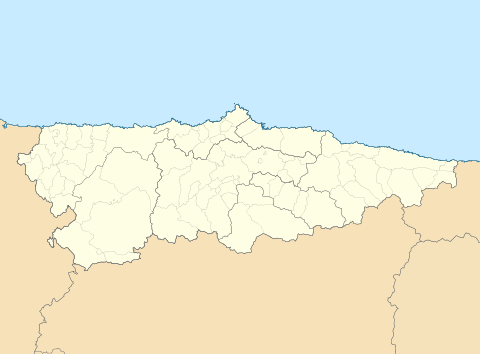  Location in Asturias | |
| Established | August 2010[1] |
|---|---|
| Location | Paseo del Muelle 25, Luarca, Asturias, Spain[2] |
| Coordinates | 43°32′52″N 6°32′02″W / 43.5479°N 6.5340°W |
| Visitors | 26,000 annually[3] |
| Director | Luis Laria[4] |
| Website | Official website |
Centro del Calamar Gigante, also known as Centro de Interpretación del Calamar Gigante, is a natural history museum in Luarca, Asturias, Spain, dedicated to the giant squid (Architeuthis dux). It is administered by Coordinadora para el Estudio y la Protección de las Especies Marinas (CEPESMA) and holds the association's cephalopod collections together with other marine exhibits.[5]
The museum officially opened its doors to the public on 13 August 2010.[1] It was visited by 14,000 people in its first three months.[6] The museum building, which has 908.75 square metres of floorspace and a 66.25-square-metre patio, was built at a cost of €1,260,000.[1] The exterior is clad in grey quartzite at ground level, and aluminium composite on the upper two floors.[1]
In November 2010 the museum had to close temporarily after being seriously damaged by a storm, the damage amounting to more than €140,000.[6] The problem was compounded by CEPESMA's financial situation at the time, with the association unable to fund its activities and having to lay off staff.[7] Plans were drawn up for a concrete wall that would protect the museum from future wave damage[7] at a cost of €573,000.[8] The museum reopened on 21 April 2011 after a little over two weeks of repair work to the ground floor and access area.[8] The museum received 1,670 visitors in its first four days after reopening.[9]
Centro del Calamar Gigante previously held the world's largest collection of giant squid, but many of the museum's specimens were destroyed during a storm on 2 February 2014.[10][11][12][nb 1] One of the specimens that survived the storm was a giant squid caught off Gandia in July 2005 – the first male recorded from the Mediterranean Sea.[14] A few days after the storm the museum was broken into at night and vandalised.[4][15][16] As of April 2014 the museum remains closed until further notice.[5]
Notes
References
- 1 2 3 4 El Centro de Interpretación del Calamar Gigante de Luarca abre sus puertas. El Comercio, 13 August 2010. (Spanish)
- ↑ C.I. Calamar Gigante. Equalitas Vitae. (Spanish)
- ↑ Guerra, Á. (2014). Carta del Dr. Angel Guerra, del Consejo Superior de Investigaciones Científicas. CEPESMA, 6 February 2014. (Spanish)
- 1 2 Álvarez, L. (2014). Luis Laria: "Alguien disfrutó de lo lindo arrasando lo que quedaba en el Museo del Calamar". El Comercio, 10 February 2014. (Spanish)
- 1 2 Centro del Calamar Gigante. CEPESMA. (Spanish)
- 1 2 El Cepesma urge al Principado a que repare el Centro del Calamar Gigante. El Comercio, 7 December 2010. (Spanish)
- 1 2 Cepesma asegura que 200 animales corren peligro por falta de fondos. El Comercio, 9 December 2010. (Spanish)
- 1 2 Luarca abre hoy el Museo del Calamar Gigante. El Comercio, 21 April 2011. (Spanish)
- ↑ El Museo del Calamar Gigante de Luarca reanuda su actividad por todo lo alto. CEPESMA, 27 April 2011. (Spanish)
- 1 2 3 Une tempête détruit «la plus grande collection» de calamars géants au monde. Agence France-Presse, 3 February 2014. (French)
- ↑ Vázquez, V.M. (2014). Asturias por Cepesma. CEPESMA, 10 February 2014. (Spanish)
- ↑ Sin palabras. CEPESMA, 4 February 2014. (Spanish)
- ↑ Llega a la costa asturiana el cadáver de un calamar gigante de 80 kilos. ABC.es, 17 August 2013. (Spanish)
- 1 2 El calamar gigante de Gandia se salva del temporal del Cantábrico. Levante-EMV, 4 February 2014. (Spanish)
- ↑ Linares, M.G. (2014). Vandalismo y vendavales. La Nueva España, 14 February 2014. (Spanish)
- ↑ Ataque vandálico al Museo del Calamar Gigante. CEPESMA, 10 February 2014. (Spanish)