Ceratobatrachidae
| Ceratobatrachidae | |
|---|---|
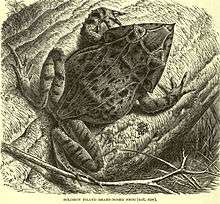 | |
| Ceratobatrachus guentheri | |
Scientific classification  | |
| Kingdom: | Animalia |
| Phylum: | Chordata |
| Class: | Amphibia |
| Order: | Anura |
| Superfamily: | Ranoidea |
| Family: | Ceratobatrachidae Boulenger, 1884 |
| Type genus | |
| Ceratobatrachus Boulenger, 1884 | |
| Genera | |
|
5, see text. | |
| Synonyms | |
|
Ceratobatrachinae | |
The Ceratobatrachidae are a family of frogs[1][2] found in the Malay Peninsula, Borneo, the Philippines, Palau, Fiji, New Guinea, and the Admiralty, Bismarck, and Solomon Islands.[1]
Taxonomy
The Ceratobatrachidae have formerly been treated as a subfamily (i.e., Ceratobatrachinae) in the Ranidae family (true frogs), but they do not seem to be particularly closely related to other former ranids. The five genera are:[1]
- Batrachylodes Boulenger, 1887 (eight species)
- Ceratobatrachus Boulenger, 1884 (one species)
- Discodeles Boulenger, 1918 (five species)
- Palmatorappia Ahl, 1927 (one species)
- Platymantis Günther, 1858 (70 species)
The largest genus, Platymantis, is known to be paraphyletic. Solving this problem will likely lead to a more narrowly defined Platymantis, possibly by transferring some species (together with Batrachylodes) to a larger Ceratobatrachus.[3]
In addition, "Ingerana" baluensis (Boulenger, 1896) is placed incertae sedis in this family, as opposed to Dicroglossidae where the rest of Ingerana are.[1]
Life history
All Ceratobatrachidae lay eggs outside of water and undergo direct development where eggs hatch directly into froglets, without free-living tadpole stages.[4]
References
- 1 2 3 4 Frost, Darrel R. (2014). "Ceratobatrachidae Boulenger, 1884". Amphibian Species of the World: an Online Reference. Version 6.0. American Museum of Natural History. Retrieved 22 February 2014.
- ↑ "Ceratobatrachidae Boulenger, 1884". Integrated Taxonomic Information System.
- ↑ Frost, Darrel R. (2014). "Platymantis Günther, 1858". Amphibian Species of the World: an Online Reference. Version 6.0. American Museum of Natural History. Retrieved 22 February 2014.
- ↑ Fuiten, Allison Marie (2012). Skeletal Variation in Melanesian Forest Frogs (Anura: Ceratobatrachidae). M.A. thesis , University of Kansas. p. 69. Retrieved 22 February 2014.