Chlorella autotrophica
| Chlorella autotrophica | |
|---|---|
 | |
| Scientific classification | |
| Domain: | Eukaryota |
| Kingdom: | Protista |
| Division: | Chlorophyta |
| Class: | Trebouxiophyceae |
| Order: | Chlorellales |
| Family: | Chlorellaceae |
| Genus: | Chlorella |
| Species: | C. autotrophica |
| Binomial name | |
| Chlorella autotrophica Shihira & R.W.Krauss | |
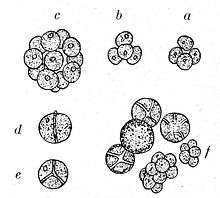
Chlorella autotrophica, or Chlorella sp. (580), is a euryhaline, unicellular microalgae found in brackish waters first isolated in 1956 by Ralph A. Lewin.[1] The species is defined by its inability to use organic carbon as a food source, making the species an obligate autotroph.[2] It is sometimes considered a variety of Chlorella vulgaris.[3]
Uses
C. autotrophica has many uses. The species has been used as a feedstock for rearing bivalves and fry in aquaculture[4] and as source of the amino acid L-Proline.[5][6] German and Russian scientists investigated the possibility of using the species as a food source for astronauts.[7][8] The algal species is also a candidate feedstock for biodiesel production due to its ability to accumulate triglycerides under nitrogen limitation.[9]
References
- ↑ Lewin, Ralph (1956). "Extracellular polysaccharides of green algae". Canadian Journal of Microbiology. 7 (2): 665–672. doi:10.1139/m56-079.
- ↑ Krauss, Robert W; Shihira, Ikurio (1965). Chlorella: Physiology and taxonomy of forty-one isolates. University of Maryland. Retrieved 28 June 2014.
- ↑ "Algaebase". Retrieved 30 June 2014.
- ↑ Ukeles, Ravenna. "A simple method for the mass culture of marine algae" (PDF). ASLO Publications. Association for the Sciences of Limnology and Oceanography. Retrieved 29 June 2014.
- ↑ Leavitt, Richard I. "Process for the preparation of L-proline by cultivating algae". Google Patents. Ethyl Corporation. Retrieved 29 June 2014.
- ↑ Hellebust, JA; Ahmad, I (1984). "Nitrogen Metabolism of the Marine Microalga Chlorella autotrophica". Plant Physiology. 76 (3): 658–663. doi:10.1104/pp.76.3.658. PMID 16663902.
- ↑ Kondratiev, Y; Bychkov, V; Ushakov, A; Boiko, N; Klyushkina, N; Abaturova, E; Terpilovsky, A; Korneeva, N; Belyakova, M; Kasatkina, A (1966). "The use of 50 and 100 g of dry biological foodstuff containing unicellular algae in food rations of man". Voprosy Pitanya. 25 (6): 9–14. PMID 6002339.
- ↑ Müller-Wecker, Hildegard; Kofrányi, Ernst (1973). "Zur Bestimmung der biologischen Wertigkeit von Nahrungsproteinen, XVIII. Einzeller als zusätzliche Nahrungsquelle". Hoppe-Seyler´s Zeitschrift für physiologische Chemie. 354 (2): 1034–1042. doi:10.1515/bchm2.1973.354.2.1034.
- ↑ Agwa, O; Ibe, S; Abu, G. (2012). "Economically effective potential of Chlorella sp. for biomass and lipid production" (PDF). Journal of Microbiology and Biotechnology Research. 2 (1): 35–45. Retrieved 28 June 2014.