Chord organ
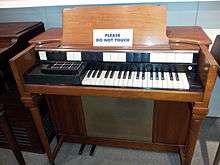
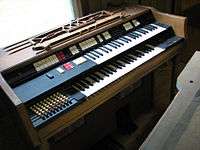
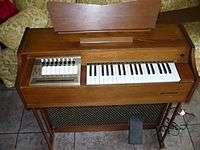
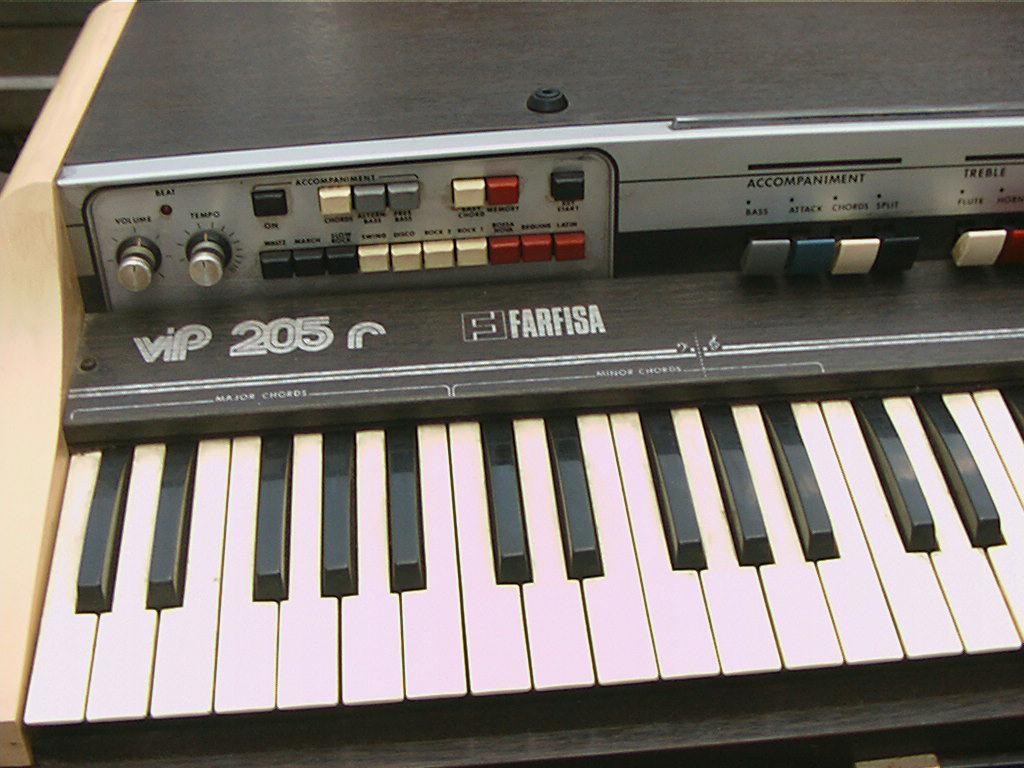
The chord organ is a kind of home organ that typically has a single short keyboard and a set of chord buttons, enabling the musician to play a melody or lead with one hand and accompanying chords with the other, like the accordion. Tone-wise, a chord organ is almost identical to an harmonium, accordion, or similar. It was invented by Laurens Hammond in 1950[1] (model S-6) as an electronic home organ based on vacuum-tube circuits, similar to his earlier Novachord and Solovox models. In addition to Hammond, also Wurlitzer,[2] Farfisa[3] and Estey Organ[4] made electronic chord organs.
In 1958, Magnus Organ Corporation introduced its electric chord organs, similar to electrically blown small home reed organs.[5] Since then, chord organs were generally designed as instruments for beginners, and separated from the mainstream of home electronic organs. In addition to Magnus, also Emenee,[6] Bontempi and Belcanto made electric chord organs.
Chord organ musicians
- Daniel Johnston
- The Microphones/Mount Eerie
- Modest Mouse (on the album Sad Sappy Sucker)
- The Music Tapes
- Elliott Smith
- Paul Tesluk (of Johnny and the Hurricanes rock group)
- Cortney Tidwell
Chord organs have seen a recent revival amongst minimalist and ambient musicians.
References
- ↑ "Laurens Hammond". Encyclopædia Britannica Online. 2014.
His later inventions included ... the chord organ (1950), on which chords are produced simply by touching a panel button.
- ↑ Wurlitzer Model 4100 BP (1959–1963) has chord unit on lower left. See image for details.
- ↑ "Farfisa Model VIP-205R". Combo Organ Heaven.
- ↑ "New Estey Chord Organs". The Milwaukee Sentinel. April 8, 1961. p. 37.
- ↑ "'Play by Numbers' Organ Hottest Musical Merchandise". Billboard (magazine). May 11, 1959. p. 1.
- ↑ "The Strydel/Emenee Story" (PDF). Stryker Area Heritage Council.
External links
 |
Wikimedia Commons has media related to Chord organs. |
- "The Hammond Chord Organ". Cook County Forest Preserve District. 2003. Archived from the original on 2013-07-11.
- "Disassembly Photographs of a Small Electric Chord Organ". Take It Apart dot net. 28 May 2006. Archived from the original on 2009-04-12.
 | ||