Coccinite
| Coccinite | |
|---|---|
|
Coccinite, from Backofen Mine, Rhineland-Palatinate, Germany | |
| General | |
| Category | Halide mineral |
| Formula (repeating unit) | HgI2 |
| Strunz classification | 3.AB.10 |
| Crystal system | Tetragonal |
| Space group |
Tetragonal ditetragonal dipyramidal H-M symbol: (4/m 2/m 2/m) Space group: P 41/nmc |
| Unit cell | a = 4.376 Å, c = 12.41 Å, Z = 1 |
| Identification | |
| Colour | Orange-red |
| Cleavage | Good on {001} |
| Mohs scale hardness | 2 |
| Streak | Orange |
| Diaphaneity | Translucent |
| Specific gravity | 3.17 (calculated) |
| Optical properties | Uniaxial (-) |
| Refractive index | 2.684 (avg) |
| Birefringence | 0.193 |
| Other characteristics | Volatile at room temperature |
| References | [1][2][3] |
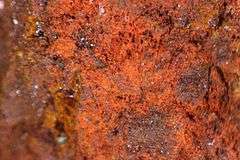
Coccinite is a rare mercury iodide mineral with chemical formula of HgI2, mercury(II) iodide.[4][5] in addition to its discovery locality of Casas Viejas, Mexico, it has also been reported from Broken Hill, New South Wales, and from a uranium mine in Thuringia and old mercury workings in the Rhineland-Palatinate in Germany.[1] At the Thuringia deposit the mineral occurs as a sublimation product resulting from fires associated with pyrite bearing, graptolitic slate.[5]
Discovery
The discovery was announced by del Rio in the journal of the Mexico city School of Mining. The news spread by reading that journal and a direct letters of del Rio. In the subsequent years several times the discovery was mentioned. One of the earliest notes of the discovery is a translation of a letter of del Rio to Freiesleben. In 1839 it was described as lemon coloured spots in the sandstone of Casas Vijecas.[6] This description was also given in a Spanish book printed in 1844.[7] In 1836 a short paper was published in Comptes rendus which was the communication of Yniestra to Arago about a discovery of del Rio. In this publication the mineral sample was deposited at the school of mines by a Mr. Jose Casas Viejas from the Querétaro province and that the mineral had a red brown colour.[8] In 1861 the book A glossary of mineralogy by Henry William Bristow states that it has been found in Casas Viejas in Mexico as reddish brown particles on mercury selenide.[9] Shortly after in 1862 a book about chemical technology gives the only location where the mineral can be found with a Mexican region Cavas Viejas.[10]
References
- 1 2 Coccinite on Mindat.org
- ↑ Coccinite data on Webmin
- ↑ Coccinite on Mineral Atlas
- ↑ Witzke, T. (1997). "New data on the mercury iodide mineral coccinite, HgI2". Neues Jahrbuch für Mineralogie - Monatshefte: 505–510.
- 1 2 Jambor, John; Pertsev, Nicolai; Roberts, Andrew (1998). "New Mineral Names" (PDF). American Mineralogist. 83: 907–910.
- ↑ Britain), Society for the Diffusion of Useful Knowledge (Great (1839). The Penny cyclopædia of the Society for the Diffusion of Useful Knowledge.
- ↑ Domeyko, Ignacio (1844). Tratado de ensayes, tanto por la via seca como por la via humeda, de toda clase de minerales y pastas de cobre, plomo, plata, oro, mercurio, &c: con descripcion de los caracteres de los principales minerales y productos de las artes en America, y en particular en Chile.
- ↑ "Une nouvelle combinaison naturelle de l'iode". Comptes rendus: 582–583. 1836.
- ↑ Bristow, Henry William (1861). A glossary of mineralogy.
- ↑ Richardson, Thomas (1863). Chemical technology; or, Chemistry in its applications to the arts & manufactures.