Codex Petropolitanus (New Testament)
|
Beginning of Luke | |
| Name | Petropolitanus |
|---|---|
| Sign | Π |
| Text | Gospels |
| Date | 9th-century |
| Script | Greek |
| Found | Tischendorf, 1859 |
| Now at | National Library of Russia |
| Size | 14.5 x 10.5 cm |
| Type | Byzantine text-type |
| Category | V |
| Note | member of the family Π |
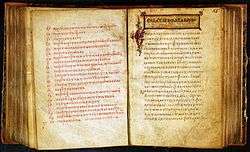
Codex Petropolitanus, designated by Π or 041 (in the Gregory-Aland numbering), ε 73 (von Soden),[1] is a Greek uncial manuscript of the Gospels, dated palaeographically to the 9th-century. The manuscript is lacunose.
Description
The codex contains an almost complete text of the four Gospels on 350 parchment leaves (14.5 cm by 10.5 cm) with some lacunae in Matt 3:12-4:17; 19:12-20:2; Luke 1:76-2:18; John 6:15-35; 8:6-39; 9:21-10:3. Texts of Mark 16:18-20 and John 21:22-25 were supplied by minuscule hand in the 12th-century.[2]
The text is written in one column per page, 21 lines per page.[3] The letters are small, with breathings, and accents.[2]
The tables of the κεφαλαια before each Gospel. The text is divided according to the Ammonian Sections with a references to the Eusebian Canons.[4]
The texts of John 5:4 and 8:3-6 are marked by an asterisk.[2]
Text
The Greek text of this codex is a representative of the Byzantine text-type, in close relationship to the Codex Alexandrinus,[5] and other later uncials.[4] Together with Codex Cyprius it belongs to the textual family Π.[6][7] Aland placed it in Category V.[3]
Luke 9:55-56
- στραφεις δε επετιμησεν αυτοις και ειπεν, Ουκ οιδατε ποιου πνευματος εστε υμεις; ο γαρ υιος του ανθρωπου ουκ ηλθεν ψυχας ανθρωπων απολεσαι αλλα σωσαι (but He turned and rebuked them and He said: "You do not know what manner of spirit you are of; for the Son of man came not to destroy men's lives but to save them) — as in codices Codex Cyprius 1079 1242 1546 (f1 omit γαρ) (Θ f13 omit υμεις and γαρ).[8]
History
- Found
The manuscript belonged to the family Parodi in Smyrna. It was brought by Tischendorf in 1859.[2]
- Present location
The codex is located in the National Library of Russia (Gr. 34) in Saint Petersburg.[3][9]
See also
References
- ↑ Gregory, Caspar René (1908). Die griechischen Handschriften des Neuen Testament. Leipzig: J. C. Hinrichs'sche Buchhandlung. p. 36.
- 1 2 3 4 Gregory, Caspar René (1900). Textkritik des Neuen Testaments. 1. Leipzig: J.C. Hinrichs’sche Buchhandlung. p. 92.
- 1 2 3 Aland, Kurt; Aland, Barbara (1995). The Text of the New Testament: An Introduction to the Critical Editions and to the Theory and Practice of Modern Textual Criticism. Erroll F. Rhodes (trans.). Grand Rapids: William B. Eerdmans Publishing Company. p. 118. ISBN 978-0-8028-4098-1.
- 1 2 Scrivener, Frederick Henry Ambrose; Edward Miller (1894). A Plain Introduction to the Criticism of the New Testament. 1 (4th ed.). London: George Bell & Sons. p. 163.
- ↑ Bruce M. Metzger, Bart D. Ehrman (2005). The Text of the New Testament: Its Transmission, Corruption, and Restoration. Oxford University Press. pp. 83–84. ISBN 978-0195161229.
- ↑ Silva Lake, "Family Π and the Codex Alexandrinus. The Text According to Mark", London 1937.
- ↑ Wisse, Frederik (1982). The Profile Method for the Classification and Evaluation of Manuscript Evidence, as Applied to the Continuous Greek Text of the Gospel of Luke. Grand Rapids: William B. Eerdmans Publishing Company. p. 52. ISBN 0-8028-1918-4.
- ↑ UBS3, p. 248.
- ↑ "Liste Handschriften". Münster: Institute for New Testament Textual Research. Retrieved 16 March 2013.
Further reading
- C. v. Tischendorf, Notitia editionis codicis Bibliorum Sinaitici, 1860, pp. 51 f.
- Silva Lake, Family Π and the Codex Alexandrinus: The Text According to Mark, S & D V (London 1937).
- J. Greelings, Family Π in Luke, S & D XXII (Salt Lake City, 1962).
- R. Champlin, Family Π in Matthew, S & D XXIV (Salt Lake City, 1964).
- Bousset, Wilhelm (1894). Die Gruppe K Π (M) in den Evangelien. Texte und Untersuchungen. 11. Leipzig. pp. 111–135. Retrieved November 14, 2010.
External links
- Codex Petropolitanus Π (041): at the Encyclopedia of Textual Criticism.
- Codex Petropolitanus Π (041): at the Russian National Library.