Sorbus aria
| Sorbus aria | |
|---|---|
 | |
| Scientific classification | |
| Kingdom: | Plantae |
| (unranked): | Angiosperms |
| (unranked): | Eudicots |
| (unranked): | Rosids |
| Order: | Rosales |
| Family: | Rosaceae |
| Genus: | Sorbus |
| Subgenus: | Aria |
| Species: | S. aria |
| Binomial name | |
| Sorbus aria Crantz | |
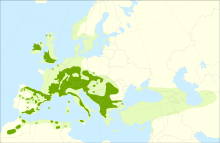 | |
| Distribution map | |
| Synonyms | |
|
Aria nivea Host. | |
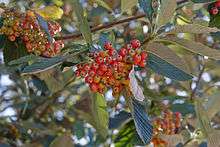
Sorbus aria (syn. Aria nivea), the whitebeam or common whitebeam,[1] is a European and Near-Eastern deciduous tree, the type species of the subgenus of the whitebeams. Typically compact and domed, with few upswept branches and almost-white underside of the leaves. It generally favours dry limestone and chalk soils. The hermaphrodite cream-white flowers appear in May, are insect pollinated, and go on to produce scarlet berries, which are often eaten by birds.[2] Developed for garden use are the cultivars S. aria 'Lutescens',[3] with very whitish-green early leaves, and S. aria 'Majestica',[4] with large leaves. Both have gained the Royal Horticultural Society's Award of Garden Merit.
References
- ↑ "BSBI List 2007". Botanical Society of Britain and Ireland. Archived from the original (xls) on 2015-02-25. Retrieved 2014-10-17.
- ↑ The Reader's Digest Field Guide to the Trees and Shrubs of Britain p.86.
- ↑ "RHS Plant Selector - Sorbus aria 'Lutescens'". Retrieved 4 June 2013.
- ↑ "RHS Plant Selector - Sorbus aria 'Majestica'". Retrieved 4 June 2013.
 |
Wikimedia Commons has media related to Sorbus aria. |
This article is issued from Wikipedia - version of the 8/11/2016. The text is available under the Creative Commons Attribution/Share Alike but additional terms may apply for the media files.